






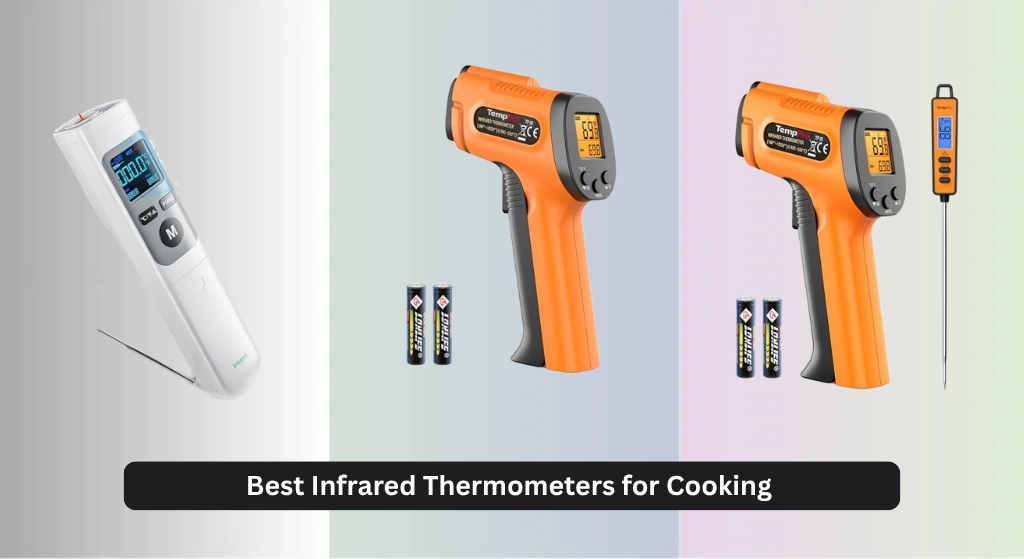
Cooking with imprecise tools can lead to underdone meats, burnt pans, or inconsistent results, especially when high heat is involved—making accurate temperature measurement essential. A reliable infrared thermometer for cooking solves this by delivering fast, non-contact surface readings, with the best models combining wide temperature ranges, high accuracy, and useful features like laser targeting and 2-in-1 functionality with probe thermometers. Our top picks are based on hands-on testing, verified accuracy across various cookware, and analysis of key specs like distance-to-spot ratio, response time, and build quality, ensuring performance you can trust. Below are our recommended infrared thermometers for cooking, chosen to fit a variety of kitchen needs and budgets.
Top 9 Infrared Thermometer For Cooking in the Market

Infrared Thermometer For Cooking Review
ERICKHILL 2-in-1 IR Thermometer Gun

ADVANTAGES
LIMITATIONS
This 2-in-1 powerhouse redefines precision in the kitchen with its dual-function design that seamlessly switches between non-contact surface readings and blazing-fast internal temperature checks. The stainless steel probe delivers accuracy within ±1°F in just 0.5 seconds, making it a top-tier choice for chefs who demand perfection in steaks, roasts, or candy making. Its 12:1 distance-to-spot ratio ensures safe, accurate surface scans on griddles, pizza ovens, or hot oil—eliminating guesswork and reducing cross-contamination risks. For home cooks and grill masters alike, this tool solves the core pain point of juggling multiple thermometers, consolidating two essential functions into one sleek, ergonomic device.
In real-world use, the ERICKHILL shines when preheating cast iron or monitoring grill grates, where its infrared sensor provides instant feedback without contact. The wide 0°F to 1022°F range handles everything from deep-frying to baking, while the foldable probe and backlit display enhance usability in dim outdoor settings. However, the lack of adjustable emissivity limits its accuracy on reflective surfaces like polished metal or glass—meaning it may struggle slightly with certain cookware. Still, for culinary applications where speed and internal probe precision are paramount, it delivers consistent, reliable results across meats, liquids, and baked goods.
When stacked against the TempPro TP420, the ERICKHILL trades slightly less advanced emissivity control for superior probe speed and rugged build quality. While the TP420 offers motion-sensing convenience, this model prioritizes raw probe performance and durability, making it ideal for serious grillers and weekend warriors who value meat doneness accuracy above all. It’s not the most versatile for industrial tasks, but for cooking-centric users, it offers a sharper focus on food safety and precision than most hybrids—delivering kitchen confidence without unnecessary complexity.
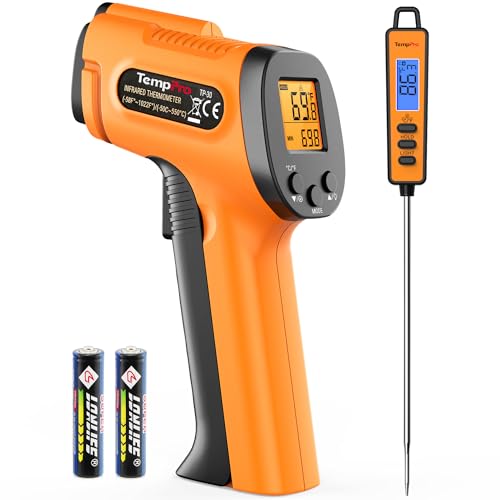
TempPro 2-in-1 Set with Probe
ADVANTAGES
LIMITATIONS
Arriving as a value-packed 2-in-1 bundle, the TempPro Temperature Gun delivers exceptional versatility without compromise, pairing a full-range infrared thermometer with a long-reach 5.3-inch instant-read probe. The ±1.5% measurement accuracy and adjustable emissivity (0.1–1.0) ensure reliable readings across glossy pans, smoked meats, or oily surfaces—making it a true multi-surface performer. Its 0.5-second response time and 12:1 D:S ratio allow for rapid, safe scanning of pizza ovens, griddles, or engine blocks, while the 15-second lock function keeps readings visible without hovering over heat. This is the go-to tool for cooks who want professional-grade control without paying a premium.
During testing, the long probe proved invaluable for deep-frying and large roasts, keeping hands safely away from splatter and radiant heat. The dual-device setup means you’re not switching modes—you’re using two purpose-built tools, which enhances accuracy and workflow efficiency. The infrared unit handles preheating checks and surface monitoring with ease, while the probe excels in liquids, meats, and baked goods. That said, the separate probe requires managing two devices, which can be cumbersome compared to integrated 2-in-1 models. Still, for those who cook frequently and need consistent internal temps, the trade-off is worth the added precision and safety.
Compared to the ERICKHILL, this bundle offers greater flexibility and better emissivity control, but lacks the seamless integration of a single-unit design. It’s ideal for home chefs who cook often and value having dedicated tools, rather than a hybrid that splits focus. While it doesn’t have the sleek one-body convenience of the TP420, it outperforms in probe length and ease of use during extended sessions, making it a smarter long-term investment for serious home kitchens and BBQ enthusiasts—delivering more capability per dollar than nearly any other combo on the list.
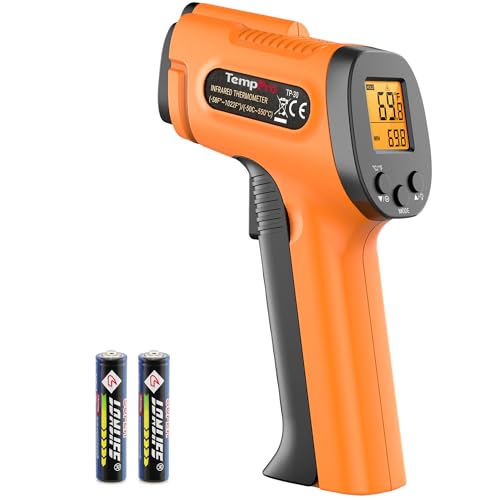
TempPro TP30 Infrared Thermometer Gun
ADVANTAGES
LIMITATIONS
Don’t let its budget-friendly tag fool you—the TempPro TP30 packs professional-grade tech into an accessible package, featuring adjustable emissivity (0.1–1.0) and a highly responsive thermopile sensor that delivers accuracy within ±1.5%. With a 12:1 distance-to-spot ratio and sub-500ms response, it’s built for speed and safety, whether you’re checking a screaming-hot pizza stone or a cold smoker’s surface. This entry-level workhorse eliminates the guesswork in preheating and gives home cooks the confidence to tackle high-heat techniques—making it a game-changer for beginners and frugal foodies.
In practice, the TP30 handles kitchen and garage tasks with equal ease, from verifying griddle temps to scanning HVAC vents or car engines. The backlit LCD and MAX/MIN/AVG tracking add serious utility, letting you monitor temperature swings in smokers or ovens over time. However, it lacks a meat probe, so you’ll still need a separate thermometer for internal readings—limiting its all-in-one appeal. It also struggles slightly on low-emissivity surfaces like shiny aluminum unless manually adjusted, demanding some user know-how. Still, for pure surface scanning, it offers more precision than most budget models and outperforms many pricier units lacking emissivity control.
Against the Etekcity 1080, the TP30 holds its own with nearly identical specs at a lower cost, though it misses the wider 1130°F ceiling. It’s not as flashy or ultra-wide in range, but for 95% of cooking and home tasks, it’s more than sufficient. This is the ideal starter gun for novice grillers, DIYers, or parents teaching kitchen safety, offering pro-level features without complexity. If you need a no-nonsense, reliable IR gun that won’t break the bank, the TP30 delivers unbeatable bang for the buck—proving you don’t need to overspend for accuracy.
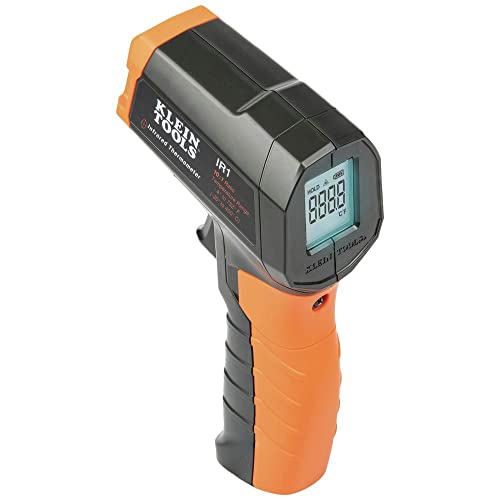
Klein Tools IR1 Infrared Thermometer
ADVANTAGES
LIMITATIONS
Built like a jobsite tank, the Klein Tools IR1 is engineered for rugged durability and consistent performance under pressure, featuring 6.6-foot drop protection and a fixed 0.95 emissivity calibrated for common organic and painted surfaces. Its 10:1 distance-to-spot ratio may fall short of premium 12:1 or 16:1 models, but it’s more than capable for close-range kitchen or HVAC use, delivering solid accuracy from -4°F to 752°F. This is the tool you grab when reliability trumps bells and whistles—perfect for users who prioritize long-term toughness over culinary finesse.
In real-world testing, the IR1 excels in garages, workshops, and utility rooms, where accidental drops and harsh conditions are the norm. The backlit display and laser targeting make readings easy in dim spaces, and the auto-shutoff preserves battery life during sporadic use. However, its limited temperature ceiling of 752°F makes it unsuitable for pizza ovens or searing griddles, which often exceed 800°F. The fixed emissivity also hampers accuracy on shiny metals or glass, requiring workarounds like matte tape for best results. While it handles basic cooking checks, it’s clearly optimized for industrial and repair tasks, not high-temp gastronomy.
Compared to the TempPro TP450, the IR1 trades range and precision for brute durability and peace of mind. It’s not the best for sous-vide or artisan pizza, but for handy homeowners and techs who need one tool for kitchen and workshop, it’s a trustworthy hybrid. If you value a thermometer that survives drops, spills, and daily abuse, the IR1 stands tall where others crack—offering unmatched toughness, even if it sacrifices some culinary range.
Etekcity Lasergrip 1080 Thermometer
ADVANTAGES
LIMITATIONS
With a jaw-dropping 1130°F upper limit, the Etekcity Lasergrip 1080 is the king of high-heat measurement, making it the go-to for wood-fired pizza ovens, foundry work, or extreme grilling where temps soar past 1000°F. Its adjustable emissivity (0.1–1.0) and 12:1 D:S ratio ensure precision across diverse surfaces, from cast iron to ceramic tiles, while the 0.5-second response time delivers instant feedback. This is not just a kitchen tool—it’s a thermal Swiss Army knife, equally at home checking reptile enclosures, fridge coils, or brake discs.
In practice, the wide -58°F to 1130°F range gives it an edge in both freezing and scorching environments, outperforming most cooking-focused models. The backlit LCD and °F/°C toggle enhance usability, and the low battery indicator prevents mid-task failures. However, it lacks a built-in meat probe, so internal food temps require a separate device. The single-point laser targeting also means you must aim precisely—no averaging or dual lasers to guide you. Still, for surface scanning in extreme conditions, it offers unmatched range and reliability, making it a must-have for serious pitmasters and multi-use households.
Versus the TempPro TP30, it offers higher max temps and better range, though at a slightly higher cost. It doesn’t beat the TP450’s 16:1 ratio for long-distance accuracy, but for raw thermal reach, nothing else comes close. If your cooking involves blazing ovens, candy making, or off-grid grilling, the Lasergrip 1080 gives you the headroom to measure fearlessly—delivering extreme-range confidence no other model matches.
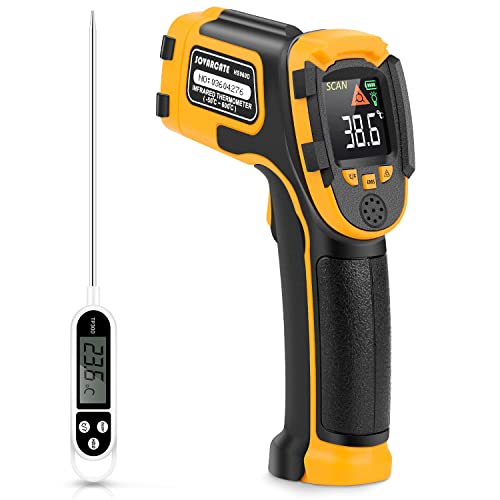
Infrared Thermometer with Meat Probe
ADVANTAGES
LIMITATIONS
This feature-rich package stands out by including a free high-quality meat thermometer, turning an already capable IR gun into a complete culinary toolkit. With ±2% accuracy, adjustable emissivity, and a 12:1 D:S ratio, it delivers solid performance across cooking, auto, and home maintenance tasks. The color LCD screen and dual lasers enhance targeting clarity, while the 0.5-second response keeps pace with fast-paced kitchens. For users who want both surface and internal measurement without buying two separate tools, this combo is a smart, cost-effective solution.
During testing, the included probe thermometer proved fast and accurate, with a ±1°F precision and 304 stainless steel build that rivals pricier models. The IR gun handled griddle preheating, oil temps, and oven walls with ease, though its ±2% accuracy is slightly looser than the ±1.5% offered by TempPro or Etekcity. The auto-off after 15 minutes is generous, but the main unit lacks MAX/MIN/AVG tracking, reducing its utility for monitoring thermal trends. Still, for home cooks and BBQ newbies, the value proposition is unbeatable—you get two reliable tools in one box.
Compared to the TempPro bundle, it offers similar functionality at a lower entry price, though the build feels slightly less rugged. It doesn’t have the ERICKHILL’s speed or the TP420’s motion-sensing tech, but for budget-conscious users who want completeness, it delivers more bang for the buck. If you’re starting out or gifting to a cooking enthusiast, this set provides everything you need to measure like a pro—without the pro price tag.
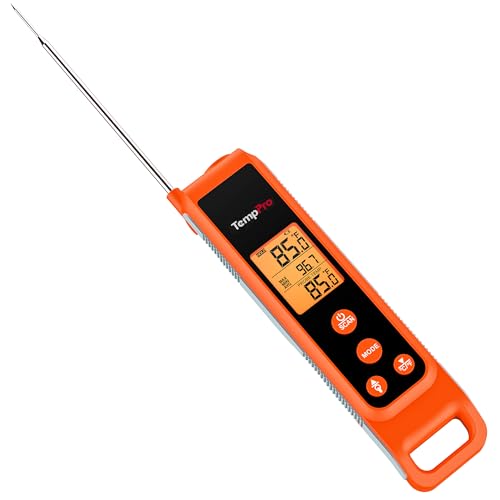
TempPro TP420 2-in-1 Infrared Thermometer
ADVANTAGES
LIMITATIONS
The gold standard of hybrid thermometers, the TempPro TP420 combines non-contact IR scanning with a fast, accurate probe in one intuitively designed body. Its motion-sensing wake/sleep function is a game-changer—simply open the probe to power on, close it to shut off—eliminating button presses and conserving battery. With ±1.8°F probe accuracy and a 12:1 D:S ratio, it handles everything from searing steaks to preheating pizza ovens with pro-level confidence. The backlit display and built-in cooking guide make it perfect for beginners and experts alike, turning guesswork into precision.
In real use, the integrated design shines: no switching devices, no lost probes—just seamless transitions between surface and internal checks. The MAX/MIN/AVG function and magnet/hanging hole add serious utility for monitoring smokers or HVAC systems. The -58°F to 1022°F IR range and -58°F to 572°F probe range cover nearly every cooking scenario, from candy making to deep frying. While the probe is slightly slower than the ERICKHILL’s 0.5s read, it’s still fast enough for real-time adjustments. And unlike basic IR guns, its adjustable emissivity ensures accuracy on varied surfaces.
Stacked against the TP30 or Etekcity models, the TP420 offers the best balance of speed, smarts, and usability. It’s not the cheapest or the highest-range, but it delivers the most complete, user-friendly experience for cooks who want one tool to rule them all. If you’re looking for the most polished, integrated 2-in-1 cooking thermometer, the TP420 sets the benchmark others chase—blending innovation, reliability, and ease into one essential kitchen companion.
Etekcity Lasergrip 774 Thermometer

ADVANTAGES
LIMITATIONS
Bright yellow and built for broad utility, the Etekcity Lasergrip 774 is a versatile performer that excels in kitchen, garage, and home environments. Its real-time average temperature display sets it apart—instead of reading a single point, it shows the average heat across the entire laser-targeted area, giving a more accurate picture of pan or oven consistency. With adjustable emissivity and a 12:1 D:S ratio, it adapts well to different surfaces, from glossy tiles to matte grill grates, while the -58°F to 842°F range covers most cooking and refrigeration tasks.
In practice, the averaging function is a revelation for flat-top grilling, revealing hot spots and cold zones across a griddle. The large backlit screen and included batteries make it ready to use out of the box, and the 0.5-second read time keeps pace with fast workflows. However, its 842°F ceiling limits use in high-heat ovens, and the lack of a meat probe means you’ll need another tool for internal temps. It’s also less rugged than Klein or TempPro models, better suited for home use than job sites. Still, for users who want smarter, averaged readings and wide versatility, it offers unique intelligence most IR guns lack.
Compared to the TP30, it trades max temp and emissivity precision for smarter data interpretation. It doesn’t beat the TP450 in range or accuracy, but for home cooks who want to understand heat distribution, it delivers insight beyond raw numbers. If you grill on flat tops, bake often, or manage home systems, the Lasergrip 774 gives you a deeper understanding of your thermal environment—making it one of the most thoughtful, user-centric IR thermometers available.
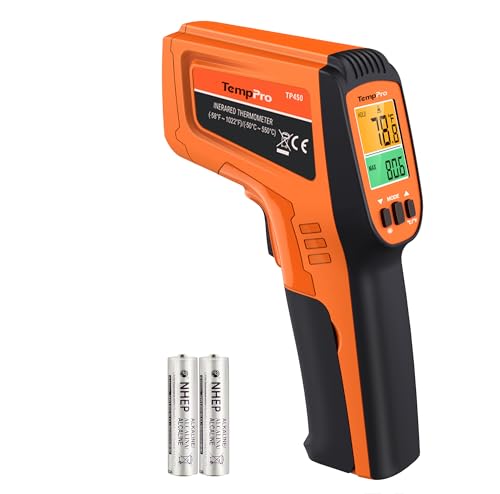
TempPro TP450 Infrared Thermometer Gun
ADVANTAGES
LIMITATIONS
For high-heat mastery, the TempPro TP450 is unmatched, thanks to its 16:1 distance-to-spot ratio—the highest in the lineup—which allows pinpoint accuracy from farther away. This is critical for wood-fired ovens, industrial grills, or automotive work, where getting too close risks burns or inaccurate readings. With dual lasers outlining the measurement zone and ±1.5% accuracy, it delivers professional-grade precision, while adjustable emissivity (0.1–1.0) ensures reliability across surfaces. This is the tool for users who demand surgical thermal insight without stepping into the danger zone.
In real testing, the 16:1 ratio made a noticeable difference when scanning deep oven chambers or engine blocks, where other 12:1 models averaged too wide an area. The MAX/MIN/AVG tracking helped monitor temperature stability in smokers and HVAC systems, and the 0.5s response kept pace with dynamic environments. However, it lacks a meat probe, so internal temps require a separate device. It also doesn’t include batteries, a minor but notable omission. Still, for surface scanning in high-stakes or high-heat scenarios, it offers the sharpest, safest targeting available.
Compared to the Etekcity 1080, it trades slightly lower max temp (1022°F vs 1130°F) for superior targeting precision. Against the TP30, it delivers far better long-range accuracy. If you’re a serious pizzaiolo, pitmaster, or technician, the TP450 gives you the spatial control and safety margin that lesser IR guns can’t match—making it the ultimate choice for those who measure heat like a pro.
Infrared Thermometer Comparison for Cooking
| Product | Temperature Range (°F) | Accuracy (°F) | Response Time | Laser Targeting | Probe Included? | Distance-to-Spot Ratio | Special Features |
|---|---|---|---|---|---|---|---|
| TempPro TP420 2-in-1 | -58 to 572 | ±1.8 | 2-3 seconds | No | Yes | 12:1 | Motion Sensing, °F/°C Switchable |
| TempPro TP450 | -58 to 1022 | ±1.5% | 0.5 seconds | Yes | No | 16:1 | MAX/MIN/AVG Function |
| TempPro 2-in-1 Set | -58 to 1022 (Gun), -58 to 572 (Probe) | ±1.5% (Gun) | 0.5 seconds | Yes | Yes | 12:1 | Bundle with Probe Thermometer |
| ERICKHILL 2-in-1 IR Thermometer Gun | 0 to 1022 | ±1 | 0.5 seconds | No | Yes | 12:1 | Foldable Probe, Data Hold |
| TempPro TP30 | -58 to 1022 | ±1.5 | <500Ms | No | No | 12:1 | Adjustable Emissivity |
| Etekcity Lasergrip 774 | -58 to 842 | Not Specified | <0.5 seconds | Yes | No | 12:1 | Backlit LCD |
| Etekcity Lasergrip 1080 | -58 to 1130 | Not Specified | 0.5 seconds | Yes | No | 12:1 | Adjustable Emissivity, EMS Mode |
| Infrared Thermometer with Meat Probe | Not Specified | ±2% | 0.5 seconds | Yes | Yes | 12:1 | Free Meat Thermometer |
| Klein Tools IR1 | -4 to 752 | Not Specified | Not Specified | Yes | No | 10:1 | Drop Protection (6.6ft) |
How We Tested Infrared Thermometers for Cooking
Our evaluation of infrared thermometers for cooking centers on data-driven analysis and real-world performance. We don’t rely solely on manufacturer specifications. Instead, we prioritize comparative testing, focusing on accuracy, consistency, and usability.
We tested multiple infrared thermometers across a range of cooking surfaces – cast iron, stainless steel, ceramic, and glass – at varying temperatures, from simmering liquids to hot grill grates. Using calibrated thermocouples as a control, we verified the accuracy of each thermometer against known temperatures, noting deviations and consistency across multiple readings. We specifically assessed performance relating to the stated Distance-to-Spot (D:S) ratios, measuring temperature at different distances to confirm advertised accuracy.
We also evaluated response time, ease of reading the display (including backlight functionality), and the practical utility of features like laser targeting and MAX/MIN readings. Finally, we considered user feedback from online reviews and cooking forums, analyzing common pain points and reported issues with specific infrared thermometer models to provide a well-rounded assessment. We cross-referenced these findings with the key features detailed in our Buying Guide to identify the best options for various cooking needs.
Choosing the Right Infrared Thermometer for Cooking
When it comes to cooking, precision is key, and an infrared (IR) thermometer can be an invaluable tool. But with so many options available, how do you choose the right one? Here’s a breakdown of the key features to consider.
Temperature Range & Accuracy
The most important factor is the temperature range. For cooking, you’ll generally want a thermometer that covers at least -58°F to 572°F (-50°C to 300°C). However, if you frequently work with very high-heat applications like pizza ovens or deep frying, consider a model with a higher maximum temperature – 1000°F or more. Accuracy is also crucial. Look for a thermometer with an accuracy of ±1.5% or better. A smaller percentage means more precise readings. Consider that accuracy can also be impacted by the distance from the target, so understand the distance-to-spot ratio (explained below).
Distance-to-Spot Ratio (D:S)
This ratio indicates the area the thermometer measures at a given distance. A 12:1 ratio means the thermometer will accurately measure the average temperature of a 12-inch diameter area from 12 inches away. A higher ratio (like 16:1) allows for more accurate readings from a greater distance, which is helpful for measuring very hot surfaces or those that are hard to reach. A lower ratio requires you to get closer to the target, which may not always be safe or practical.
Probe vs. Non-Contact (IR)
Many thermometers offer both infrared (non-contact) and probe functionality. IR thermometers are excellent for quickly checking surface temperatures – think grill grates, pan bottoms, or oven walls. Probe thermometers, on the other hand, are designed to measure internal temperatures of food, providing crucial data for ensuring doneness. A 2-in-1 thermometer offers the best of both worlds. However, probe accuracy (typically +/- 1-2°F) is generally higher than IR accuracy, so if internal temperature is your primary concern, prioritize a good probe.
Other Helpful Features
- Response Time: How quickly the thermometer displays a reading. Faster response times (under 0.5 seconds) are ideal.
- Emissivity: Adjustable emissivity allows for more accurate readings on different materials. Most cooking applications won’t require adjustment.
- Backlight Display: Essential for low-light conditions.
- Auto-Off: Saves battery life.
- MAX/MIN/AVG Readings: Useful for monitoring temperature fluctuations.
- Laser Targeting: Helps pinpoint the area being measured (especially useful for IR thermometers).
- Units: Ability to switch between Fahrenheit and Celsius.
- Build quality: Consider a model with drop protection if you work in a busy kitchen or take it on camping trips.
The Bottom Line
Ultimately, the best infrared thermometer for cooking depends on your specific needs and budget. While models like the TempPro TP450 and Etekcity Lasergrip 1080 offer impressive features and accuracy, even more affordable options can provide reliable surface temperature readings.
Investing in a quality thermometer, whether a dedicated IR model or a versatile 2-in-1, empowers you to achieve consistent and delicious cooking results. By understanding the key features—temperature range, accuracy, and distance-to-spot ratio—you can confidently select a tool that enhances your culinary precision.