


500 Watt vs 1500 Watt Electric Heater: Which One Should You Buy?
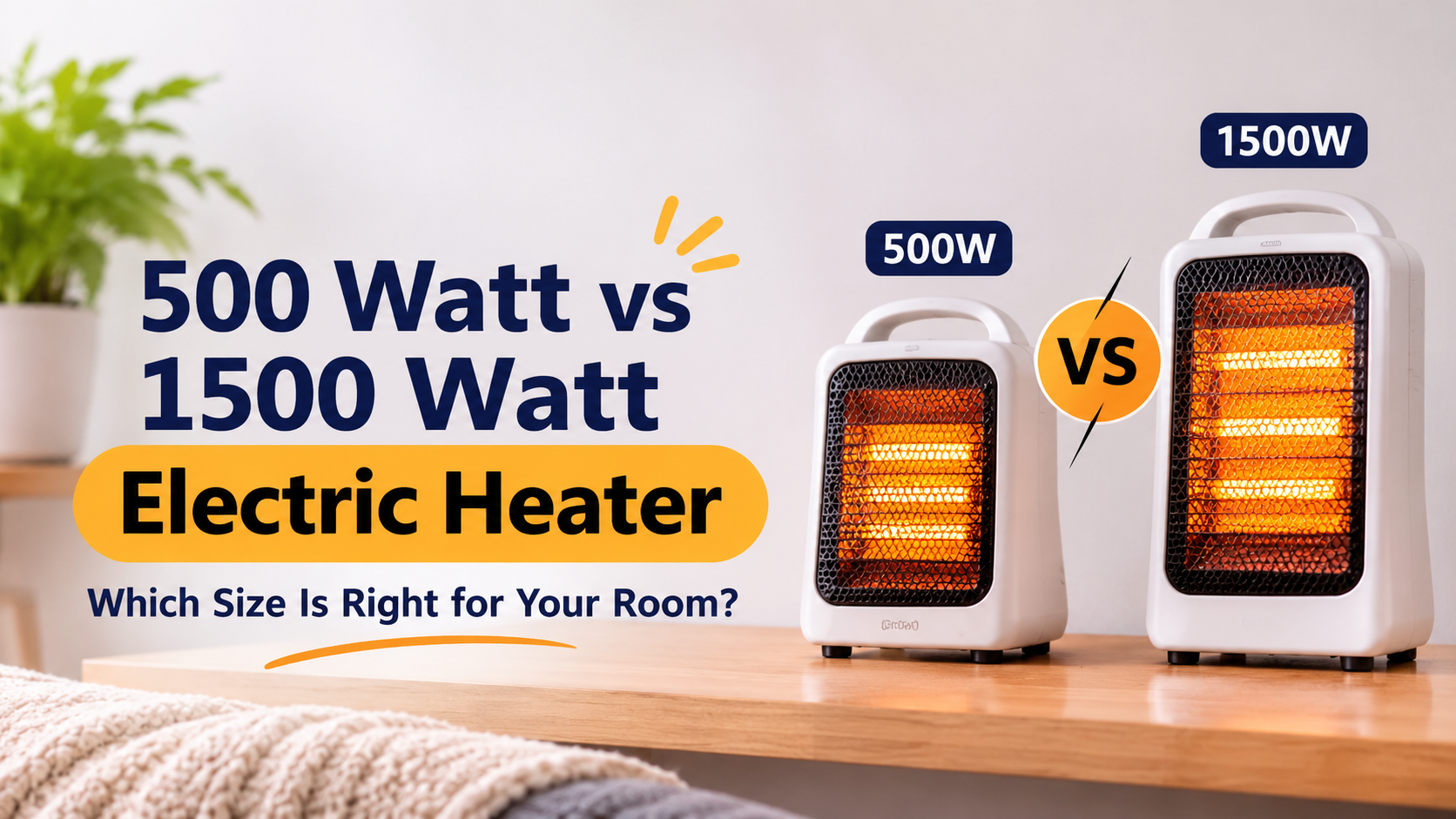
When you shop for a portable electric heater, one number stands out on every box: the wattage. The two most common choices are the compact 500 watt heater and the full-size 1500 watt heater. They look similar and use the same plug, but they behave very differently when it comes to heating power, electricity cost, room size, and safety.
Choosing wrongly can mean a room that never gets warm, or a heater that wastes electricity and trips your circuit breaker. This guide compares the two side by side so you can pick the right one with confidence.
Quick Answer
- Choose 500 watts for personal heating: a desk, a small bathroom, a bedside area, or a tiny room of up to about 50 square feet (roughly 5 square meters).
- Choose 1500 watts for a real room: a bedroom, living room, or office of up to about 150 square feet (roughly 14 square meters).
- Choose something in between (750 to 1000 watts) if your room is 60 to 120 square feet, or buy a 1500 watt heater with adjustable power settings.
What Does Wattage Mean for a Heater?
Wattage tells you how much electrical power the heater uses, and for an electric heater it also tells you how much heat it produces. Almost all of the electricity is turned into heat, so a heater with three times the wattage makes about three times as much heat, and uses about three times as much electricity.
Heat output is often shown in BTU per hour. To convert, multiply watts by 3.412:
- 500 W is about 1,700 BTU per hour
- 1500 W is about 5,100 BTU per hour
500 Watt vs 1500 Watt: Side-by-Side Comparison
| Feature | 500 Watt Heater | 1500 Watt Heater |
|---|---|---|
| Heat output | About 1,700 BTU/h | About 5,100 BTU/h |
| Best room size | Up to about 50 sq ft | Up to about 150 sq ft |
| Energy per hour | 0.5 kWh | 1.5 kWh |
| Cost per hour (at 0.15 per kWh) | About 0.08 | About 0.23 |
| Current on 120 V supply | About 4.2 A | About 12.5 A |
| Current on 230 V supply | About 2.2 A | About 6.5 A |
| Warm-up speed | Slow in anything but a tiny space | Fast |
| Breaker trip risk | Very low | Moderate on shared 15 A circuits |
| Portability | Very compact and light | Larger and heavier |
| Typical price | Lower | Moderate |
500 Watt Electric Heater: Pros and Cons
Pros
- Low running cost: about one-third of the electricity cost of a 1500 watt model.
- Light on the circuit: uses very little current, so it is unlikely to trip a breaker and is safe on most circuits with other devices.
- Compact and portable: easy to carry, store, or place under a desk.
- Ideal for personal warmth: works well for warming your feet, hands, or immediate area.
- Often quieter: smaller fans or no fan at all.
Cons
- Not enough for a full room: it will not noticeably raise the temperature of a normal-size bedroom or living room in cold weather.
- Slow results: takes much longer to make any difference in larger spaces.
- Fewer features: budget models may lack a thermostat or timer.
1500 Watt Electric Heater: Pros and Cons
Pros
- Strong heating power: warms a standard bedroom, home office, or living room.
- Fast warm-up: noticeable heat within minutes.
- More features: usually includes multiple heat settings, adjustable thermostat, timer, oscillation, and remote control.
- Flexible: most models can run at 750 W or 1000 W as well, so they can act like a smaller heater when needed.
Cons
- Higher running cost: costs about three times as much per hour as a 500 watt heater at full power.
- Circuit load: draws around 12.5 amps on a 120 V supply, which can trip a shared 15 A breaker.
- Overkill for tiny spaces: in a very small room it can make the area too hot and waste energy.
- Bigger and heavier than compact models.
How Much Heat Does Your Room Need?
A widely used rule of thumb is 10 watts per square foot of floor area, based on a standard ceiling height of about 8 feet. To use it, multiply your room’s length by its width, then multiply by 10.
- 5 ft × 8 ft bathroom (40 sq ft): about 400 W, so a 500 W heater is enough.
- 8 ft × 10 ft small bedroom (80 sq ft): about 800 W, so a 1000 W or 1500 W heater with a thermostat works well.
- 12 ft × 12 ft room (144 sq ft): about 1,440 W, so a 1500 W heater is the right match.
- Larger than 150 sq ft: a single portable heater may not be enough, especially if the room is poorly insulated or has high ceilings.
Adjust upward for drafty rooms, uninsulated walls, large windows, or very cold climates, and downward for well-insulated, small spaces.
Running Cost: 500 W vs 1500 W
At full power, a 500 watt heater uses 0.5 kWh per hour and a 1500 watt heater uses 1.5 kWh per hour. Here is what that means at an electricity price of 0.15 per kWh:
- 500 W: about 0.08 per hour, about 0.60 for 8 hours, about 18 per month if run 8 hours daily at full power.
- 1500 W: about 0.23 per hour, about 1.80 for 8 hours, about 54 per month if run 8 hours daily at full power.
A bigger heater is not automatically more expensive in practice. A 1500 watt heater warms a room faster and then the thermostat switches it off, while a 500 watt heater in the same room may run constantly without ever reaching your target temperature. Always match the heater to the space instead of picking by price alone.
Electrical Safety and Circuit Capacity
A 1500 watt heater draws about 12.5 amps on a 120 volt supply. A standard 15 amp circuit should only carry about 12 amps continuously, so a 1500 watt heater can use almost the entire circuit by itself. If other devices share the circuit, the breaker may trip. A 500 watt heater draws only about 4.2 amps and rarely causes problems.
On 230 volt systems the currents are lower (about 2.2 A and 6.5 A), but the same safety rules apply:
- Plug the heater directly into a wall outlet, not an extension cord or power strip.
- Keep at least 3 feet (about 1 meter) of clear space around the heater.
- Never leave a heater on while you sleep or when you leave home.
- Check the cord and plug for damage or heat marks regularly.
- Choose models with tip-over and overheat protection.
Which One Is Better for Different Uses?
| Use Case | Best Choice | Why |
|---|---|---|
| Under-desk or foot warming | 500 W | Low cost, targeted heat |
| Small bathroom (rated for it) | 500 W | Small space, quick top-up heat |
| Child’s or small bedroom | 750–1000 W or 1500 W with thermostat | Enough power with thermostat control |
| Standard bedroom or home office | 1500 W | Fast, even heating |
| Living room | 1500 W | Needed to make a real difference |
| Rental or old building with weak wiring | 500–1000 W | Lower breaker trip risk |
| Caravan or camper hookup | 500–1000 W | Limited supply capacity |
The Smart Middle Option: Adjustable Wattage Heaters
Many 1500 watt heaters have two or three settings, for example 750 W and 1500 W. This gives you the best of both worlds: run it on high to warm a room quickly, then drop to low to maintain the temperature. If you are unsure which size to buy, a 1500 watt heater with adjustable power and a thermostat is the most flexible choice for most rooms.
What to Look for When Buying
- Adjustable thermostat so the heater cycles off once the room is warm.
- Multiple power settings for flexibility and lower bills.
- Tip-over protection and overheat shut-off as essential safety features.
- Timer and eco mode to prevent wasted energy.
- Heater type: ceramic for fast heat, oil-filled for steady long-lasting heat, infrared for direct warmth.
- Cool-touch housing and a thick power cord.
- Noise level if the heater will be used in a bedroom or office.
- Recognized safety certification and a reasonable warranty.
Frequently Asked Questions
Can a 500 watt heater heat a whole room?
Only a very small room of around 50 square feet or less. In a normal bedroom or living room it will barely change the temperature in cold weather and is better used as a personal heater.
Is a 1500 watt heater too much for a small room?
It can be, but a heater with a thermostat will cycle on and off, so it will not necessarily waste energy. A model with a lower power setting is ideal for small rooms.
Which is cheaper to run, 500 W or 1500 W?
At full power, 500 W costs about one-third as much per hour. But if the 500 W heater is too weak, it may run constantly and still not warm the room, so the right size for the space is what really saves money.
Will a 1500 watt heater trip my breaker?
It can if the circuit is shared with other devices or is already heavily loaded. Plug it directly into a wall outlet and avoid running other high-power appliances on the same circuit.
Is it safe to use two 500 watt heaters instead of one 1500 watt heater?
Two 500 watt heaters give a total of 1000 W, which is less heat than one 1500 W heater. Both would need separate outlets, ideally on different circuits. A single properly sized heater with a thermostat is usually simpler and safer.
Do 500 W heaters use less electricity overall?
They use less power at any moment, but total usage depends on how long they run. In a room that is too large they run all the time without ever reaching the set temperature.
Final Verdict
The 500 watt vs 1500 watt electric heater choice comes down to space and purpose. If you want a low-cost, compact heater for personal warmth in a very small area, a 500 watt heater is a great fit. If you need to warm a real room such as a bedroom, home office, or living room, a 1500 watt heater is the better choice, especially one with a thermostat and adjustable power settings. Measure your room, apply the 10 watts per square foot rule, check your circuit capacity, and choose the model with the right safety features. That way you will stay comfortable without overspending or overloading your wiring.