



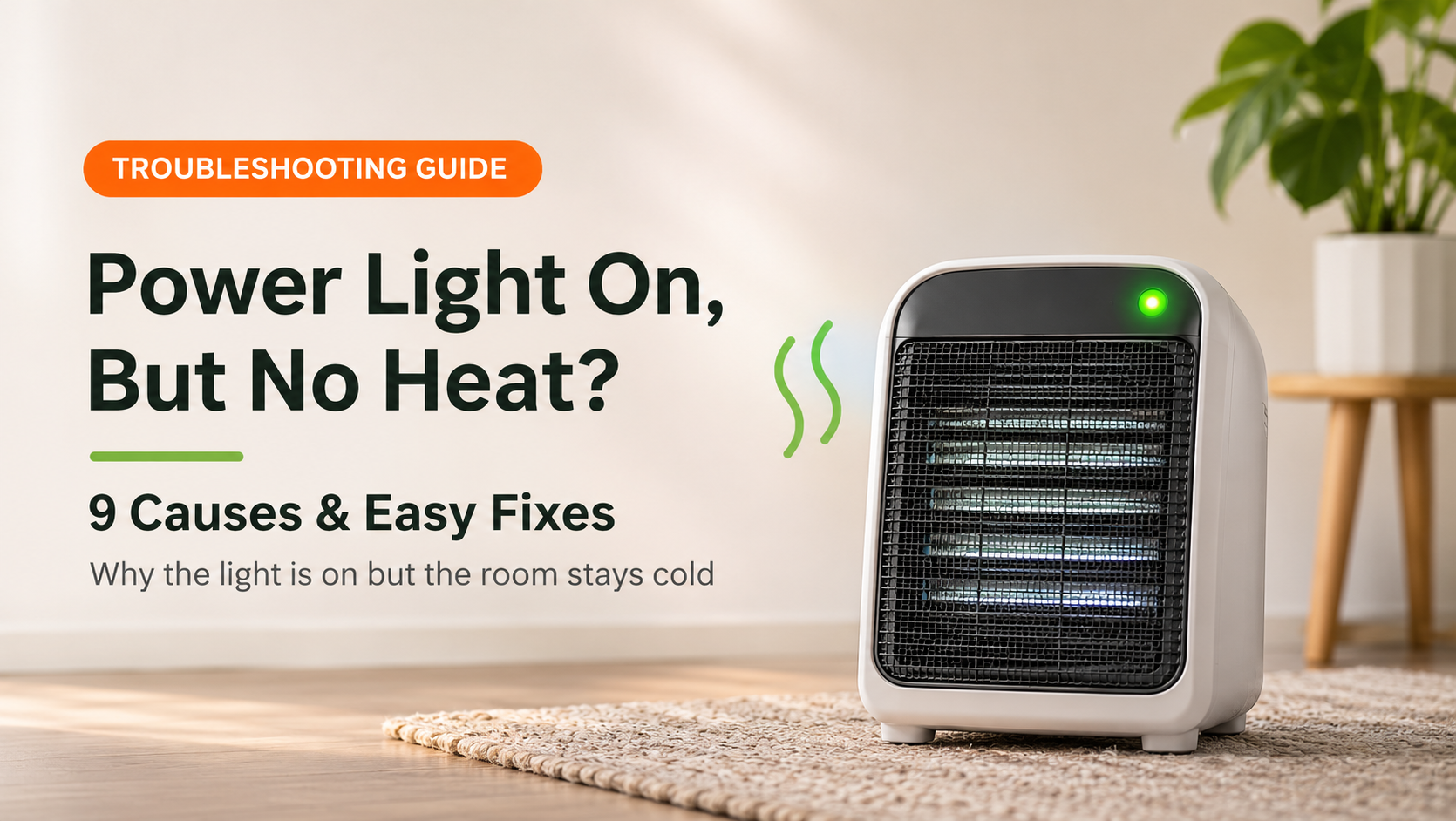
The power light glows, you can hear the heater, and yet the room stays cold. A room heater with the power light on but no heat is confusing, because everything seems to be working. The reason is simple: the indicator light only tells you that the controls have power. It does not prove that the heating element is switched on.
This guide explains why the light and the heat are separate, nine common causes with fixes, how to read the light pattern, the right order for checks, safety advice and what to look for in a better heater.
Why the Light Can Be On With No Heat
Inside a heater, the indicator light sits on a small, low-power circuit that is powered as soon as the heater is switched on. The heat comes from a separate path that must pass through safety cut-offs, the thermostat or relay and then the heating element. A break anywhere on that second path stops the heat, but the light stays on because it never depended on that path.
9 Reasons the Power Light Is On but There Is No Heat
1. Thermostat set too low or the room is already warm
Why it happens: The thermostat only sends power to the element when the room is colder than the setting. If the dial is low, the light stays on while the element stays off.
What to do: Turn the thermostat to the highest setting and see whether heat starts within a few minutes. If it does, the heater is fine.
2. Wrong mode, standby, timer or child-lock
Why it happens: Many heaters have fan-only, eco, low-power, standby and timer modes. In these modes the light stays on but the element is off or limited. A child-lock can also block controls.
What to do: Select the heat or high mode, cancel the timer, turn off the child-lock and replace the remote battery.
3. Tripped overheat cut-off or tip-over switch
Why it happens: Safety switches cut power to the element while leaving the indicator circuit alive. The light stays on, but you get no heat until the switch resets.
What to do: Place the heater on a flat, hard surface, unplug it for 30 minutes, clean the vents and press the reset button if present.
4. Blown thermal fuse
Why it happens: A thermal fuse is a one-time safety part in the element’s power line. When it blows, the heater looks alive but the element is cut off completely.
What to do: If cooling and resetting do not help, a technician can test and replace the thermal fuse. Never bridge or bypass it.
5. Failed heating element
Why it happens: The element is the part that creates heat. If the coil, ceramic plate or tube is broken, the light and fan work normally but the air stays cold.
What to do: When the fan runs and the light is on but there is never any heat, have the element tested. Replacement is often not worth it for older, low-cost heaters.
6. Faulty thermostat or temperature sensor
Why it happens: A failed thermostat contact stays open, or a faulty sensor reports a warm room. The element never gets switched on even though the controls look normal.
What to do: Test on maximum in a cold room. If heat still never starts, the thermostat or sensor needs professional replacement.
7. Failed relay or control board
Why it happens: Digital heaters use a relay or electronic switch to send power to the element. If it fails, the display and light work but the element gets no power. You may hear no click when it should switch on.
What to do: Avoid opening the heater. Ask a technician to check the relay and board, or replace the heater if it is old.
8. Loose or burnt internal connection
Why it happens: A loose connector or burnt terminal in the element’s wiring breaks the heat path while the light circuit stays intact. This can cause weak, patchy or intermittent heat and a faint burning smell.
What to do: Stop using the heater if you smell burning. A technician must inspect and repair internal wiring.
9. Weak circuit, low voltage or extension cord
Why it happens: The indicator light needs only a tiny current, but the element needs a lot. A thin extension cord, shared socket or weak mains supply can run the light while starving the element.
What to do: Plug directly into a wall socket and avoid sharing the circuit with air conditioners, geysers or irons.
What the Light Pattern Tells You
A steady light, a blinking light and a flickering light mean different things. Check your manual for the exact codes for your model, then use this guide for the usual meanings.
Do the Checks in the Right Order
Indicator Lights by Heater Type
| Heater Type | What the Light Usually Means | What “Light On, No Heat” Often Means |
|---|---|---|
| Fan heater | Power is on, and sometimes that heat is selected | Low thermostat, wrong mode, tripped cut-off, failed element |
| Ceramic (PTC) heater | Power or heat mode, often with a display | Display powered but relay or ceramic plate not working |
| Oil-filled radiator | On many models, the element is switched on | Needs 20 to 30 minutes to warm, or the thermostat is set too low |
| Convector heater | Power on, and sometimes heating status | Thermostat satisfied, or a faulty thermostat |
| Halogen or quartz heater | Power on, usually with a visible glow | Light on but no tube glow means a burnt tube or loose connection |
Step-by-Step Troubleshooting
- Select the right mode. Choose heat or high. Cancel eco, standby, timer and fan-only modes, and turn off the child-lock.
- Turn the thermostat to maximum. Wait 5 to 10 minutes and feel the air outlet.
- Unplug and cool down for 30 minutes. This resets many overheat cut-offs.
- Press the reset button if there is one.
- Place the heater on a flat, hard surface. This releases the tip-over switch.
- Clean the vents and grille. Remove dust and lint with a vacuum and a soft brush.
- Test the power. Try another wall socket, check the plug and cord, and avoid extension cords.
- Observe the heater for 10 minutes. Listen for a relay click and watch for a glow on halogen tubes.
- Call a technician if there is still no heat. The thermal fuse, thermostat, relay or element needs professional testing.
DIY Fix or Professional Repair?
| You Can Do It Yourself | Leave to a Professional |
|---|---|
| Checking mode, timer and child-lock | Testing or replacing the thermal fuse |
| Setting the thermostat higher | Replacing the thermostat or relay |
| Cooling down and pressing reset | Repairing the control board or wiring |
| Cleaning vents and testing the socket | Replacing the heating element |
Repair or Replace?
Replace the heater if it is more than 5 to 7 years old, the element or control board has failed, there are signs of burning or melted parts, or repair would cost more than half the price of a new one. Repair is sensible for newer heaters, heaters under warranty, or a simple part like a thermal fuse.
What to Look for When Buying a New Room Heater
- Clear indicator lights or a display that show both power and active heating, so you always know what is happening.
- Error codes or protection indicators that explain why the heater has stopped heating.
- Adjustable thermostat that is easy to read and accurate.
- Overheat and tip-over protection for safety.
- Correct wattage for your room size.
- Easy-clean vents and filter to prevent dust problems.
- Good warranty, solid build and trusted safety certifications.
How to Prevent This Problem
- Clean vents and filters regularly so overheat cut-offs do not trip.
- Keep the heater on a flat, stable surface.
- Plug directly into a wall socket and inspect the plug often.
- Test your heater before the first cold night of the season.
- Replace old heaters before elements, relays and fuses start to fail.
Frequently Asked Questions
Why is my heater’s power light on but there is no heat?
The light only shows that the controls have power. The heat path through the safety cut-offs, thermostat or relay and element may be broken, switched off or set wrongly.
Does the power light mean the element is working?
No. On many heaters the light is on a separate low-power circuit. On some oil-filled models it does show when the element is on, so check your manual.
Why does my heater light blink?
A blinking light often signals a fault or protection mode such as overheating, tip-over or a sensor error. Check your manual for the pattern for your model.
Why does the fan run but the air is cold?
The fan and the element are separate. The thermostat, thermal fuse, relay or element may be stopping heat, or the mode may be set to fan-only.
Can a thermal fuse cause no heat?
Yes. When a thermal fuse blows, it cuts power to the element while the light and fan can keep working. It needs professional replacement.
Is it worth repairing a heater with no heat?
For newer or higher-quality heaters, yes, especially when the fault is a fuse or switch. For older, low-cost heaters with a failed element or board, replacement is usually better.
Conclusion
When your room heater’s power light is on but there is no heat, remember that the light and the heat are separate. Start with the free checks: mode, thermostat, cooling and reset, clean vents and a good wall socket. If the heater is still cold, the thermal fuse, thermostat, relay, wiring or element needs testing by a technician. Stop using the heater if you notice burning smells, sparks or a hot plug, and choose a replacement with clear indicators and strong safety features so you always know whether it is really heating.