



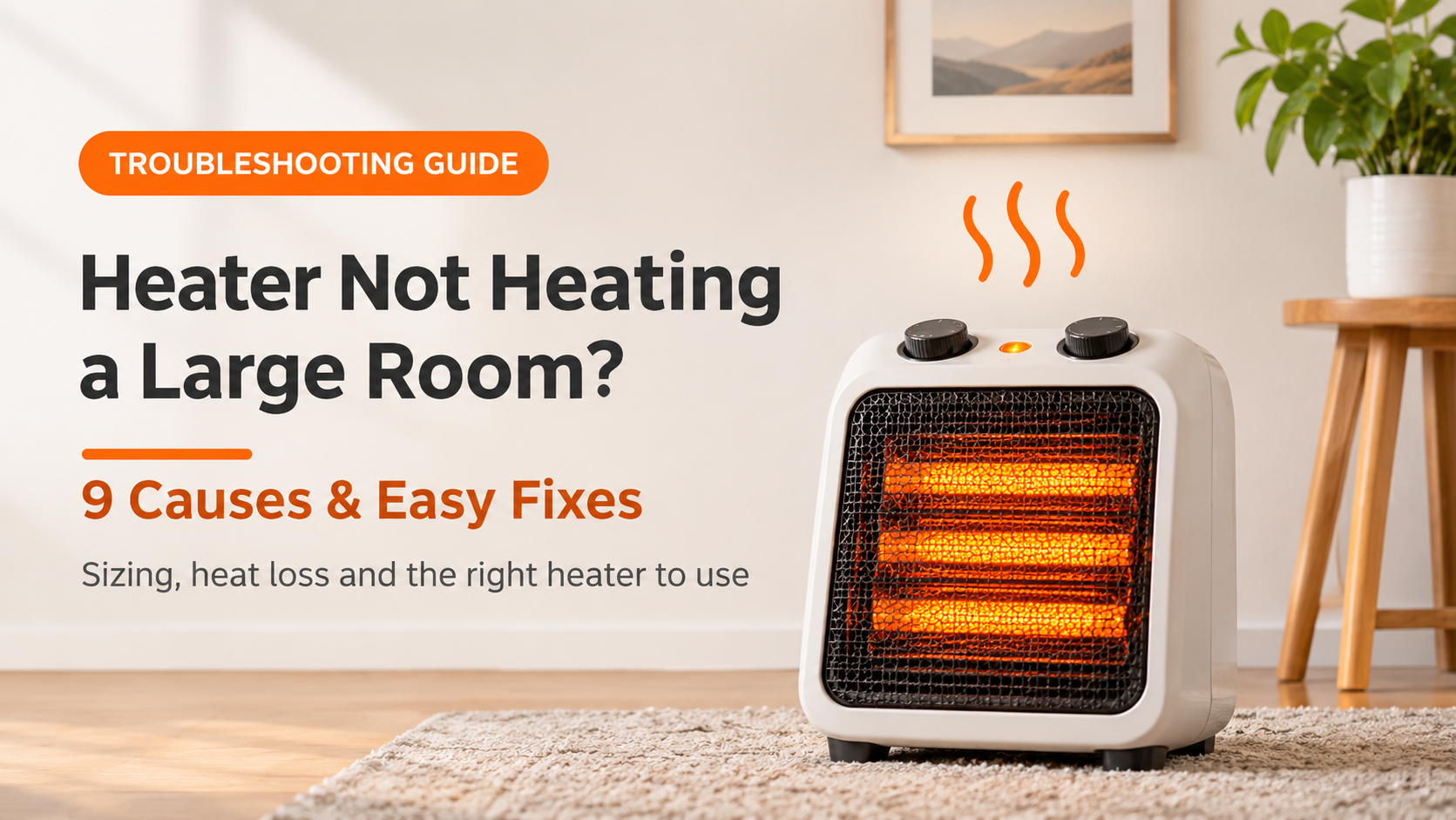
You turn the heater to its highest setting, yet the big living room, open-plan space or large bedroom stays cold. A room heater that is not heating a large room is very often not broken at all. Portable heaters are designed to warm small and medium spaces, and in a large room the problem is usually size, heat loss or placement.
This guide shows how to work out the power you need, why large rooms are hard to heat, nine common causes with fixes, how to tell an undersized heater from a faulty one, how to choose the right heater type, and how to avoid circuit overloads.
Why Large Rooms Are Hard to Heat
A bigger room contains more air, has more wall, window and floor area through which heat can escape, and often has higher ceilings. A portable heater adds a fixed amount of heat each second, so a room that loses heat faster than the heater supplies it will never reach a comfortable temperature, however long you wait.
How Much Heater Power Does Your Room Need?
A simple rule is about 10 watts per square foot of floor area, or roughly 100 watts per square meter. Adjust upward for high ceilings, many windows, poor insulation or a cold climate.
| Room Size (sq ft) | Approx. Size (m²) | Suggested Power | Approx. BTU per Hour |
|---|---|---|---|
| Up to 100 | Up to 9 | 1000 W | 3,400 |
| 100 to 150 | 9 to 14 | 1500 W | 5,100 |
| 150 to 250 | 14 to 23 | 2000 to 2500 W | 6,800 to 8,500 |
| 250 to 400 | 23 to 37 | 3000 to 4000 W (usually two heaters) | 10,200 to 13,600 |
| Above 400 | Above 37 | Several heaters, or fixed heating | Above 13,600 |
Worked Example
A room measuring 20 feet by 15 feet is 300 square feet. At 10 watts per square foot you need about 3000 W. With a high ceiling and single-glazed windows, plan for 3500 to 4000 W. A single 2000 W heater would supply only about half to two-thirds of that, which explains why the room never feels warm. Two 2000 W heaters on separate circuits, or a combination of heating methods, would be a better match.
9 Reasons Your Heater Is Not Heating a Large Room
1. The heater is too small for the room
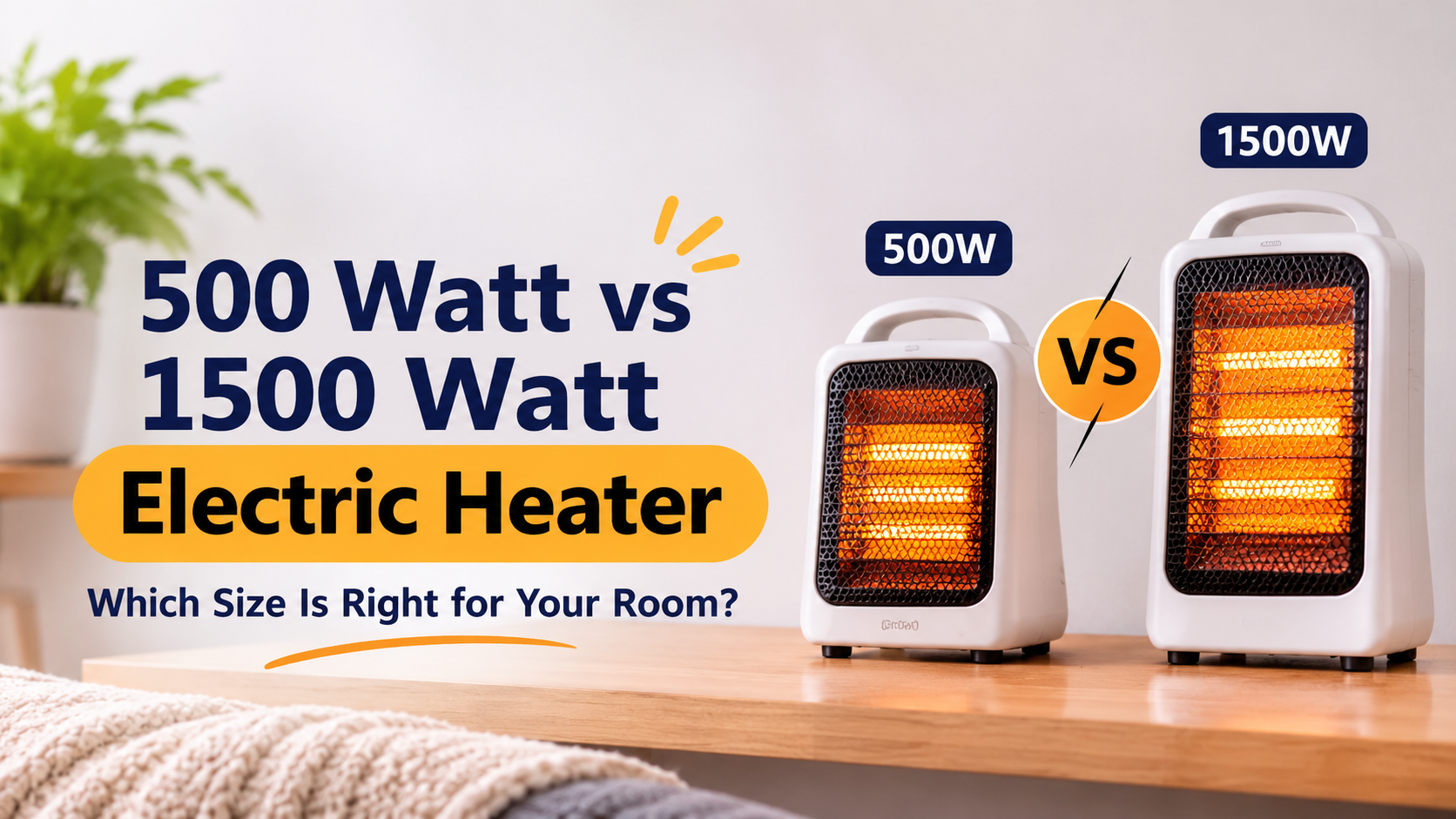
Why it happens: The most common reason. A 1000 or 1500 W heater is designed for a small or medium room. In a large room, it simply cannot add heat as fast as the room loses it.
What to do: Work out the power you need (about 10 W per square foot, or 100 W per square meter) and choose a heater that matches, or use two heaters.
2. Heat escapes through windows, doors and gaps
Why it happens: Single-glazed windows, gaps under doors, vents and thin walls let heat escape. A large room has more surface area, so it loses heat faster, and the heater can barely keep up.
What to do: Close doors and windows, fit draught excluders, use thick curtains or window film, and seal visible gaps.
3. High ceilings mean more air to heat
Why it happens: Heat rises, so in a room with a tall ceiling the warm air collects high up while you sit in the cold air below. The total air volume is also much larger.
What to do: Add roughly 10 to 25 percent more power for ceilings above about 8 feet (2.4 m), and use a ceiling or floor fan on low to push warm air down.
4. The wrong type of heater for large spaces
Why it happens: Compact fan heaters and halogen heaters give fast, local warmth, but they do not spread heat well across a large room. Oil-filled and convector heaters spread heat more evenly but take longer.
What to do: Choose a convector, oil-filled or larger fan-assisted heater for big rooms, and use a radiant heater only for warming the area where you sit.
5. Poor placement of the heater
Why it happens: A heater in a corner, behind furniture or far from where you sit loses much of its effect. A heater blowing onto a wall or sofa wastes heat.
What to do: Place it in the open, ideally under or near the coldest wall or window, with 3 feet of clear space around it, and point fan heaters into the room.
6. Poor air circulation and cold zones
Why it happens: In large or open-plan rooms, warm air stays near the heater while the rest of the room stays cold. Doors, shelves and furniture can trap pockets of cold air.
What to do: Use a fan on its lowest setting to circulate air, keep internal doors closed, and place heaters at opposite ends for large, long rooms.
7. The heater is not delivering its full output
Why it happens: Dust on the element, blocked vents, a failing element, a tripped thermal fuse or low voltage can cut output. The heater seems to work but gives less heat than it should.
What to do: Clean the vents and filter, check the outlet air for warmth and test on a different socket. If the air is cold or weak, the heater itself may be faulty.
8. The thermostat is set too low or reads the wrong temperature
Why it happens: A sensor close to the heater senses a warm local area and switches the heater off before the rest of the room is warm. A low setting does the same.
What to do: Turn the thermostat up, place a separate room thermometer away from the heater and move the heater so the sensor is not blasted by its own heat.
9. Circuit limits stop you using full power
Why it happens: Large rooms may need more power than one socket allows, so the heater is run on a lower setting, or trips the breaker. Extension cords and shared circuits can also reduce output.
What to do: Plug directly into a wall socket, use a separate circuit for each heater, and do not exceed the circuit’s rating. Ask an electrician about extra capacity if needed.
Is the Heater Too Small or Is It Faulty?
Before buying a new heater, work out whether yours is delivering what it should. The outlet air tells you most of what you need to know.
| What You Notice | Most Likely | What to Do |
|---|---|---|
| Warm air from the outlet, but the room stays cold | Undersized heater or heavy heat loss | Size up, add a second heater, cut heat loss |
| Cold or barely warm air from the outlet | A faulty heater (element, fuse or thermostat) | Clean it, test it and have it repaired or replaced |
| Heater switches off while the room is still cold | Thermostat placement, overheat protection or timer | Move the heater, clean the vents, check settings |
| Heat is fine near the heater only | Poor air circulation | Use a fan and place the heater centrally |
| Breaker trips on high | Circuit limit | Use a separate circuit or lower setting |
Which Heater Types Work Best in Large Rooms?
No portable heater matches fixed heating in a very large space, but some types suit big rooms better than others. Use the guide below along with the table of room sizes.
| Heater Type | Best For | Limits in a Large Room |
|---|---|---|
| Fan heater | Fast, short-term warmth | Short range and uneven spread |
| Ceramic tower heater | Medium rooms, fast warm-up | Struggles in very large spaces |
| Oil-filled radiator | Steady, quiet heat over hours | Slow warm-up, large units needed |
| Convector heater | Even heat across big rooms | Takes time and needs wall space |
| Radiant (halogen or infrared) | Warming people and seating areas | Does not warm the air in the whole room |
Three Ways to Fix a Cold Large Room
Step-by-Step Plan
- Measure the room. Multiply length by width and note the ceiling height.
- Calculate the power you need. Use about 10 W per square foot and adjust for ceiling height and draughts.
- Check your heater’s rating. Compare its wattage with what the room needs.
- Test the heater’s output. Feel the outlet air to confirm that the heater itself is working.
- Reduce heat loss. Close doors, seal gaps, use curtains and shut off rooms you do not use.
- Place the heater well. Keep it in the open, 3 feet from objects, ideally near the coldest wall.
- Circulate the air. Use a fan on low or position heaters at opposite ends.
- Add a second heater if needed. Use a separate circuit for each heater.
- Consider a better heater type or fixed heating. If the room is very large, portable heaters may never be enough.
What Will It Cost to Run?
Running cost equals the heater’s power in kilowatts times the hours it runs times your price per unit of electricity. A 2 kW heater running for 5 hours uses 10 kWh. A thermostat and a well-insulated room cut that figure by making the heater cycle off instead of running at full power all the time. Using several heaters in a large room multiplies the cost, which is another reason to reduce heat loss first.
What to Look for When Buying a Heater for a Large Room
- Right wattage for your room size, ceiling height and insulation.
- Heater type suited to big spaces, such as convector, oil-filled or fan-assisted models.
- Accurate adjustable thermostat and multiple power settings.
- Oscillation or built-in fan to spread warm air.
- Timer and remote control so you can pre-heat the room.
- Overheat and tip-over protection and trusted safety certifications.
- Plug and cord rated for the load, a solid warranty and good build quality.
Keep the Heater Working at Full Strength
- Clean vents and filters so airflow and output stay high.
- Keep the heater on a flat, hard surface with free space around it.
- Plug directly into a wall socket, never a multi-plug.
- Pre-heat the room with a timer so the heater is not fighting a cold start.
- Replace old heaters that deliver weak heat even after cleaning.
Frequently Asked Questions
Why does my heater not heat a big room?
Most portable heaters are made for small and medium rooms. In a large room the heater is often undersized, and the room loses heat faster than the heater supplies it.
How many watts do I need to heat a large room?
A common guide is about 10 watts per square foot, or 100 watts per square meter. Add more for high ceilings, many windows and poor insulation.
Is one big heater better than two smaller ones?
A single large heater may overload a circuit, while two smaller heaters at opposite ends can spread heat better. Use separate circuits for each heater.
Which heater type is best for large rooms?
Convector and oil-filled heaters spread heat evenly, while larger fan-assisted models warm faster. Radiant heaters warm people and seating areas rather than the whole room.
Can I use an extension cord to place the heater better?
No. Extension cords can overheat with a heater. Move the heater or ask an electrician about a socket in a better position.
How do I know my heater is working properly?
Feel the air at the outlet. If it is warm and strong, the heater is working, and the problem is size or heat loss. If it is cold or weak, the heater itself may be faulty.
Conclusion
If your room heater is not heating a large room, the first question is not what is broken, but whether it is the right size. Calculate the power you need, cut heat loss, place the heater well and move the air around. If the outlet air is cold or weak, clean the heater and check it for faults. For very large spaces, use two heaters on separate circuits or consider fixed heating. A correctly sized, well-placed heater with a good thermostat and safety features will keep a large room comfortable all winter.