







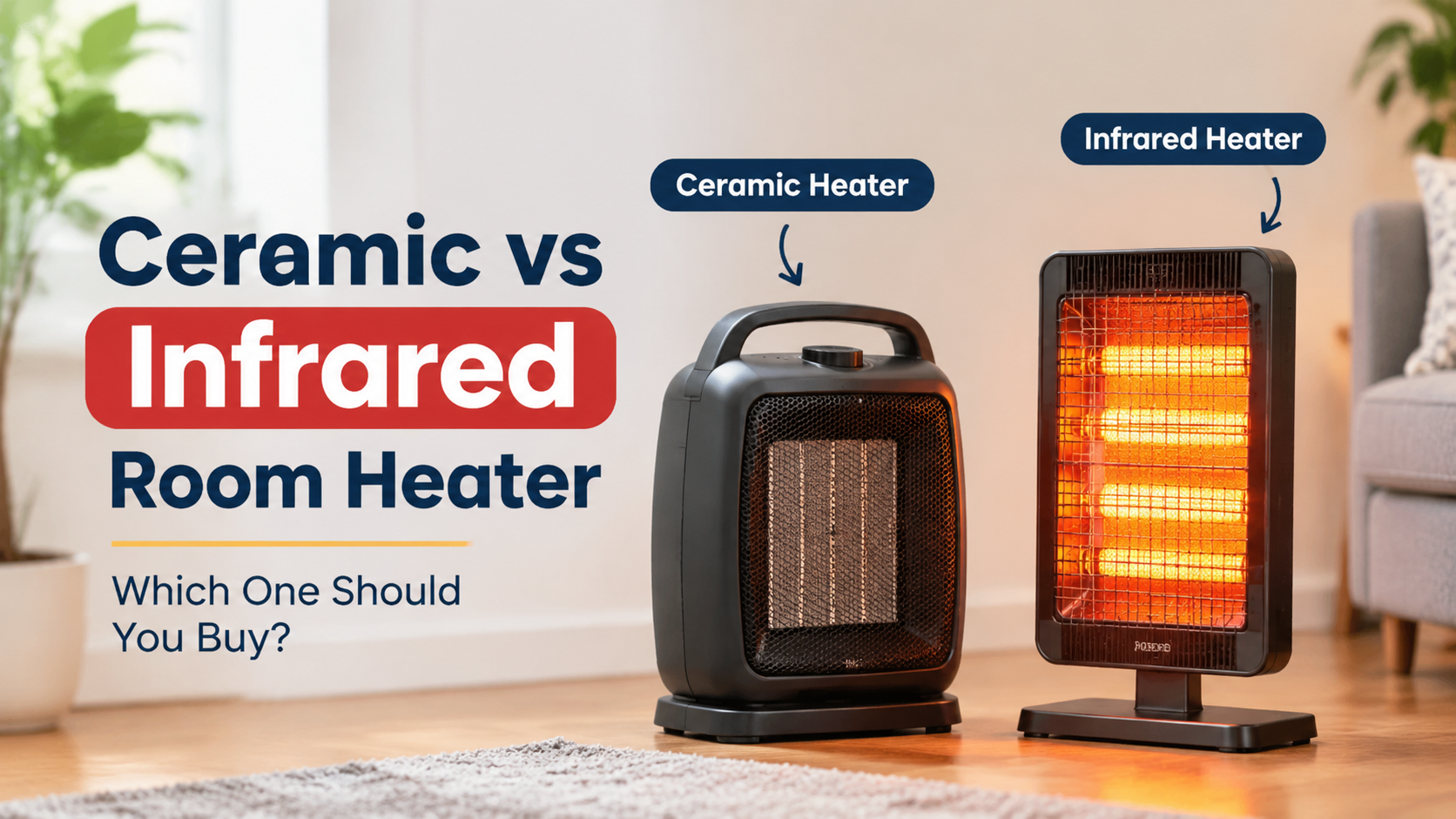
Ceramic vs Infrared Room Heater: Which One Should You Buy?
When the temperature drops and your central heating is either missing or too expensive to run, a room heater is the quickest fix. But the moment you start shopping, two names appear on almost every list: ceramic heaters and infrared heaters. Both plug into a wall, both promise fast warmth, and both come in compact sizes. So what is the real difference, and which one deserves a place in your home?
In this guide we compare ceramic and infrared room heaters in plain language. You will learn how each one produces heat, how they differ in running cost, safety, noise and comfort, and which type suits your bedroom, living room, office, garage or balcony. By the end you will know exactly what to look for before you buy.
Quick Answer
- Choose a ceramic heater if you want to warm the air in a small or medium closed room, such as a bedroom, study or small living room.
- Choose an infrared heater if you want instant, silent warmth on your body in a drafty, open or hard-to-heat space such as a garage, workshop, balcony or desk area.
- At the same wattage, both cost about the same to run. The better choice depends on where and how you will use it.
What Is a Ceramic Heater?
A ceramic heater uses a heating element made of ceramic plates or stones, commonly called a PTC (positive temperature coefficient) element. When electricity flows through it, the ceramic gets hot, and a fan blows air across the hot surface. The warmed air is then pushed into the room. This method is called convection heating.
PTC ceramic has a helpful safety property: as it gets hotter, its electrical resistance rises, which reduces the current and naturally limits the temperature. That is one reason ceramic heaters have such a strong reputation for being safe and reliable in homes.
Common Types of Ceramic Heaters
- Ceramic tower heaters: Tall, slim and often oscillating, they spread warm air across a room and usually include a remote, timer and thermostat.
- Compact ceramic fan heaters: Small, portable units ideal for desks, bathrooms (if rated for it) and small bedrooms.
- Ceramic panel or silent ceramic heaters: Fanless models that heat more quietly, though they are generally slower to warm a room.
What Is an Infrared Heater?
An infrared heater produces invisible infrared radiation, similar to the warmth you feel from the sun on your skin. Instead of heating the air first, this radiant energy travels in straight lines and warms people, furniture and surfaces directly. The objects then release some of that heat back into the room. This method is called radiant heating.
Because there is usually no fan, infrared heaters tend to be silent, and you feel warm almost the moment you switch one on, as long as you are in front of it.
Common Types of Infrared Heaters
- Quartz or halogen infrared heaters: Glowing tubes that give strong, instant heat and often a visible orange light.
- Carbon (far-infrared) heaters: Use carbon elements for a softer glow and gentle, comfortable warmth.
- Infrared panel heaters: Flat, wall-mounted or freestanding panels with a cooler, flat surface and little to no glare.
How Each Heater Warms You: Convection vs Radiation
This is the single most important difference between the two. A ceramic heater warms the air, and the air carries warmth around the room. An infrared heater warms you directly, with no need to warm the air first.
Ceramic vs Infrared Room Heater: Side-by-Side Comparison
| Feature | Ceramic Heater | Infrared Heater |
|---|---|---|
| Heating method | Convection: heats the air | Radiation: heats people and objects |
| Warm-up feel | Fast, but takes a few minutes to feel the room warm up | Almost instant warmth when you are in front of it |
| Best room type | Small to medium closed rooms | Open, drafty or large areas where you need spot warmth |
| Whole-room heating | Good | Limited, only what the rays reach |
| Noise | Fan noise on most models | Usually silent |
| Safety features | Self-regulating PTC element, cool-touch body on many models | Glowing tubes can get very hot, panel models are safer |
| Light output | None | Quartz and halogen models glow, panels do not |
| Dust and air feel | Fan can stir dust and the air may feel dry | No fan, so no air stirring, many people find the air feels less dry |
| Effect of drafts | Warm air is lost quickly | Less affected, because you are warmed directly |
| Portability | Very portable, many compact designs | Portable or wall-mounted |
| Typical power | 750 W to 2,000 W | 400 W to 2,000 W |
Running Cost: Is One Cheaper Than the Other?
This is where many sales pages mislead buyers. Some infrared heater ads claim huge savings over other heater types. The reality is simple: nearly all plug-in electric heaters convert almost 100% of the electricity they use into heat. A 1,500 W ceramic heater and a 1,500 W infrared heater both use 1.5 kWh of electricity per hour, so they cost the same to run at the same setting.
Where infrared can save money is in how you use it. Because it warms you directly, you may feel comfortable with a lower-wattage model, a lower setting or a shorter run time, especially when you only need to warm one person or one area. On the other hand, to heat an entire closed room evenly, a ceramic heater with a thermostat is often the more practical choice.
Safety: Which Heater Is Safer?
Both types are safe when used correctly and when they come with modern protection features. Still, they have slightly different risk profiles.
Ceramic Heater Safety
- PTC elements limit their own temperature, which reduces overheating risk.
- Many models have a cool-touch housing, tip-over switch and overheat cut-off.
- Fan models can pull in dust and hair, so regular cleaning matters.
Infrared Heater Safety
- Quartz and halogen tubes glow and get very hot, so keep them away from children, pets and anything flammable.
- Infrared heat is directional and intense. Never leave a heater too close to furniture or bedding.
- Panel and carbon models usually have a safer, flatter, cooler surface.
- Plug it directly into a wall socket. Do not use cheap extension cords or multi-plug adaptors.
- Keep at least one metre of clear space in front and around it.
- Choose a model with tip-over and overheat protection.
- Do not cover the heater or use it to dry clothes.
- Do not use a heater in a bathroom unless it is specifically rated for that environment.
Noise, Light and Comfort
Noise: Most ceramic heaters use a fan, and the fan produces a steady hum. Quiet fan models exist, but if you are a light sleeper or want to work in silence, infrared heaters have a clear advantage. Fanless ceramic panels are quieter but heat more slowly.
Light: Quartz and halogen infrared heaters glow orange, which is nice in a living room but can disturb sleep in a bedroom. Carbon and panel infrared models give off much less light.
Comfort: Ceramic heaters give an even, room-filling warmth once the space has heated up. Infrared heaters give a pleasant, sun-like warmth on your skin but feel cooler if you step out of the beam or someone stands in the way.
Which Heater Is Best for Each Room?
| Where You Will Use It | Better Choice | Why |
|---|---|---|
| Bedroom | Ceramic (with thermostat and timer) | Warms the whole closed room, no glow, auto shut-off |
| Small living room | Ceramic tower | Oscillation spreads heat evenly, remote control is handy |
| Home office or study desk | Infrared (low wattage) | Silent, warms your legs and body directly |
| Large, open-plan room | Infrared for spot warmth | Heating all the air is costly and slow |
| Garage or workshop | Infrared | Drafts make air heating inefficient |
| Balcony or semi-outdoor area | Infrared (rated for the location) | Warms people even where the air escapes |
| Bathroom | Ceramic model rated for bathrooms | Compact and fast, but only if waterproof-rated |
| Kids’ room | Ceramic with cool-touch body | Self-limiting element and safer exterior, still supervise |
Pros and Cons at a Glance
Ceramic Heater
Pros
- Warms an entire small or medium room
- Self-regulating element and good safety features
- Wide choice of sizes, designs and prices
- Thermostats, timers and remotes are common
Cons
- Fan noise on most models
- Stirs dust and can feel drying
- Heat is lost quickly in drafty rooms
Infrared Heater
Pros
- Instant warmth you can feel immediately
- Silent, with no fan
- Great for drafty or open spaces
- Efficient for warming one person or area
Cons
- Directional: warmth only where rays reach
- Poor for evenly heating a large closed room
- Some models glow and have very hot elements
Which One Should You Choose?
Use this simple decision chart to find your match in a few seconds.
Our Verdict
For most households, a ceramic heater with a good thermostat is the all-round choice for bedrooms and small living spaces. If you spend your time in one spot, work in a drafty space or want silent, instant warmth, an infrared heater is the better tool. Many homes benefit from owning one of each.
Buying Guide: What to Check Before You Buy
| Feature | What to Look For | Applies To |
|---|---|---|
| Wattage | About 100 W per square metre of room for ceramic. Lower wattage is enough for a spot infrared heater. | Both |
| Thermostat | Adjustable, so the heater cycles off when the room is warm | Both, especially ceramic |
| Timer and remote | Programmable timer, 24-hour if possible | Both |
| Tip-over and overheat protection | Automatic shut-off if knocked over or too hot | Both |
| Oscillation | Spreads warm air evenly across the room | Ceramic |
| Fan noise level | Check the decibel rating or reviews for a quiet fan | Ceramic |
| Heating element type | Carbon or panel for softer light and safer surface | Infrared |
| Mounting options | Stand, wall mount or ceiling mount for convenience | Infrared |
| Warranty and certification | Recognised safety marks and at least a 1–2 year warranty | Both |
How to Get the Most From Either Heater
- Close doors and windows so warmth stays in the space you want to heat.
- Use the thermostat and timer to avoid running at full power for hours.
- Place infrared heaters at the right distance, usually a metre or more from you, aimed at where you sit.
- Place ceramic heaters on a flat floor away from curtains and furniture, with space around the fan.
- Clean fan vents and filters monthly so the heater runs efficiently and safely.
- Seal drafts and use thick curtains to make any heater work better.
- Layer your clothing so you can use a lower setting and still feel comfortable.
Frequently Asked Questions
Is an infrared heater cheaper to run than a ceramic heater?
Not at the same wattage. Both use the same amount of electricity per hour. Infrared can feel more cost-effective when you are heating just yourself, because you can use a smaller heater or run it for less time.
Which heater warms up faster?
Infrared heaters feel warm almost immediately because they heat you directly. Ceramic heaters also start quickly, but it takes a few minutes before the room air feels noticeably warmer.
Which is better for a bedroom, ceramic or infrared?
A ceramic heater with a thermostat and timer is usually better for a closed bedroom, since it warms the whole room evenly and has no glowing element. A silent carbon or panel infrared heater can also work if you want to avoid fan noise.
Can I leave a ceramic or infrared heater on overnight?
It is best not to leave any room heater running unattended for long periods. If you must use one at night, pick a model with a timer, thermostat, tip-over switch and overheat protection, and follow the manufacturer’s instructions.
Do infrared heaters really heat a whole room?
They warm surfaces and people within their line of sight, and those surfaces then warm the room a little. For a small, well-insulated room they can work well, but they are not as effective as a ceramic or convector heater at evenly heating a large closed space.
Do ceramic heaters dry out the air?
Electric heaters do not remove moisture from the air, but the blowing warm air from a fan heater can make skin and eyes feel dry. Keeping a bowl of water in the room or using a humidifier can help if you notice dryness.
Is it safe to use a ceramic or infrared heater with children and pets?
Choose a model with a cool-touch body, tip-over protection and a safety guard, keep it out of reach, and supervise. Glowing infrared tubes are generally less suitable where small children or pets can reach them.
Final Thoughts
The ceramic vs infrared debate is not about one being better in every situation. It is about matching the heating method to your space. If you want to warm the air in a bedroom or small living room, a thermostat-controlled ceramic heater is simple, safe and effective. If you need instant, silent warmth at a desk, in a garage or in a drafty space, an infrared heater delivers comfort exactly where you need it.
Whichever you pick, focus on the features that matter: the right wattage, a reliable thermostat, a timer and strong safety protection. Pair your heater with good habits like sealing drafts and layering up, and you will stay warm all winter without an oversized electricity bill.