







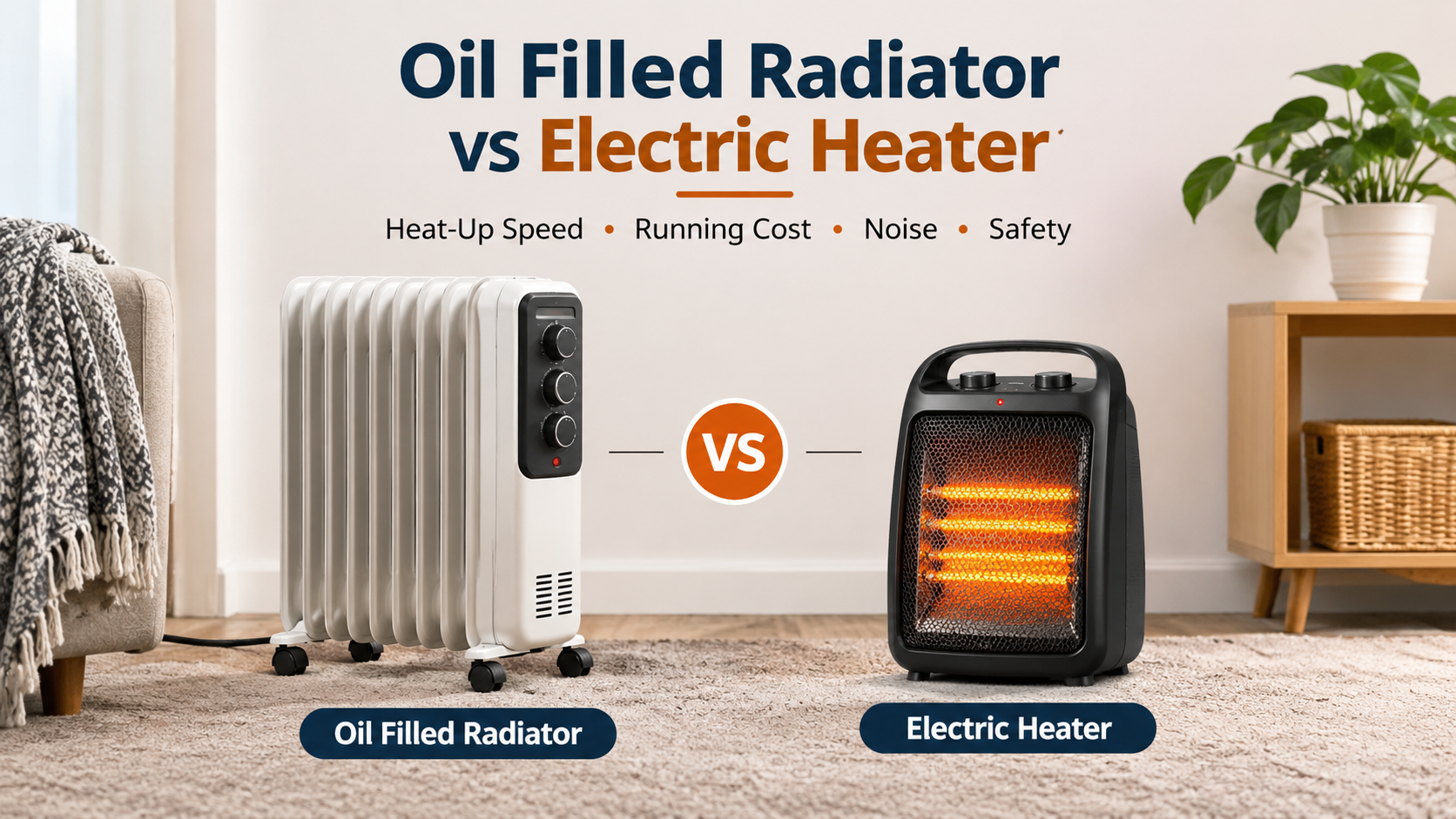
Choosing between an oil filled radiator vs electric heater sounds simple until you see the options. Both plug into a wall socket, both are close to 100% efficient at turning electricity into heat, and both come in similar wattages. Yet they feel completely different in a room. One warms slowly and keeps radiating heat for a long time. The other blasts hot air within seconds and goes cold the moment it switches off. This guide explains how each works, compares them on seven practical points, and helps you pick the right one for your space and budget.
Note: “Electric heater” is a broad term that includes oil filled radiators too. In this article it mainly means fan heaters and ceramic fan heaters, which most shoppers compare against oil radiators. Infrared, halogen, and panel heaters are covered briefly later.
Table of Contents
- What is an oil filled radiator?
- What is an electric (fan) heater?
- Heat-up speed and heat retention
- Performance scorecard
- Electricity consumption and running cost
- Noise, air quality, and comfort
- Safety
- Size, weight, and portability
- Price and lifespan
- Which one should you buy?
- Other electric heater types
- Buying guide
- Frequently asked questions
- Conclusion
What Is an Oil Filled Radiator?
An oil filled radiator looks like a traditional hot-water radiator, but it is completely self-contained. Inside its metal fins is a sealed reservoir of thermal oil. An electric element heats the oil, and the oil warms the metal body, which releases heat into the room through convection and radiant heat. The oil never needs refilling or replacing because it is a closed system, and it is not burned or consumed.
Pros of Oil Filled Radiators
- Silent operation, since there is no fan
- Keeps giving off heat after it switches off
- Gentle, even warmth that feels natural
- Does not blow dust around the room
- Thermostat cycling reduces average electricity use over long periods
- Long lifespan with very few moving parts
Cons of Oil Filled Radiators
- Slower to warm a cold room (often 15 to 30 minutes to feel the difference)
- Heavier and bulkier than fan heaters
- Usually costs more than a basic fan heater
- Body stays hot after switch-off, so it needs care around children and pets
What Is an Electric (Fan) Heater?
A fan heater pulls air across a hot element, either a metal coil or a ceramic plate, and blows the warm air into the room. This forced-air method delivers heat almost immediately, which is why fan heaters are popular for bathrooms, home offices, and quick warm-ups. Ceramic fan heaters use PTC ceramic elements that regulate their own temperature and are often a little safer than exposed coil models.
Pros of Fan Heaters
- Heats the air within seconds
- Low price
- Small, light, and easy to carry
- Often has oscillation, timers, and multiple settings
Cons of Fan Heaters
- Fan noise, which can be annoying in bedrooms
- Heat disappears quickly after switching off
- Can circulate dust and feel drying to some people
- Less comfortable for long, continuous heating
Heat-Up Speed and Heat Retention
This is the biggest practical difference. A fan heater feels warm almost at once, but the room cools quickly after it stops. An oil filled radiator takes longer to start but stores heat in its oil and metal body, so warmth continues for a while after the element cycles off. The illustrative chart below shows the typical pattern.
If you need warmth for 20 minutes while you shower or work, a fan heater makes sense. If you want a bedroom to stay comfortable for hours, an oil filled radiator is usually the better choice.
Performance Scorecard
The scorecard rates both heater types on seven practical points. Scores are general guidance based on how the two designs typically behave, not lab measurements for any specific model.
Head-to-Head Comparison Table
| Feature | Oil Filled Radiator | Electric Fan Heater |
|---|---|---|
| Typical power | 600W – 2500W | 1000W – 2000W |
| Warm-up time | Slow (15–30 min) | Instant to a few minutes |
| Heat after switch-off | Yes, for a while | Almost none |
| Noise | Silent (occasional tick) | Audible fan noise |
| Best room size | Small to medium rooms | Small rooms and spot heating |
| Weight | Heavy (often 5–15 kg) | Light (often 1–3 kg) |
| Price | Medium | Low |
| Best for | Bedrooms, long hours | Bathrooms, offices, quick use |
Electricity Consumption and Running Cost
Here is a fact that surprises many buyers: at the same wattage, both heaters draw the same power while the element is on. A 1500W oil filled radiator and a 1500W fan heater each use 1.5 kWh per hour at full power. Neither is “more efficient” at turning electricity into heat, because both are nearly 100% efficient.
The difference shows up in how long the element has to stay on. Because an oil radiator holds heat, its thermostat can switch the element off more often once the room reaches the set temperature. Over many hours, that can lower the total energy used. The graphic below shows an illustrative 8-hour example using assumed thermostat on-times.
For short sessions, such as 20 to 30 minutes, the fan heater can be cheaper because it gets the job done fast, and the oil radiator would still be warming up.
Noise, Air Quality, and Comfort
Oil filled radiators are silent, which makes them a favorite for bedrooms, nurseries, and study rooms. Fan heaters produce a constant hum and airflow noise. Fan models also move dust and can make the air feel dry, while oil radiators warm more gently and do not blow air. People with allergies or sensitive sleep usually prefer the oil radiator. Neither type burns fuel, so neither produces fumes in the room.
Safety
- Tip-over protection and overheat cut-off should be present on any heater you buy, of either type.
- Oil radiators have large surfaces that get hot and stay warm after switching off. Keep a safe distance from children, pets, and fabrics.
- Fan heaters have hot air outlets and elements. Never cover them, and keep the grille clear.
- Plug directly into a wall socket. Avoid extension leads and multi-plugs with 1500W+ heaters.
- Do not dry clothes on any heater, since this blocks heat and raises fire risk. Some radiators are designed with a drying rail, but follow the manual.
- Keep at least one metre of clear space around the heater.
Size, Weight, and Portability
Fan heaters are small and light, so they are easy to move from room to room and store in summer. Oil filled radiators are heavier and take more floor space, but most have wheels and a cord wrap. If you need to heat different rooms during the day, a fan heater is more convenient. If the heater stays in one room all winter, the extra size of an oil radiator rarely matters.
Price and Lifespan
Fan heaters are generally the most affordable. Oil filled radiators cost more upfront but typically last for many years because they have no fan motor to wear out. The sealed oil does not degrade in normal use. When comparing, look at the total cost over several winters, not just the shelf price.
Which One Should You Buy?
Best choices by room
- Bedroom: Oil filled radiator, for silence and steady warmth.
- Nursery or child’s room: Oil filled radiator with a thermostat, placed well out of reach.
- Bathroom: A bathroom-rated fan heater with the correct safety rating, used briefly.
- Home office: Ceramic fan heater for quick warmth, or an oil radiator if you work long hours.
- Living room: Oil filled radiator for steady heat, plus a fan heater for fast boosts.
- Garage or workshop: A fan or radiant heater, depending on insulation.
Other Electric Heater Types Worth Knowing
- Infrared (radiant) heaters warm people and objects directly, good for spot heating in a drafty space.
- Halogen heaters give instant radiant heat at a low price, but are best for short use.
- Convection panel heaters are slim, quiet, and often wall-mountable.
- Micathermic heaters combine convection and radiant heat in a slim body.
Buying Guide: What to Check Before You Buy
- Room size: Aim for roughly 100 watts per square metre (about 10 watts per square foot) as a starting point.
- Adjustable thermostat: The most important feature for saving electricity.
- Multiple power settings: Lets you reduce wattage on mild days.
- Timer or programmable mode: Helps avoid heating an empty room.
- Safety features: Tip-over switch, overheat protection, and a cool-touch handle.
- Number of fins (oil radiators): More fins give more surface area and usually gentler heat.
- Wheels and cord storage: Valuable for heavier oil radiators.
- Warranty: Choose a model with clear support and replacement terms.
Frequently Asked Questions
Is an oil filled radiator cheaper to run than an electric heater?
At the same wattage, both use the same power when on. An oil radiator can use less over long periods because its thermostat cycles off more often. For short use, a fan heater can be cheaper.
Do oil filled radiators use a lot of electricity?
They draw 600W to 2500W depending on the setting, similar to other electric heaters. Total use depends on the hours and thermostat settings.
Which heater is best for a bedroom?
Most people prefer an oil filled radiator because it is silent and gives steady warmth through the night, though it should be used with a thermostat or timer and kept clear of bedding.
Is it safe to leave an oil filled radiator on overnight?
Many modern models include overheat and tip-over protection, but it is safest to use a thermostat or timer, keep the area clear, and follow the manufacturer’s instructions.
Do oil radiators need refilling?
No. The oil is sealed inside and does not need to be topped up or replaced during normal use.
Which heats a room faster?
A fan heater warms the air faster. An oil filled radiator takes longer but holds warmth much better.
Conclusion
There is no single winner in the oil filled radiator vs electric heater debate, only a better match for your needs. Oil filled radiators excel at quiet, steady, long-lasting warmth, making them ideal for bedrooms and regularly used rooms. Electric fan heaters shine when you want instant heat, a low price, and a portable unit for small spaces. Match the heater to the room, use a thermostat, and keep safety in mind, and you will stay warm without wasting electricity.