
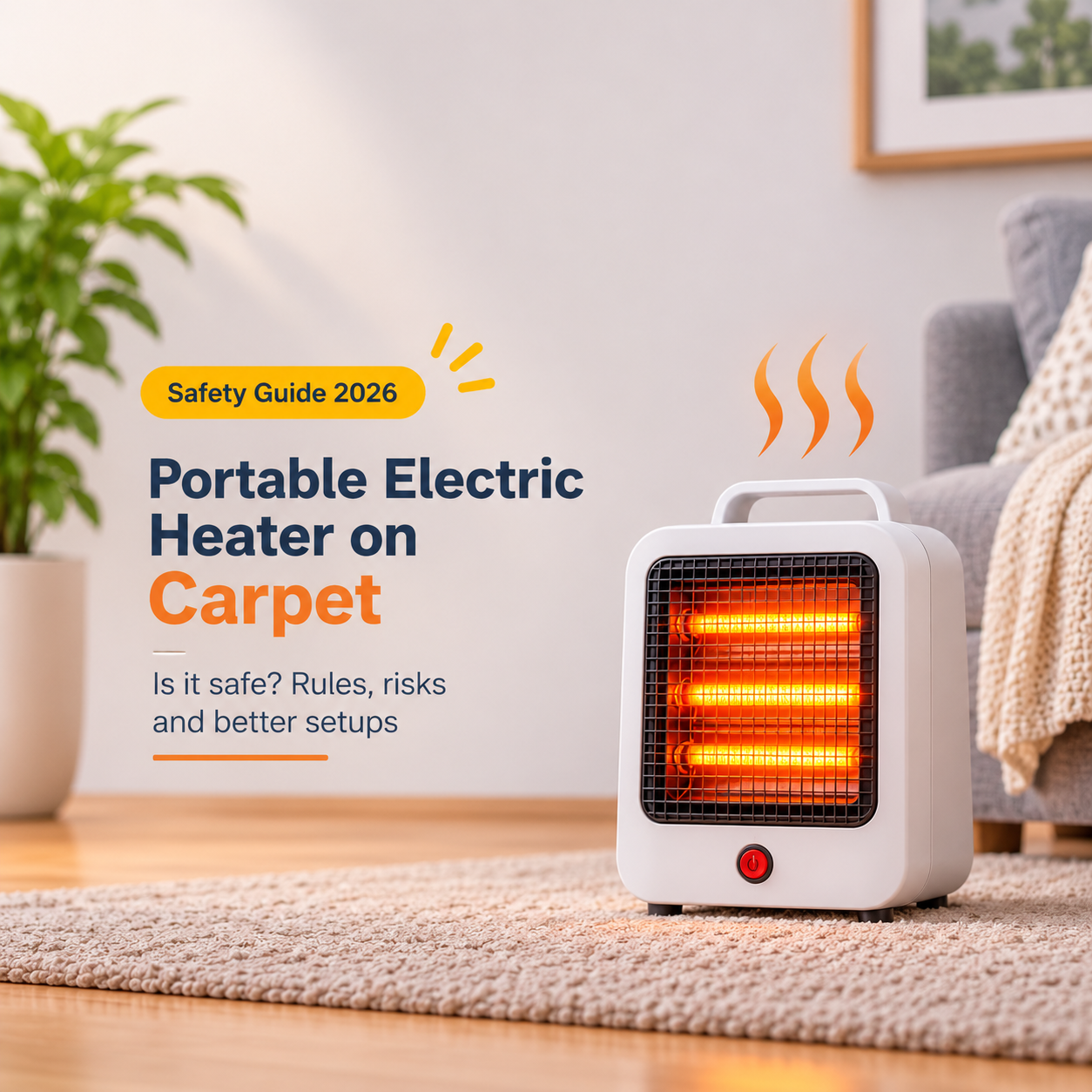
If your home has wall-to-wall carpet or large rugs, you have probably wondered whether you can simply set a heater on the floor and switch it on. It is a very common question, and the safe answer is: usually not. Using a portable electric heater on carpet introduces risks that are easy to avoid with a few smart changes.
This guide explains why heaters and carpet do not mix well, what manufacturers typically say, which heater types are more problematic, and safer ways to heat a carpeted room.
Why Carpet Is a Problem for Portable Heaters
- Instability: Soft pile compresses unevenly, so a heater can wobble, lean or fall, especially tall or light models.
- Airflow blockage: Many heaters have intakes near the base. Carpet fibers, lint and dust can clog them and cause overheating.
- Heat buildup: A heater sitting in carpet pile has less airflow below and may transfer heat to the floor covering.
- Material risk: Synthetic fibers can melt or scorch, and dry, dusty carpet can ignite more easily than a hard floor.
- Safety switch limits: Tip-over protection is designed for a standard hard surface and may not respond consistently on soft ground.
What Do Manufacturers and Safety Groups Say?
Most portable heater manuals tell you to use the heater on a flat, hard, level surface, and many explicitly warn about carpet. Fire safety organizations also recommend keeping a heater at least 3 feet away from anything that can burn, which includes rugs, bedding and curtains. The exact wording varies by brand and model, so your own manual is the final authority.
Does the Heater Type Make a Difference?
| Heater type | Behavior on carpet | Relative risk |
|---|---|---|
| Oil-filled radiator | Heavy, wide base; wheels can sink in | Moderate: stable, but still hot underneath and best on a hard surface |
| Ceramic fan heater | Light and easily tipped; pulls in lint | Higher: low intake can clog with fibers |
| Infrared / quartz | Glowing element, often narrow base | Higher: tilt risk plus intense radiant heat |
| Tower heater | Tall and narrow | Higher: easy to topple on soft surfaces |
| Panel / convection | Flat feet or wall mount | Moderate: wall mounting avoids the issue |
No type is a free pass. Heavier, wider heaters are more stable, but the airflow and heat concerns remain. If you are unsure, assume carpet is not an approved surface.
Safer Ways to Heat a Carpeted Room
1. Use a hard, flat base
Set the heater on a bare section of floor, such as tile, vinyl, laminate or hardwood. In a fully carpeted room, a solid ceramic tile placed on the floor creates a stable, non-combustible base, as long as the heater sits level and the manual allows it.
2. Choose a model that suits the room
Oil-filled radiators with wide bases are more stable than tall, narrow towers. Wall-mounted panel heaters remove the floor problem altogether.
3. Consider a heater designed for table or wall use
Compact heaters meant for desks, or wall-mounted units, can warm a seating area without sitting on the carpet at all, provided the manual approves the placement.
4. Keep a 3-foot clear zone
Remove rugs edges, slippers, blankets, toys and curtains from the area around the heater. Do not drape anything over it.
5. Reduce reliance on the heater
Seal door and window gaps, close doors to keep warmth in, and use thermal curtains kept away from the heater. This lowers how hard the heater has to work.
Safety Checklist for Carpeted Rooms
Heater Features That Matter Most on Soft Floors
- Tip-over shut-off: An important backup, though not a reason to ignore the surface rule.
- Overheat protection: Cuts power if internal temperatures rise too high.
- Wide, sturdy base: Makes accidental tipping less likely.
- Thermostat: Lowers runtime and heat buildup.
- Timer or auto-off: Prevents long unattended use.
- Safety certification: Look for marks like ETL or UL on the product.
Common Mistakes to Avoid
- Placing a heater on a thick, fluffy rug because it is the warmest spot.
- Using an extension cord to reach a carpeted corner.
- Letting pets or children play around the heater.
- Ignoring a burning smell, scorch mark or flickering power.
- Leaving the heater on while asleep or away from home.
Quick Recommendations by Room
| Room | Suggested setup | Why |
|---|---|---|
| Carpeted bedroom | Oil-filled radiator on a ceramic tile, or a wall-mounted panel | Quiet and stable, no airflow under the base |
| Carpeted living room | Wide-base convection heater or wall-mounted unit | Even warmth, lower tipping risk |
| Home office desk area | Compact ceramic heater on a desk or hard surface, if the manual allows | Keeps it off the carpet entirely |
| Kids’ room or playroom | Wall-mounted or other hard-to-reach option, with a safety gate | Reduces contact and tipping risks |
Frequently Asked Questions
Can I put a portable heater on carpet?
Many manufacturers instruct users to place heaters on a hard, flat, level surface, and some manuals specifically warn against carpet or rugs. Check your manual. If it says no carpet, treat that as a firm rule.
Why is carpet unsafe for a heater?
Carpet is soft and uneven, so the heater can tilt or fall. Pile and lint can block intakes, trapping heat, and fabric fibers may scorch or burn if the heater overheats or tips.
Does a tip-over switch make carpet safe?
No. A tip-over switch is a backup. On soft surfaces it might not trigger when expected, and it cannot fix blocked airflow or heat buildup. Do not rely on it as the reason to use a heater on carpet.
Can I use a rug, board or mat under the heater?
Placing a heater on a rug or a loose board is not recommended. A purpose-made, non-combustible heater mat or a ceramic tile set on the floor gives a hard base, but it must still be stable and the heater manual must allow it.
What if my whole room is carpeted?
Use a stable hard surface such as a tile, or choose a wall-mounted heater. Keep a 3-foot clear zone, and consider heaters designed with wide stable bases and strong safety features.
Final Thoughts
A portable electric heater on carpet is not a good idea for most models. Soft flooring makes heaters less stable, can block airflow, and puts a flammable surface right below a hot appliance. Put the heater on a hard, flat, level surface, keep a clear zone around it, follow your manual, and choose a model with strong safety features. Do that, and you can enjoy a warm carpeted room without taking unnecessary risks.
Disclosure: Some affiliate sites earn a commission from qualifying purchases at no extra cost to readers. Add your own disclosure text here as required.