Disclosure: This article is for information. If you buy a product after reading it, the site owner may earn a small commission at no extra cost to you.
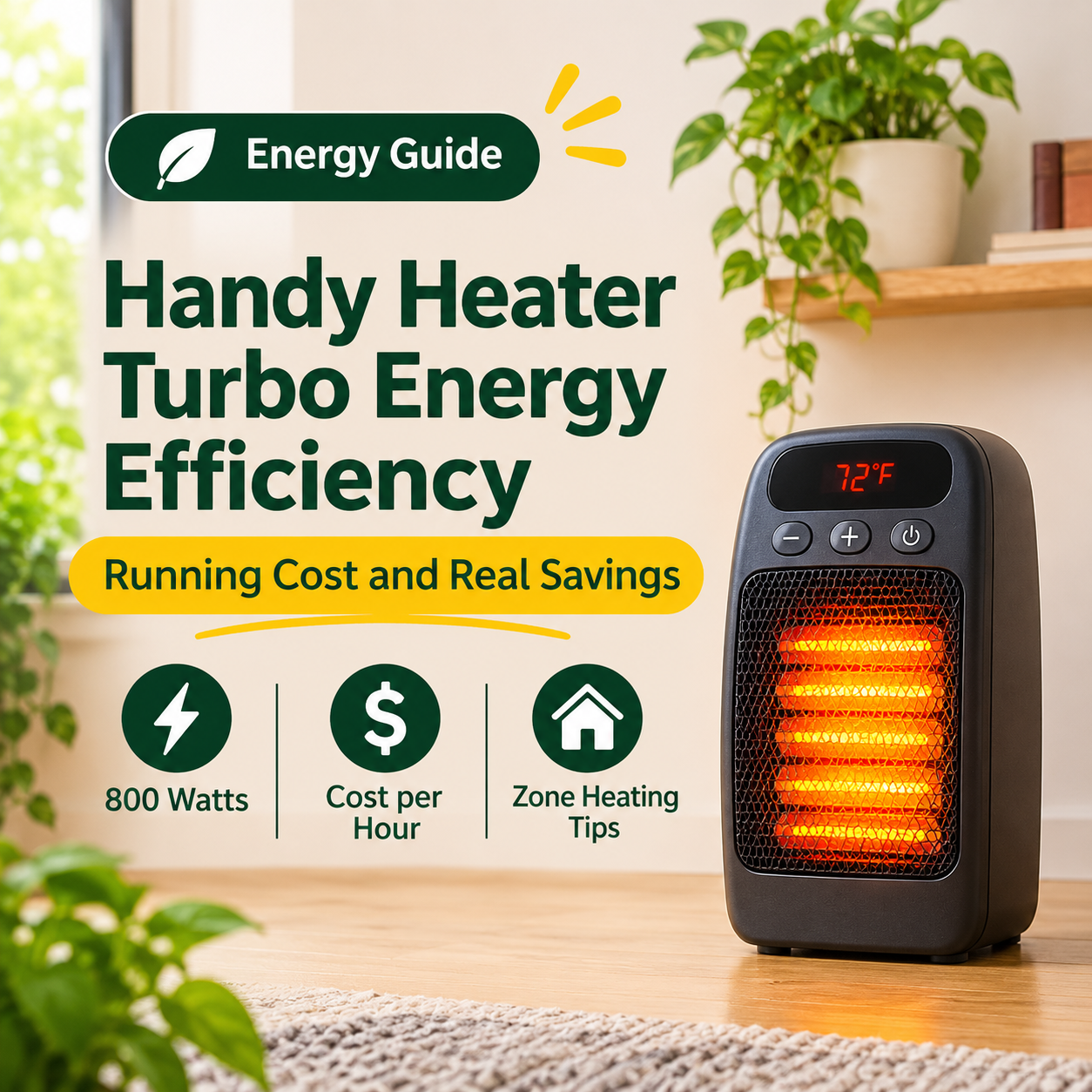
Product pages for the Handy Heater Turbo describe it as powerful and energy efficient. That sounds reassuring when heating bills are high, but what does “energy efficient” actually mean for a small plug-in heater? And will it really save you money?
This guide explains the Handy Heater Turbo energy efficiency claim in plain language, shows what the heater costs to run at different electricity prices, explains when it can reduce your bills and when it cannot, and gives practical ways to use less energy.
What “Energy Efficient” Means for a Space Heater
An electric resistance heater, including ceramic heaters like this one, converts electrical energy into heat at close to 100% efficiency. For every 1 kilowatt-hour (kWh) of electricity it draws, it produces about 3,412 BTU of heat. No electric space heater can do better than that, and none does meaningfully worse, so one brand or type is not inherently more efficient than another.
This is why the phrase “100% efficient” can mislead. It describes how well electricity becomes heat, not how cheaply that heat is made. Electricity is usually more expensive per unit of heat than natural gas, and heat pumps can deliver roughly 2.5 to 3 units of heat for each unit of electricity, so a plug-in resistance heater is not the cheapest way to heat a whole home.
What the Product Claims Actually Tell You
| Claim | What It Really Means |
|---|---|
| “Energy efficient” | True in the sense that all electricity becomes heat, but this is the same for every electric resistance heater |
| “Ceramic heating” | A heating element type that warms up quickly. It does not use less energy for the same heat output |
| “Turbo” | A brand name, not a different efficiency level. Check the manual for how your model uses its fan and heat |
| “800 watts” | The maximum power draw. Lower wattage costs less per hour but produces less heat |
| Adjustable thermostat (60°F–90°F) | A real energy-control feature, because the heater cycles off when the room reaches the target |
| 12-hour timer | A real energy-control feature, because it stops the heater from running longer than you need |
How Much Does the Handy Heater Turbo Cost to Run?
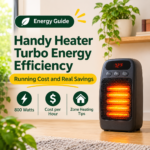
The formula is simple: watts ÷ 1,000 × hours × price per kWh. For an 800-watt heater, that is 0.8 kWh per hour of full-power running. Using an example price of 18 cents per kWh, which is close to recent US residential averages reported for 2026, the cost looks like this:
| Running Time | Energy (Max) | Cost at 18¢/kWh (Max) |
|---|---|---|
| 1 hour | 0.8 kWh | About $0.14 |
| 4 hours | 3.2 kWh | About $0.58 |
| 8 hours | 6.4 kWh | About $1.15 |
| 4 hours a day for 30 days | 96 kWh | About $17.30 |
| 8 hours a day for 30 days | 192 kWh | About $34.60 |
These are maximums, assuming the heater runs at full power the whole time. In a small, well-sealed room the thermostat switches the heater off once the room is warm, so real use is often lower. In a drafty or too-large room the heater may run almost constantly and still not feel warm.
Electricity prices differ a lot. Reported 2026 residential averages range from roughly 11 cents per kWh in some low-cost states to well above 28 cents in some regions and over 40 cents in Hawaii. Check the “price per kWh” or “energy charge” on your own bill for the most accurate figure.
When a Small Heater Can Actually Save Money
The one situation where a small electric heater can lower your bill is zone heating: heating only the room you are using while you turn down the central heating for the rest of the home. If your whole house is being heated to keep one office comfortable, a small heater in that office plus a slightly lower central setting may cost less.
- You spend long periods in a single small room, such as a home office.
- You can lower the central thermostat for the unused parts of the home.
- The room is small and reasonably well insulated, so 800 watts is enough.
- You turn the heater off when you leave.
When It Will Not Save Money
- Heating a large or open room: 800 watts is not enough, so the heater runs constantly and the room still feels cold.
- Running several plug-in heaters to heat a whole home: electric resistance heat is usually the most expensive common way to heat per unit of heat.
- Leaving it on in an empty room: you pay for heat nobody feels.
- Using it in a drafty room: heat escapes as fast as it is produced.
- Keeping the thermostat at 90°F: it does not heat faster, it only keeps the heater running longer.
If you have cheap gas heating, or a heat pump, heating your whole home with that system is often cheaper per unit of heat than electric resistance heaters. Compare based on your own local prices.
Efficiency Features You Can Actually Use
Adjustable Thermostat
The thermostat from 60°F to 90°F is your main energy control. Lower settings mean the heater cycles off sooner. For most small rooms, 68°F to 70°F is comfortable, and layering clothing lets you go lower.
12-Hour Timer
Use the timer to match the heater to the time you need it, for example a 3-hour work session. The heater switches off at the end, which prevents wasted energy when you forget.
Auto Shut-Off Functions
The heater includes automatic shut-off if it overheats and tip-over protection. These are safety features first and energy features second, but they also stop the heater from continuing to draw power in those situations.
The 90°F Reset: An Easy Way to Waste Energy
The manual states that after a power interruption the temperature may default to 90°F. If you do not notice, the heater may keep running at a much higher target than you intended. Always check the display after a power cut.
10 Ways to Use Less Energy
- Match the heater to the room. About 80 to 100 square feet is a sensible limit for 800 watts.
- Close the door. Do not heat the corridor.
- Block drafts. A draft stopper and sealed window gaps reduce heat loss.
- Use thermal curtains. Keep them well away from the heater.
- Layer up. A sweater and warm socks let you set a lower temperature.
- Set a sensible temperature. 68°F to 70°F works for most people.
- Use the timer. Choose the hours you need.
- Lower the central heating in rooms you are not using, but not so low that pipes could freeze.
- Switch off and unplug when you leave the room or go to bed.
- Keep vents clean. Dust-free vents help the heater work as intended and avoid overheating shut-offs.
Efficient Does Not Mean Powerful Enough
A low-wattage heater costs less per hour, but it produces proportionally less heat. A common rule of thumb is about 10 watts per square foot, so an 800-watt heater suits around 80 square feet. Retail pages sometimes claim up to about 250 square feet in ideal conditions, and independent consumer testing in Australia found that a version of this heater delivered far less heat than its advertising suggested. If the heater cannot bring the room to a comfortable temperature, you spend money without getting comfort, so the right size matters more than any efficiency label.
How It Compares With Other Heating Options
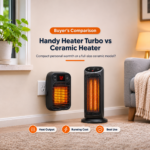
| Option | Relative Cost per Unit of Heat | Best For |
|---|---|---|
| Handy Heater Turbo (800 W resistance) | Same as any electric resistance heater | A very small room you are using |
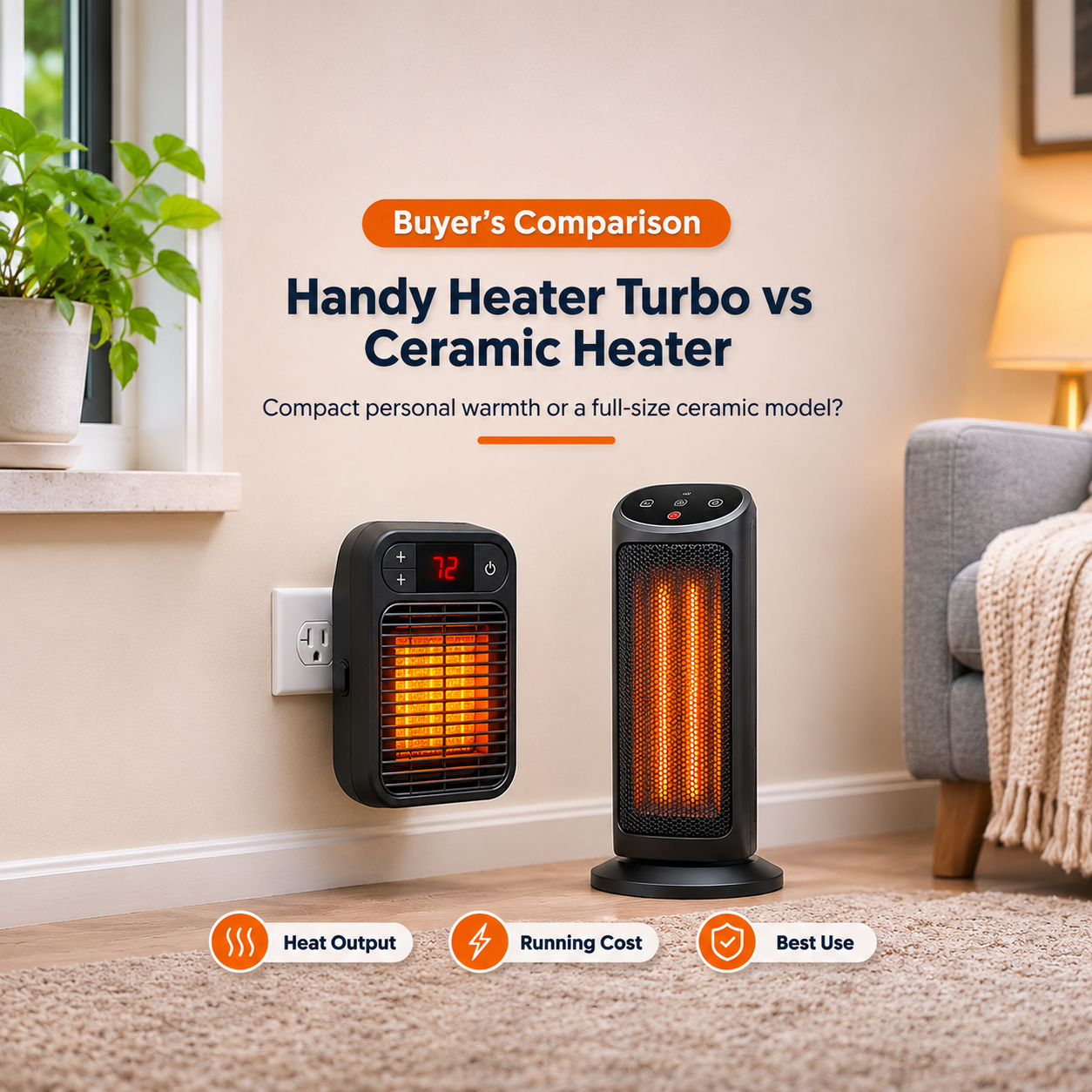
| Larger electric space heater (1,500 W) | Same per unit of heat; higher cost per hour | Medium rooms for short periods |
| Oil-filled electric radiator | Same per unit of heat; heat lingers after switch-off | Steady heat in a small to medium room |
| Heat pump or mini-split | Often much lower, since it moves heat | Regular heating of rooms or the whole home |
| Gas central heating | Often lower than electric at typical gas prices | Whole-home heating where available |
If you spend most of your winter heating the same room, a more efficient permanent system, or better insulation, can pay off over time more than a small plug-in heater. A qualified heating professional can advise on options for your home.
What to Look For If You Want to Lower Your Heating Costs
- The right wattage for your room, not the highest or lowest number.
- An accurate adjustable thermostat so the heater cycles off at the right time.
- A programmable timer to limit running hours.
- Recognised safety certification such as UL, ETL or CSA, with overheat and tip-over protection.
- A design that suits your outlet and space, including enough clearance for safe use.
- Better insulation and draft-proofing, which cut heat loss for any heater.
Frequently Asked Questions
Is the Handy Heater Turbo energy efficient?
It converts essentially all the electricity it uses into heat, as every electric resistance heater does. That does not make it cheaper to run than other electric heaters, but its thermostat and timer help you avoid wasted energy.
How much electricity does it use?
Up to 0.8 kWh per hour at full power, because it is an 800-watt heater. The thermostat reduces actual use once the room reaches the target.
How much does it cost to run per hour?
About 14 cents per hour at full power at 18 cents per kWh. Multiply 0.8 by your own price per kWh for a precise figure.
Will it lower my heating bill?
It can, but only if you use it for zone heating: warming a small room you are in while lowering the central heating for other rooms. It will not lower your bill if it is added on top of normal heating, or used to warm a room that is too large.
Does the thermostat save energy?
Yes. The heater cycles off when the room reaches the set temperature, so a lower setting means less running time.
Does setting a higher temperature heat the room faster?
No. It only makes the heater run longer before switching off.
Is it cheaper than central heating?
Usually not per unit of heat. Electric resistance heat tends to cost more than gas or heat pump heating, so the savings come from heating less space, not from the heater being cheaper per unit of heat.
Does it use power when it is switched off?
A plugged-in appliance with a display may draw a small amount of standby power. Unplugging it when not in use is good practice for both energy and safety.
Is a ceramic heater more efficient than an oil-filled heater?
Not in terms of converting electricity to heat. Both convert nearly all electricity to heat. They differ in how quickly they warm up and how they deliver warmth.
Final Thoughts
The Handy Heater Turbo is not magic when it comes to energy saving. It is an 800-watt resistance heater, so it turns electricity into heat as well as any other electric heater, and no better. Its value is that it is small, cheap to run per hour and has a thermostat and timer, which make it a decent tool for zone heating a very small room you are using. Keep expectations realistic, size the room correctly, block drafts, use the timer, and switch it off when you leave. If you need to heat larger spaces regularly, compare more efficient permanent options for your home.
Electricity prices and running costs vary by location and change over time. Figures here are examples based on rounded reported averages. Features and instructions can vary by version and region, so follow the manual supplied with your heater. This article is general information, not professional energy, electrical or fire-safety advice.