Disclosure: This article is for information. If you buy a product after reading it, the site owner may earn a small commission at no extra cost to you.
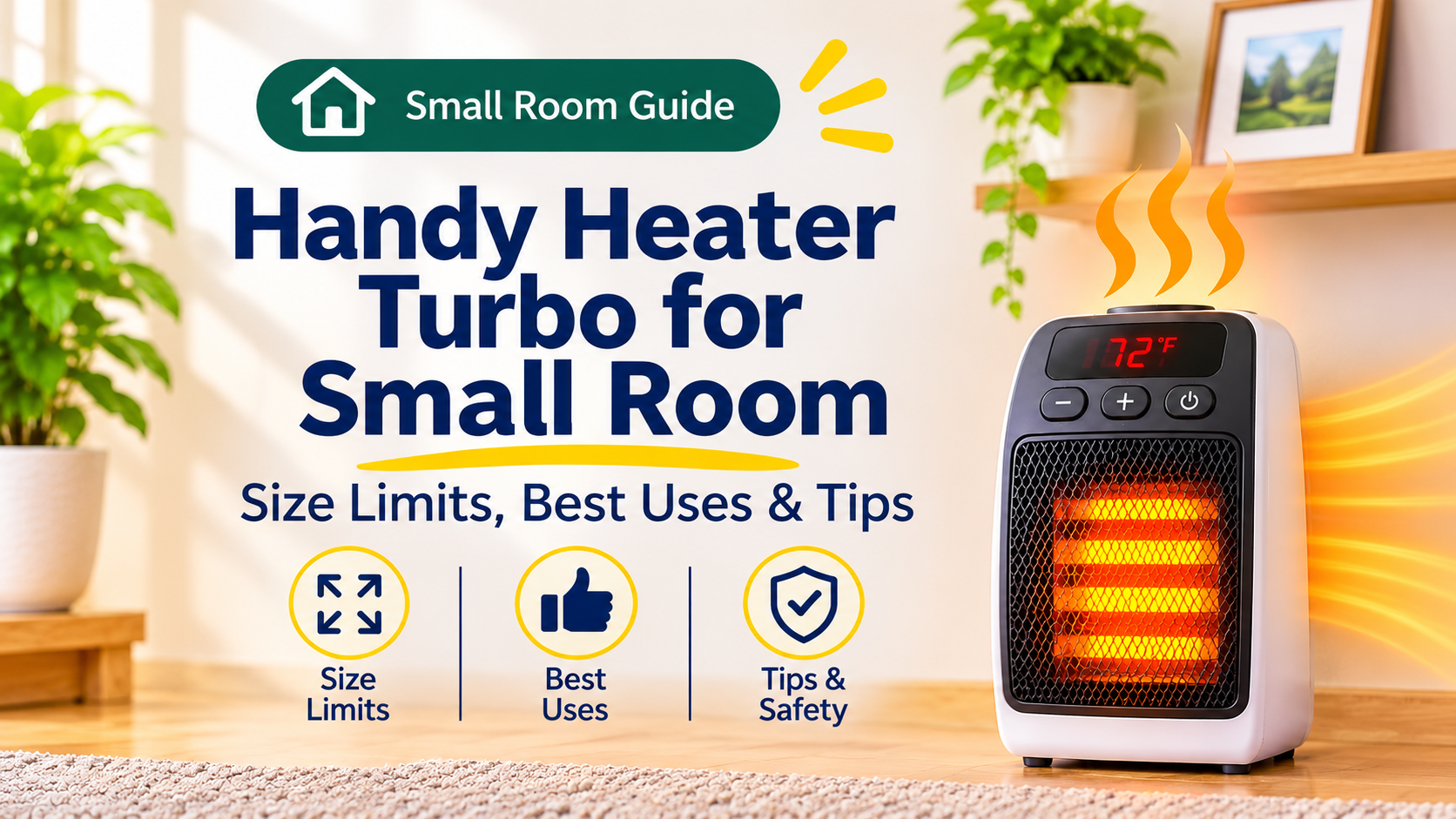
Small heaters are easy to buy and easy to misjudge. A tiny home office or a cold reading corner does not need a big, expensive heater, yet a heater that is too weak will leave you disappointed. If you are weighing the Handy Heater Turbo for a small room, this guide tells you how small is small enough, which rooms it suits, where to place it, how to get more warmth from its 800 watts and which safety rules matter most in tight spaces.
Why a Plug-In Heater Suits Small Rooms
- No floor space used: it plugs into the wall, which matters in a room where every square foot counts.
- Small heat demand: a small volume of air warms quickly compared with a large space.
- Adjustable thermostat (60°F to 90°F): it cycles on and off to hold the temperature you choose.
- 12-hour timer: useful for work sessions, as the heater switches off when time ends.
- Safety features: overheat shut-off and tip-over protection are described in the manual and listings, and retailers state it is ETL listed.
- Low cost: it is an inexpensive way to try supplemental heat before investing in something larger.
How Small Is “Small Enough”?
The Handy Heater Turbo 800 is rated at 800 watts. A widely used rule of thumb is about 10 watts of heating per square foot of floor space, which means 800 watts suits roughly 80 square feet. Some retail pages say it can warm up to about 250 square feet in ideal conditions, but that depends on good insulation and mild weather. Independent consumer testing in Australia found that a version of this heater delivered far less heat than its advertising suggested, so plan conservatively.
| Room Size | Example | What To Expect |
|---|---|---|
| Up to 64 sq ft | 8 x 8 ft closet or tiny office | Likely to feel noticeably warmer |
| 65–80 sq ft | 8 x 10 ft study or nook | Reasonable with the door closed |
| 81–100 sq ft | 10 x 10 ft small room | Borderline; needs good insulation and mild weather |
| Over 100 sq ft | 12 x 12 ft or larger | Likely to feel only slightly warmer |
Ceiling height, windows, outside walls and draughts also matter. A small room with a large window or an uninsulated outside wall can lose heat faster than an 800-watt heater supplies it.
Best Small-Room Uses
Home Office or Study
This is the classic use case. You sit still for hours, you are present to monitor the heater, and the room is usually small. Set the thermostat around 70°F, use the timer for your work block, and keep paper and cables outside the 3-foot zone.
Reading Nook or Craft Corner
A small, enclosed corner heats quickly. Choose an outlet with open floor space and keep fabric, yarn and paper well away from the heater.
Dressing Room or Walk-In Closet
For short, supervised warm-ups before you get dressed. Remember that clothes are combustible, so keep hanging clothing and stored fabric at least 3 feet from the unit.
Entryway or Small Utility Nook
Useful for a small, dry indoor entry space. Do not use it where the floor or outlet may get wet, and do not use it to dry clothes or shoes.
Small Spare Room
Pre-warm the room while you are awake and in the home, then switch it off. Safety authorities advise against leaving any space heater on while you sleep.
Rooms Where You Should Not Use It
- Bathrooms and laundry rooms: the manual says not to use the heater anywhere water may be present, even though some retailers promote bathroom use. Follow the manual.
- Children’s rooms and nurseries: safety guidance advises against space heaters where children may knock them over or touch the hot grille.
- Garages, workshops and basements: these are usually too large, cold and drafty, and may contain flammable materials.
- Open-plan or large rooms: 800 watts will not make a meaningful difference.
- Any room where the outlet is behind furniture, curtains or bedding.
Also check your own rules. Some dormitories, rental agreements and workplaces restrict space heaters, so confirm before you plug one in.
The Clearance Challenge in Small Rooms
The manual requires 3 feet (0.9 m) of clear space around the heater, and consumer-safety authorities give the same rule for bedding, drapes and furniture. In a small room this is harder than it sounds, because furniture is packed in and the outlet may be low behind a desk. If you cannot keep 3 feet clear of fabric, paper and furniture, this heater is not suitable for that outlet.
- Do not use an extension cord or power strip to reach a better position. The manual says to plug directly into a wall outlet.
- Rotate the plug so the heater sits upright and fits snugly.
- Check that the plug and outlet do not feel warm after a while.
How to Get More Warmth From 800 Watts
- Close the door: Heat leaks fast into corridors.
- Block drafts: A draft stopper under the door and sealing gaps around windows can make a noticeable difference.
- Use thermal curtains: They cut heat loss through glass. Keep them well away from the heater.
- Add a rug on a cold floor: It helps warmth at foot level. Keep it outside the 3-foot zone around the heater.
- Dress for the room: Layers allow a lower thermostat setting, which saves energy.
- Do not set the thermostat to 90°F to heat faster. The heater produces the same power regardless. A higher setting just makes it run longer.
Best Settings for a Small Room
| Use | Thermostat | Timer |
|---|---|---|
| Home office work session | 68°F–72°F | 2–4 hours |
| Reading or hobby time | 66°F–70°F | 1–3 hours |
| Quick warm-up before use | 70°F–72°F | 30–60 minutes |
| Energy saving | 62°F–66°F | As needed |
After any power cut, check the display. The temperature may default to 90°F after power returns, according to the manual.
Running Cost in a Small Room
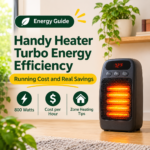
An 800-watt heater uses at most 0.8 kWh per hour while the element is on. At an example electricity price of $0.16 per kWh, that is about $0.13 per hour at most, or about $0.51 for a 4-hour work session if it runs the whole time. Because the thermostat cycles, real cost is often lower. A small, well-sealed room benefits most, because the heater switches off sooner once the target temperature is reached.
Pros and Cons for Small Rooms
| Pros | Cons |
|---|---|
| Compact and takes no floor space | Only 800 watts, so it suits very small rooms |
| Adjustable thermostat and 12-hour timer | Not a whole-room heater |
| Overheat shut-off and tip-over protection | Depends on a good, correctly placed wall outlet |
| Low upfront cost | 3-foot clearance is hard in cramped rooms |
| Quiet operation | Consumer testing raised concerns about heat output and plug fit |
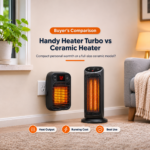
How It Compares With Other Small-Room Options
| Type | Best For | Consider |
|---|---|---|
| Plug-in wall heater (Handy Heater Turbo) | Very small, dry rooms; no floor space needed | Low output; depends on outlet position and condition |
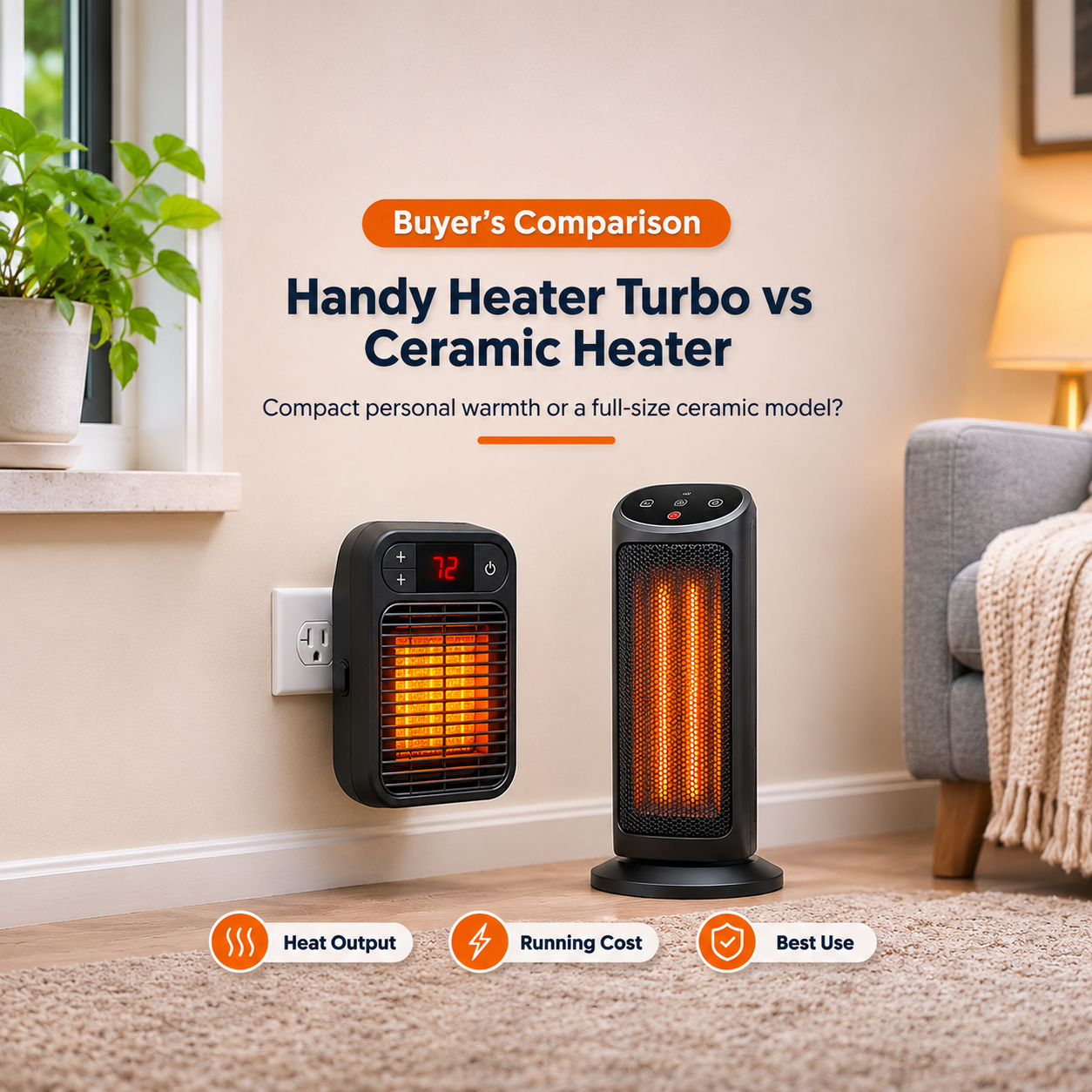
| Small ceramic heater with a cord | Desks and flexible placement | Takes a little floor or desk space; check certification and tip-over protection |
| Mini oil-filled radiator | Steady, quiet warmth in a small room | Slower to warm up; heavier |
| Compact tower heater | Slightly larger small rooms | Larger footprint |
If your room is near the upper size limit, or you want to position a heater away from the outlet, a corded heater with recognised safety certification (UL, ETL or CSA), overheat protection and tip-over protection may suit you better.
Safety Essentials for Small Rooms
- Plug directly into a 120V wall outlet. No extension cords, power strips or surge protectors.
- Keep 3 feet clear of furniture, curtains, bedding, paper, clothing and pets.
- Do not touch the front grille while the heater is on.
- Do not use it in damp rooms, and keep it away from water.
- Switch it off and unplug it when you leave the room, and before you sleep.
- If the plug or outlet is hot, discolored or smells of burning, stop using the heater.
Frequently Asked Questions
Is the Handy Heater Turbo good for a small room?
Yes, for a very small, dry indoor room of up to about 80 to 100 square feet when you are present and can keep the area around it clear. It is not suited to larger rooms.
How many square feet can it heat?
A common rule of thumb for 800 watts is about 80 square feet. Retailer claims go up to around 250 square feet, but this is a best case and depends on insulation and weather.
Can I use it in a small bathroom?
No. The manual says not to use it in bathrooms, laundry rooms or anywhere water may be present.
Can it be my main heater in a small room?
It can supplement heating in a very small, insulated room, but it is not designed to replace proper home heating in cold weather.
What temperature should I set?
For most small rooms, 68°F to 72°F while you are in the room. A higher setting does not heat faster.
Does it heat the room quickly?
A small, closed room warms faster than a large one, but results vary with insulation, outdoor temperature and room size. Closing the door and blocking drafts helps.
Can I use it in a dorm room?
Check the building rules first. Many dormitories and rentals restrict space heaters. If it is allowed, follow the same clearance and outlet rules.
Can I leave it on when I leave the room?
No. Turn it off and unplug it when you leave the room, and never leave it running while you sleep.
What if my outlet is behind the desk?
Then this heater is not a good choice for that outlet. It needs 3 feet of clearance and cannot be used with an extension cord.
Final Thoughts
The Handy Heater Turbo is a sensible little heater for a very small, dry room where you want a bit of extra warmth and can keep the outlet area clear. Measure the room first: if it is about 80 square feet or smaller, it can work well, and if it is much bigger, 800 watts will probably disappoint you. Seal drafts, set the thermostat at a sensible temperature, follow the safety rules and keep expectations realistic. If your space is larger, or the outlet is awkwardly placed, a corded heater with a recognised safety certification will serve you better.
Features and instructions can vary by version and region. Always follow the manual supplied with your heater and the guidance of fire-safety authorities. This article is general information, not professional electrical or fire-safety advice.