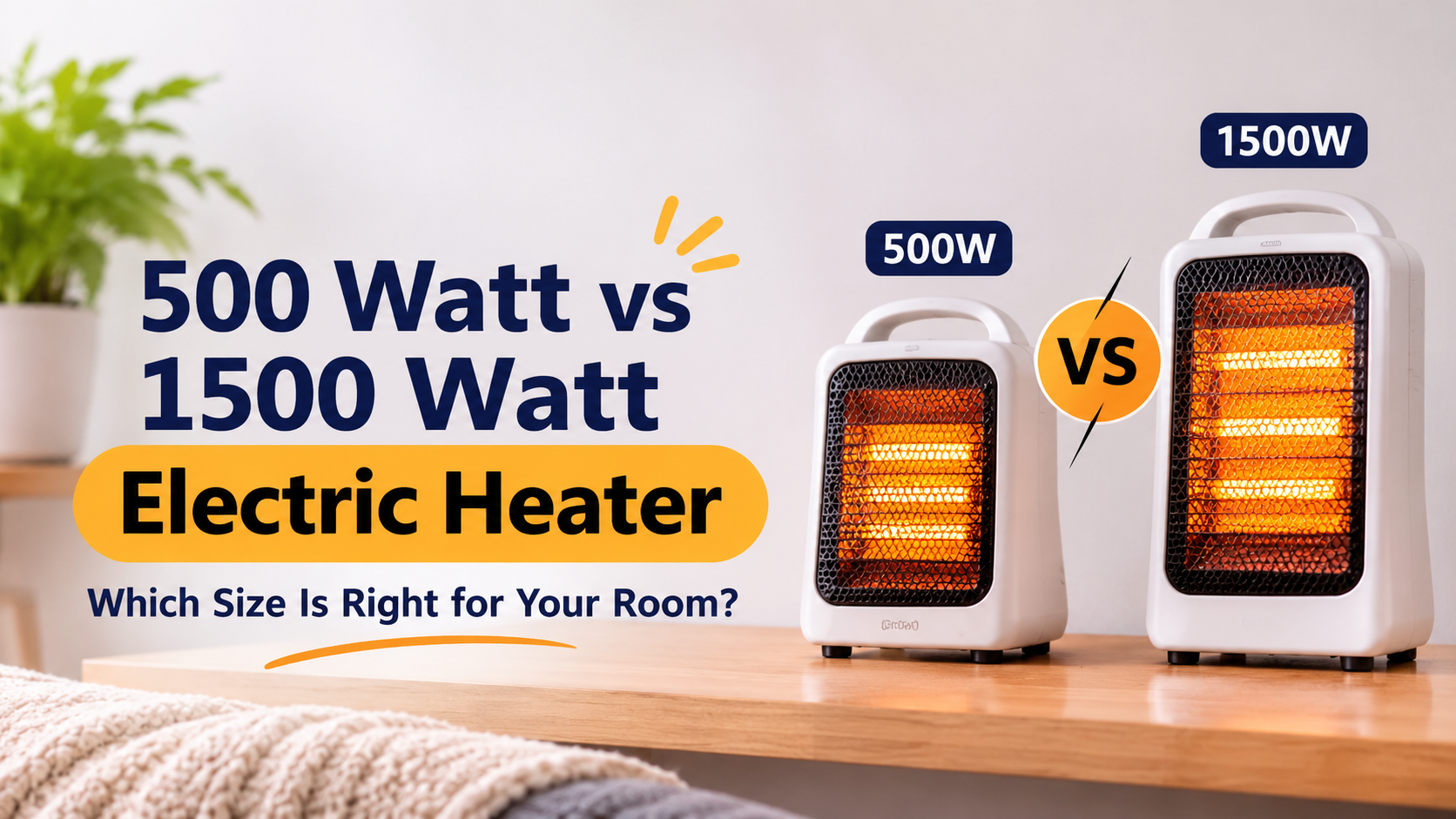




500 Watt vs 1500 Watt Electric Heater: Which One Should You Buy?
Walk into any store or scroll through any online listing and you will see electric heaters sold in a handful of wattages. The two that cause the most confusion are the small 500 watt models and the powerful 1500 watt models. Both plug into a wall outlet. Both turn electricity into heat. Yet they behave very differently in a real room, on a real electricity bill and on a real circuit breaker.
In this 500 watt vs 1500 watt electric heater comparison, we break down heat output, room coverage, running cost, electrical load, safety and everyday comfort. By the end you will know exactly which size fits your space, so you do not waste money on a heater that is too weak or too hungry.
Quick answer
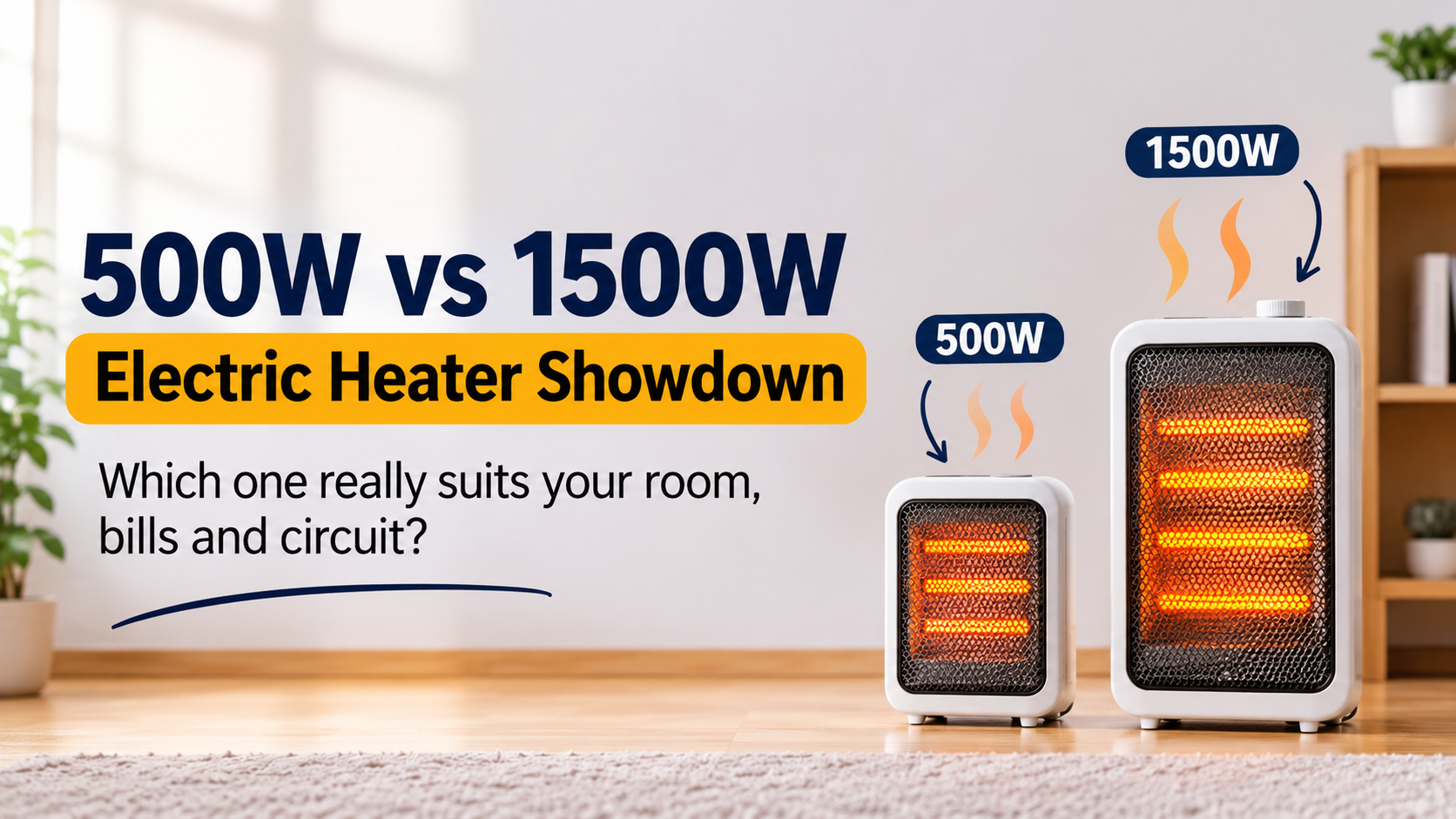
Choose a 500W heater for a desk, small bathroom or a space under about 50 square feet. Choose a 1500W heater for a bedroom, living room or office up to about 150 square feet. If you only need to warm yourself, 500W is cheaper. If you need to warm the air in a room, 1500W is the realistic option.
What Does Heater Wattage Actually Mean?
Wattage is the rate at which a heater uses electricity. Almost all of that electricity ends up as heat, because an electric resistance heater is close to 100% efficient at turning power into warmth. That means a 1500W heater produces roughly three times the heat of a 500W heater, regardless of brand, price or design.
One watt of power produces about 3.41 BTU of heat per hour. Using that conversion:
- 500W is about 1,700 BTU per hour.
- 1500W is about 5,100 BTU per hour.
Because the efficiency is nearly identical, the real differences come down to how much space each heater can warm, how fast it does the job and how much power it pulls from your home.
500W Electric Heater: Overview
A 500 watt heater is a personal heater. It is designed to take the chill off a small zone, not to change the temperature of a whole room. You will find 500W units in ceramic desk heaters, mini fan heaters, small oil-filled radiators and some bathroom or under-desk panels.
Where a 500W heater works best
- Under a desk to keep your feet and legs warm while you work.
- In a small bathroom or toilet room for short bursts of warmth.
- Next to a reading chair or bedside table.
- In a tiny office, storage room or sunroom corner.
- As a gentle top-up in a room that is already mildly warm.
Pros of 500W
- Very low running cost per hour
- Draws only about 4 amps on a 120V outlet, so it is easy on circuits
- Compact, light and easy to move between rooms
- Usually quiet, especially oil-filled or ceramic panel types
- Lower fire risk because of lower heat density
Cons of 500W
- Cannot warm a medium or large room
- Slow to make a noticeable difference in cold weather
- Best used close to you, so it heats a person rather than a space
1500W Electric Heater: Overview
A 1500 watt heater is the standard full-size portable heater, and 1500W is the maximum most manufacturers allow for plug-in models on a regular household outlet. It is what you will see in most oil-filled radiators, ceramic tower heaters, fan heaters and infrared cabinet heaters.
Where a 1500W heater works best
- Bedrooms and kids rooms in cold climates.
- Living rooms, home offices and dens up to about 150 square feet.
- Garages or workshops that are insulated and small.
- Spaces without central heating or with a weak heating zone.
- Situations where you want the room warm quickly.
Pros of 1500W
- Heats a whole small to medium room
- Reaches a comfortable temperature much faster
- Often comes with thermostat, timer, remote and multiple heat settings
- Better value per BTU than buying three small heaters
- Can serve as the primary heat source in a cold room
Cons of 1500W
- Costs about three times more per hour to run
- Draws around 12.5 amps on a 120V outlet, close to a circuit limit
- Needs a dedicated outlet and no extension cord
- Fan models can be louder
500W vs 1500W: Side-by-Side Comparison
| Feature | 500W Heater | 1500W Heater |
|---|---|---|
| Heat output | about 1,700 BTU/hr | about 5,100 BTU/hr |
| Recommended room size | up to 50 sq ft | up to 150 sq ft |
| Current at 120V | about 4.2 A | about 12.5 A |
| Current at 230V | about 2.2 A | about 6.5 A |
| Cost per hour at $0.16/kWh | about $0.08 | about $0.24 |
| Warm-up speed | Slow, local warmth | Fast, whole room |
| Typical noise | Very quiet to quiet | Quiet to moderate |
| Best for | Desk, bathroom, nook | Bedroom, living room, office |
| Needs a dedicated outlet? | Usually not | Strongly recommended |
Room Size: How Big a Space Can Each Heater Warm?
The simplest sizing rule is 10 watts per square foot of floor area, assuming a standard 8 foot ceiling and average insulation. Under that rule, a 1500W heater covers around 150 square feet, which is a room of about 12 by 12 feet. A 500W heater covers roughly 50 square feet, about 7 by 7 feet.
Adjust the numbers for your situation. You may need more power if the room has any of the following:
- High ceilings above 8 feet.
- Poor insulation, single-pane windows or drafty doors.
- An exterior-facing wall, a garage floor or an unheated basement below.
- A very cold climate where the outdoor temperature drops far below freezing.
On the other hand, a well-insulated room that already stays mildly warm may need less. If you are not sure, a 1500W heater with an adjustable thermostat is the safer choice because it can lower its output when the room reaches the temperature you set.
Running Cost: How Much Do They Really Cost?
Electric heaters are priced in kilowatt-hours (kWh). Here is the formula so you can calculate your own cost:
Running cost formula
Heater kW x hours used x your price per kWh = cost. A 500W heater is 0.5 kW and a 1500W heater is 1.5 kW.
Using an example rate of $0.16 per kWh:
- 500W: 0.5 kW x $0.16 = about $0.08 per hour, or $0.64 for an 8 hour day.
- 1500W: 1.5 kW x $0.16 = about $0.24 per hour, or $1.92 for an 8 hour day.
These are worst-case numbers, because they assume the heater runs at full power the entire time. In practice, a heater with a thermostat cycles on and off once the room is warm, so your real bill is usually lower. A 1500W heater in a small, well-sealed room may run at full power for only part of each hour, while a 500W heater in the same room may never catch up and run constantly.
This is an important point many buyers miss: a bigger heater is not always more expensive to heat a room. A 1500W heater may heat the room in 30 minutes and then cycle off, while a 500W heater may run all night and still leave the room cool. Cost per hour is lower for 500W, but cost per degree of comfort depends on the room.
Remember that electric rates differ widely by country, city and time of day, so replace $0.16 with the rate on your own bill.
Electrical Load and Safety
This is where the difference between 500W and 1500W matters most. A standard 15 amp household circuit at 120V can supply up to 1,800 watts, but safety guidelines recommend keeping a continuous load to about 80% of that, or roughly 1,440 watts. A 1500W heater sits right at that limit by itself, so anything else on the same circuit can trip the breaker.
Safety rules for 1500W heaters
- Plug directly into a wall outlet. Avoid extension cords and power strips.
- Do not run other high-power devices (hair dryer, microwave, space heater) on the same circuit.
- If the plug or outlet feels hot, stop using it and have an electrician check the outlet.
- In countries with 220V to 240V supply, the current is much lower (about 6.5 A), but the same cord and outlet rules apply.
A 500W heater, at about 4 amps, is much more forgiving. You can usually run it alongside lights, a laptop and a TV without any trouble. That makes it a good choice for older homes, rentals with outdated wiring and shared circuits.
Safety features to look for on any heater
- Tip-over switch that cuts power if the heater falls.
- Overheat protection that shuts off the element if it gets too hot.
- Adjustable thermostat so the heater does not run endlessly.
- Cool-touch housing if you have children or pets.
- Recognized safety certification such as UL, ETL, CE or the standard that applies in your country.
- Timer or auto shut-off for overnight use.
Noise, Portability and Features
Noise: Oil-filled and ceramic panel heaters are nearly silent, whether 500W or 1500W. Fan heaters are the noisiest, and 1500W fan models are usually louder than 500W fan models because they move more air. If you plan to use the heater in a bedroom or a quiet office, choose a silent oil-filled or infrared type.
Portability: 500W heaters are typically small and light enough to carry with one hand. A 1500W oil-filled radiator can weigh 20 pounds or more, although most have wheels. Tower and fan heaters at 1500W are lighter than oil-filled models.
Features: Smaller 500W heaters tend to be basic, often with a simple on/off switch. Most 1500W heaters offer extras such as multiple power settings (for example 600W, 900W and 1500W), digital thermostats, remote controls, oscillation and timers. Those settings make a 1500W model flexible enough to act like a smaller heater when you do not need full power.
Which One Should You Choose?
Choose a 500W heater if:
- You only need to warm yourself at a desk or in a chair.
- Your room is under about 50 square feet.
- Your outlet or circuit is shared or old.
- You want the lowest possible running cost.
- You need something small and quiet for a dorm, cubicle or bathroom.
Choose a 1500W heater if:
- You want to warm an entire bedroom, living room or home office.
- Your room is between 50 and 150 square feet.
- You have a dedicated outlet that can handle the load.
- You want the room warm quickly on cold mornings and nights.
- You prefer thermostat control, a timer and multiple heat settings.
What if your room is bigger than 150 square feet?
A single portable heater is rarely enough. Consider two 1500W heaters on separate circuits, a higher-capacity wall-mounted unit installed by an electrician, or a different heating solution such as a heat pump. Never plug two high-wattage heaters into the same outlet or circuit.
Buying Checklist for Electric Heaters
- Measure your room in square feet and note the ceiling height.
- Decide whether you need personal warmth (500W) or room heating (1500W).
- Pick a type: oil-filled for quiet steady heat, ceramic or fan for fast heat, infrared for direct warmth.
- Check for a tip-over switch, overheat protection and a safety certification.
- Look for an adjustable thermostat and a timer to control running cost.
- Confirm the cord length and plug type, and plan to use a wall outlet directly.
- Read the warranty and customer reviews, especially notes on durability and noise.
Common Mistakes to Avoid
- Buying too small: a 500W heater cannot warm a whole bedroom, and you will end up running it all night with little effect.
- Using an extension cord: heaters draw high current, and ordinary cords can overheat.
- Placing it near curtains, bedding or furniture: keep at least 3 feet of clear space on all sides.
- Ignoring the thermostat: without it, the heater keeps drawing full power and wastes electricity.
- Leaving it on unattended: turn it off when you leave the room or go to sleep unless the model is designed and rated for safe overnight use.
Frequently Asked Questions
Is a 1500W heater three times more expensive than a 500W heater?
Per hour of full-power running, yes. A 1500W heater uses three times the electricity. However, a thermostat-controlled 1500W heater may switch off sooner once the room is warm, so the real difference over a day is often smaller than three times.
Can a 500W heater warm a bedroom?
It can only take the edge off a very small or well-insulated bedroom. For a typical bedroom of 100 to 150 square feet, a 1500W heater is the more realistic choice, or a 500W heater placed close to the bed as a personal heater.
Can I plug a 1500W heater into a regular outlet?
Yes, 1500W heaters are designed for standard household outlets, but you should plug directly into the wall and avoid sharing the circuit with other high-power devices. If the breaker trips or the plug gets hot, stop using it and consult an electrician.
Is it safe to leave an electric heater on overnight?
Only if it is designed for it and has features such as a tip-over switch, overheat protection and a thermostat. Oil-filled radiators are often preferred for overnight use because of their lower surface temperature and steady output. Always follow the manufacturer’s instructions.
Do 1500W heaters use more electricity than 500W heaters?
At full power, yes. A 1500W heater consumes 1.5 kWh per hour, while a 500W heater consumes 0.5 kWh per hour.
Which is better for a bathroom, 500W or 1500W?
A 500W heater is usually enough for a small bathroom and is lower in cost. For a larger bathroom, choose a model made for bathrooms with appropriate water and moisture protection, and never place a portable heater where it can contact water.
Does a higher wattage heater heat the room faster?
Yes. Because it produces more heat each hour, a 1500W heater raises the room temperature much faster than a 500W heater, as long as the room size and insulation are the same.
Final Verdict: 500 Watt vs 1500 Watt Electric Heater
The 500 watt electric heater is the smart pick for personal warmth. It is cheap to run, gentle on your wiring and perfect for desks, bathrooms and tiny spaces. The 1500 watt electric heater is the right tool when you want to warm a real room. It heats quickly, offers better features and can serve as a main heat source, but it demands a proper outlet and costs more per hour to run.
Measure your room, check your circuit, think about how you will use the heater and pick the wattage that matches. Do that, and you will stay warm without overspending or overloading your home.
Note: Figures in this article are estimates for general guidance. Actual heat output, room coverage and running cost depend on your room, insulation, climate and local electricity rates. For wiring concerns, consult a licensed electrician.