






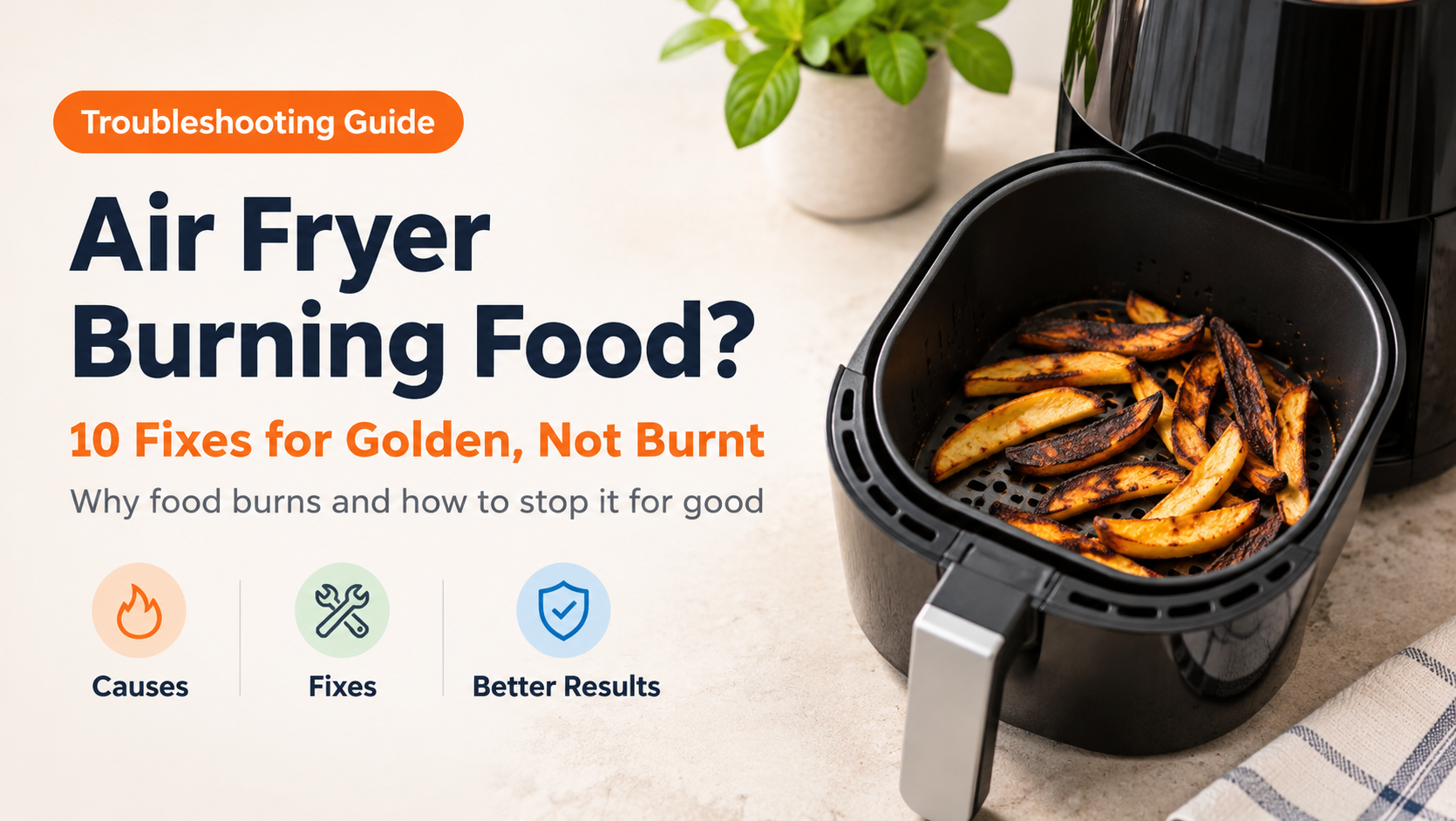

You were expecting crispy and golden. Instead, you pull out the basket to find food that is dark, bitter, or charred on the edges. When an air fryer is burning food, it is tempting to blame the appliance, but most of the time the cause is a handful of settings and habits that are easy to correct.
Air fryers cook very differently from ovens. They are small, powerful, and heat from above with a fast fan, so food can go from perfect to burnt in a minute or two. In this guide you will learn why food burns, how to fix it step by step, how to handle burnt smells and smoke, and when the problem may be the air fryer itself.
Quick Answer: Why Is My Air Fryer Burning Food?
An air fryer usually burns food because the temperature is too high, the cooking time is too long, the food is piled too close to the heating element, or it is coated in sugary sauces or marinades that scorch quickly. Small, light, or thin foods can also burn fast. Less often, grease buildup or a faulty thermostat or temperature sensor makes the unit run hotter than it should.
Safety first: If you see flames or black smoke, keep the basket closed, turn the unit off, and unplug it if it is safe to do so. Never throw water on a grease fire. Always let the air fryer cool completely before cleaning or inspecting it, and never leave it running unattended when cooking high-fat or sugary foods.
Table of Contents
- How an air fryer heats food
- Lower the temperature and shorten the time
- Check the food early
- Keep food away from the heating element
- Add sugary sauces at the end
- Handle small and light foods carefully
- Use the right oil, in the right amount
- Clean out grease and burnt residue
- Test the temperature accuracy
- Check the warranty and contact support
How an Air Fryer Heats Your Food
An air fryer is a compact convection oven. A heating element sits above the basket, and a fan blows that heat down and around the food at high speed. Because the space is small and the air moves fast, the surface of the food browns quickly, and anything close to the element gets the strongest heat.
That is why a thick pile of food will often burn on top while staying pale or raw underneath, and why recipes written for a conventional oven can burn in an air fryer if you do not adjust them.

Fix 1: Lower the Temperature and Shorten the Time
The most common reason for burnt food is using oven temperatures and times. Air fryers cook faster, so the same settings are usually too aggressive.
- Reduce oven recipe temperatures by about 25°F (15°C).
- Reduce cooking times by roughly 20 to 25 percent, then adjust.
- For thick foods, cook at a moderate temperature so the inside cooks before the outside burns, then raise the heat for the final few minutes if you want extra crispness.
- Remember that package instructions are a starting point. Every air fryer runs a little differently.
Fix 2: Check the Food Early
Because air fryers cook so quickly, a minute or two can be the difference between golden and burnt. This is especially true the first few times you cook a new food.
- Look at the food 3 to 5 minutes before the recipe says it should be done.
- Use a meat thermometer for meat and poultry instead of relying on color alone.
- Write down the best time and temperature for your favorite foods in your own unit.
- Do not leave the air fryer unattended, particularly for fatty, sugary, or small foods.
Fix 3: Keep Food Away From the Heating Element
Because the element is above the basket, food that is piled high gets much closer to the heat than food spread flat. The top pieces burn while the lower ones may stay undercooked.
- Fill the basket no more than about two-thirds full.
- Spread food in a single, loose layer wherever possible.
- Cook large amounts in batches rather than in one tall pile.
- Check that tall items such as whole chickens or large roasts are not touching or nearly touching the element, and trim or reposition them if needed.
- Never let foil, parchment, or liners rise up and touch the element. Always weigh them down with food.

Fix 4: Add Sugary Sauces at the End
Sugar burns quickly at high temperatures. Honey, maple syrup, barbecue sauce, teriyaki, glazes, and sweet marinades can scorch within minutes in an air fryer.
- Cook the food first, then brush the sauce on for the last 2 to 4 minutes.
- Pat marinated food dry before cooking, since pooling marinade burns and smokes.
- Use a lower temperature for glazed foods.
- Watch closely once the sauce goes on, and stop as soon as it bubbles and sets.
Fix 5: Handle Small and Light Foods Carefully
Thin and light foods, such as breadcrumbs, nuts, herbs, leafy greens, small vegetables, and thin chips, can burn fast, and the fan may blow them toward the element.
- Use a lower temperature and a shorter time.
- Press breading or toppings on firmly so they do not fly off and scorch.
- Use a rack or a basket insert to keep lightweight food in place.
- Shake the basket gently, and check often.
- Cut thin and thick items separately, and cook them in different batches.

Fix 6: Use the Right Oil, in the Right Amount
Too much oil, or the wrong type, can smoke and cause burnt flavors. Air fryers need very little oil.
- Use about a teaspoon or two for most batches, and toss food in a bowl so the coating is even.
- Choose oils with a high smoke point, such as avocado, canola, sunflower, or refined peanut oil.
- Avoid extra-virgin olive oil at very high temperatures, since it can smoke earlier.
- Avoid aerosol sprays on the basket. Propellants can damage nonstick coatings and leave sticky residue that burns.
Fix 7: Clean Out Grease and Burnt Residue
Old grease and burnt food bits in the basket, tray, and around the element smoke and smell. They can also make fresh food taste burnt, even when it is cooked properly.
- Unplug the air fryer and let it cool for at least 30 minutes.
- Wash the basket and tray in warm, soapy water. Soak stuck-on residue before scrubbing gently with a soft sponge.
- Turn the unit over and wipe the heating element area with a damp, soft cloth, avoiding abrasive pads.
- Clear the vents with a soft, dry brush.
- Let everything dry fully before plugging the unit back in.
Never pour water into the unit, and do not submerge the main body in water.
Understanding Smoke and Burnt Smells
Not all smoke means the same thing. Knowing the difference helps you decide what to do.
- White smoke: This is usually caused by fat, grease, or oil heating up, for example from bacon, sausages, or leftover grease. Add a little water to the tray under the basket for very fatty foods if your manual allows it, and clean regularly.
- Light smoke from a new unit: New air fryers can give off a mild smell during the first uses as residues burn off. Wash the parts and run the empty unit briefly in a ventilated kitchen, following the manual.
- Black smoke or a sharp plastic smell: This is not normal. Turn the unit off, unplug it, let it cool, and do not use it until you find the cause.
Fix 8: Test the Temperature Accuracy
If you have corrected your technique and food still burns, the air fryer may be running hotter than the display says. A cheap oven-safe thermometer makes this easy to check.
- Place an oven-safe thermometer in the empty basket, away from the sides.
- Set the air fryer to 350°F (180°C) and run it for about 10 minutes.
- Carefully read the thermometer once the cycle ends, using oven mitts.
Small differences are normal, since the thermometer is not next to the unit’s sensor. If it reads far higher than the setting, or food burns even at low settings, the thermostat or sensor may be faulty.
Fix 9: Check the Warranty and Contact Support
If the air fryer burns food at low settings, produces black smoke, or runs far hotter than it should, the problem is probably internal: a faulty thermostat, temperature sensor, or control board. These parts are not safe to repair at home, and opening the housing can void your warranty.
- Find your receipt, order confirmation, or serial number.
- Check whether the unit is still under warranty. One to two years is common.
- Contact the manufacturer and describe the thermometer test results and the steps you tried.
- Ask about a repair, replacement, or refund if your model is covered.
Food-by-Food Tips to Avoid Burning
| Food | Why It Burns | Best Fix |
|---|---|---|
| Chicken wings with sauce | Sugar in the sauce scorches | Cook plain, toss in sauce at the end |
| French fries | Thin pieces over-brown fast | Lower the temperature, shake often |
| Bacon | Grease smokes and burns | Clean the tray first, cook in single layer |
| Breaded foods | Crumbs scorch at high heat | Press breading on, use moderate heat |
| Vegetables | Thin edges and leaves char | Cut evenly, toss with a little oil |
| Nuts and seeds | Small, they burn in seconds | Low heat, short time, watch closely |
| Baked goods | Top browns before the center sets | Lower the temperature, use a smaller pan |
When to Repair and When to Replace Your Air Fryer
Most air fryers are affordable, sealed appliances, so a professional repair often costs close to the price of a new one. If the unit is out of warranty and the repair would cost more than half the price of a comparable new model, replacing it usually makes more sense.
Replace it right away if it burns food even on low settings, produces black smoke or flames, gives off a burnt smell when empty, or runs far hotter than the temperature you set.

How to Stop Burning Food in Your Air Fryer
- Adjust oven recipes. Lower the temperature and shorten the time.
- Check early and often. Look before the timer ends.
- Use a single layer. Keep food away from the element.
- Glaze late. Add sugary sauces at the very end.
- Use little oil. Choose a high smoke point oil.
- Keep it clean. Remove grease and burnt residue after each use.
- Shake or flip. Even exposure prevents hot spots.
- Stay nearby. Never leave it unattended with fatty or sugary food.
What to Look for in a Replacement Air Fryer
If your air fryer has reached the end of its life, consider what will give you more control over results:
- Precise temperature control: Digital controls with small temperature steps help you avoid overcooking.
- Accurate thermostat: Look for reviews that mention consistent, accurate heat.
- Basket size and shape: A wide, shallow basket spreads food out, which reduces burning near the element.
- Preset programs: Useful presets can give you a good starting point for common foods.
- Window or light: A viewing window or interior light makes it easy to check food without opening the basket.
- Safety features: Automatic shut-off, overheat protection, and a cool-touch handle matter.
- Easy cleaning: Dishwasher-safe, nonstick parts make regular cleaning simple.
- Warranty and support: A longer warranty and responsive customer service are strong signs of quality.
Frequently Asked Questions
Why is my air fryer burning the outside of food but leaving the inside raw?
The temperature is probably too high for the thickness of the food. Lower the temperature, cook for a little longer, and for thick items such as chicken, use a thermometer to check that the inside is cooked.
Why does my air fryer burn food on top?
The heating element is above the basket, so the top gets the strongest heat. Avoid piling food high, use a single layer, and shake or flip halfway through.
Do I need to lower the temperature when converting oven recipes?
Yes, usually by about 25°F (15°C), and with a shorter cooking time. Check early, then adjust for your own unit.
Why does my air fryer smell burnt even when I am not cooking?
Old grease and burnt food residue on the basket, tray, or heating element are the usual cause. Clean the unit thoroughly once it has cooled. If the smell is sharp, like burning plastic, stop using it and contact the manufacturer.
Can I use foil or parchment to stop food burning?
Perforated liners made for air fryers are fine when weighed down with food. Never cover the full basket floor with solid foil, since it blocks airflow, and never let loose paper or foil touch the heating element.
Why does my air fryer smoke when I cook bacon or fatty foods?
Fat drips onto the hot tray and smokes. Clean the tray before cooking, avoid overfilling, and check your manual about adding a little water to the tray for very fatty foods.
Is a burnt smell from a new air fryer normal?
A mild smell during the first uses is common as manufacturing residues burn off. Wash the removable parts, run the unit empty for a short time in a ventilated area, and follow the manual.
How long does an air fryer last?
With proper care, most air fryers last about three to five years, and often longer. Regular cleaning, careful use, and good ventilation help the unit stay accurate and safe.
Final Thoughts
Burnt food from an air fryer is frustrating, but it is almost always fixable. Lower the temperature, shorten the time, and check early. Keep food in a single layer away from the element, add sugary sauces at the end, and keep the unit clean. If food still burns at low settings or you see black smoke, rely on your warranty or choose a replacement instead of attempting an unsafe repair.
With a little care and the right technique, your air fryer will deliver crisp, golden, perfectly cooked food, batch after batch.
Disclaimer: This article is for general information only. Always follow your air fryer’s user manual and food safety guidelines, and consult the manufacturer or a qualified technician for electrical repairs.