







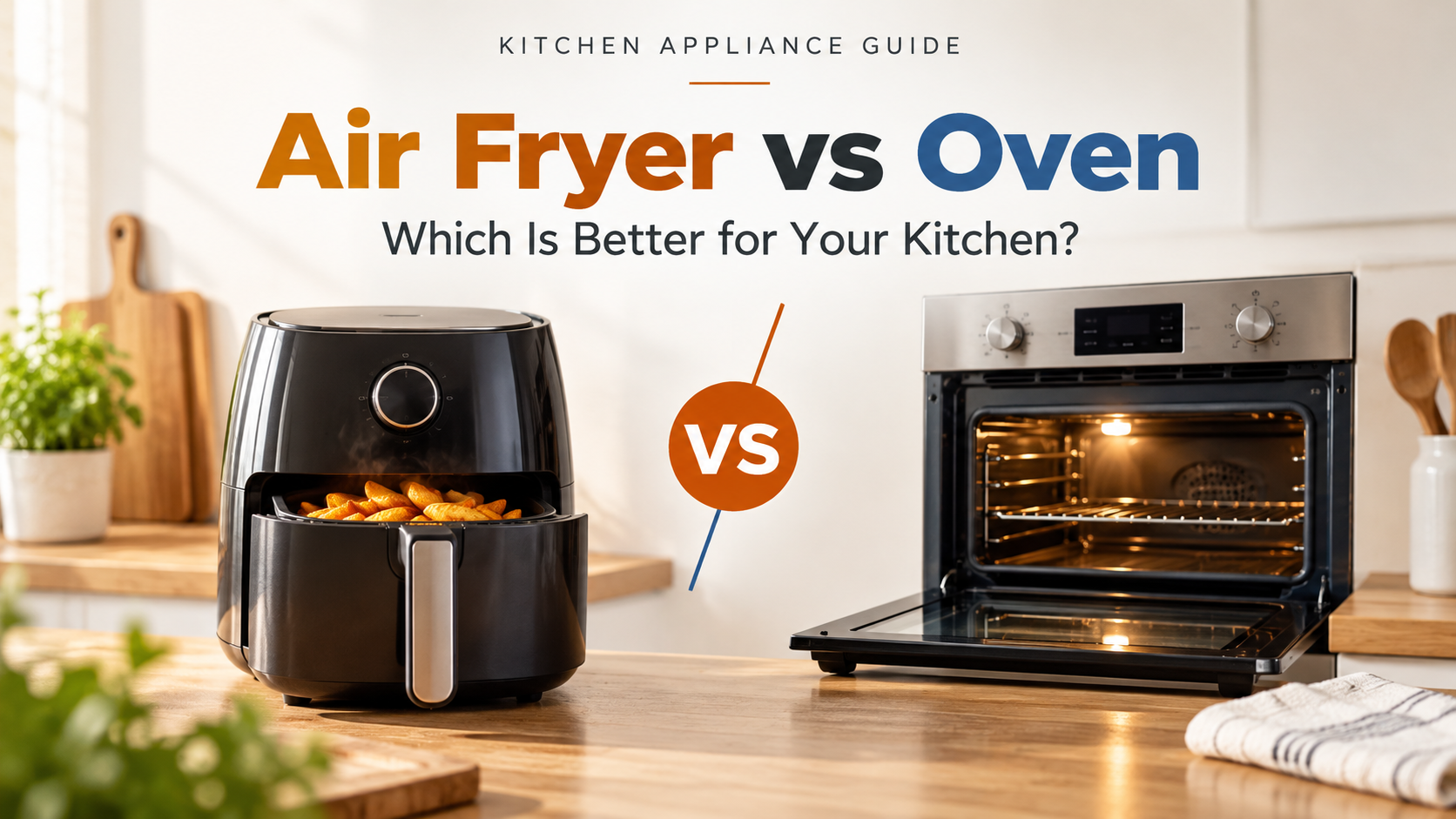

Few kitchen debates have become as common as air fryer vs. oven. Air fryers have moved from a niche gadget to a countertop staple in just a few years, while the oven remains the backbone of nearly every kitchen. If you are wondering whether a compact air fryer can really replace your oven, or whether it is just a smaller version of something you already own, you are in the right place.
This guide compares the two appliances on the things that matter most: how food actually cooks, how much each one costs to run, how efficient they are, how much they can hold, and which one makes sense for your household. By the end, you will know exactly when to reach for the air fryer, when the oven is still the better tool, and how to get the best results from both.
Quick Answer: Which Is Better, an Air Fryer or an Oven?
Neither one wins every situation. For small to medium meals, the air fryer is usually faster, crispier and cheaper to run. For large meals, baking and multi-dish cooking, the oven is still the more capable and practical appliance.
- Choose an air fryer if you cook for one to three people, love crispy food, want quick weeknight dinners and care about lower energy use on short cooks.
- Choose an oven if you regularly feed a large family, bake cakes and bread, roast whole birds or cook several dishes at the same time.
- Own both if you can. They complement each other far more than they compete.
How an Air Fryer and an Oven Actually Work
To understand the differences, it helps to know what is happening inside each appliance.
How an Oven Cooks
A conventional oven heats a large insulated cavity using electric elements or a gas burner. Heat reaches the food mainly through radiation from the walls and elements and through the hot air around it. A fan-assisted (convection) oven adds a fan that moves the air around, which evens out hot spots and speeds up cooking, though the fan usually turns at modest speeds and the cavity is large.
How an Air Fryer Cooks
An air fryer is, in simple terms, a compact and very powerful convection oven. A heating element sits close to the food, and a high-speed fan blasts hot air around a small chamber, usually through a perforated basket or tray. Because the space is small and the air moves fast, moisture on the surface of the food evaporates quickly. That is what produces a crisp, golden exterior with little or no added oil, and it is why the term “air frying” is really a marketing name for rapid convection cooking.
Cooking Performance: Speed, Crispiness and Results
Preheating Time
This is where the air fryer takes its biggest early lead. Most air fryers reach cooking temperature in roughly two to five minutes, and some recipes skip preheating entirely. A conventional oven typically needs around 10 to 15 minutes to reach the same temperature. For a quick dinner, that gap alone can put food on the table 10 minutes sooner.

Cooking Time
Once both appliances are hot, the air fryer usually still finishes first. As a general rule, air fryer recipes run about 20 to 25 percent shorter than the same recipe in a conventional oven. In one independent consumer test, a meal of sausages and roasted vegetables took about 36 minutes in the oven and about 20 minutes in the air fryer. Frozen snacks showed a similar pattern, with the oven needing noticeably longer.
There is an important exception. When you cook in large batches, the air fryer’s small basket forces you to cook in rounds, and the total time can climb. If you are feeding six people wings, an oven with two full trays may finish the whole meal sooner than an air fryer cooking three separate batches.
Crispiness and Texture
For anything that should be crunchy on the outside and tender inside, the air fryer is hard to beat. Fries, chicken wings, breaded cutlets, spring rolls, roasted chickpeas and frozen snacks all come out crisper because the fast airflow strips away surface moisture. A standard oven can get good results, especially with a hot tray and a little oil, but it generally needs more time and often produces a slightly softer finish.
Baking, Roasting and Browning
Here the oven fights back. Cakes, bread, cookies, casseroles, lasagna and large roasts rely on steady, even, gentle heat. The air fryer’s powerful fan can dry out batters, blow around light mixtures and brown the top before the inside is set. Cooking a whole large turkey or a tray bake for a crowd is also simply beyond what a typical basket air fryer can hold.
Performance by Food Type
| Food | Air Fryer | Oven |
|---|---|---|
| French fries and frozen snacks | Excellent: crisp and fast | Good, but slower and less crisp |
| Chicken wings and thighs | Excellent: crispy skin | Good for large batches |
| Roasted vegetables | Very good in small portions | Very good for big trays |
| Fish fillets and salmon | Very good, cooks quickly | Very good, gentler heat |
| Reheating leftovers | Excellent: restores crunch | Fair: slow to heat up |
| Whole roast chicken | Good (small birds only) | Excellent |
| Cakes, bread and cookies | Limited: small batches only | Excellent |
| Casseroles and lasagna | Not suitable for most models | Excellent |
| Pizza | Good for personal-size | Excellent for full size |
Energy Use and Running Costs
For many shoppers, this is the real reason to compare the two. Running costs depend on two things: how much power the appliance draws and how long it runs. The simple formula is:
Cost = power (kW) x time (hours) x your electricity price per kWh
Power Ratings
Most air fryers draw between about 800 and 2,000 watts, with many popular basket models sitting near 1,500 watts. Electric ovens usually draw anywhere from about 2,000 to 5,000 watts when their elements are working, and a full-size oven averages around 3,000 watts. The oven does not draw that power continuously, because the thermostat cycles the elements on and off once it is hot, but it still has a much larger space to heat and keep hot.
A Real Cost Example
Consider a typical meal for one or two people. A 1,500 watt air fryer running for 30 minutes uses 0.75 kWh. A 2,100 watt oven running for an hour uses 2.1 kWh, and that does not even count the preheat. Using a sample electricity price of $0.16 per kWh, that works out to roughly $0.12 for the air fryer and about $0.34 for the oven. The exact numbers change with your local rates, but the proportion stays similar: for a short, small cook, the air fryer often uses around one third of the energy.

Independent testing backs this up. One consumer comparison that measured real meals with a smart meter found the air fryer cooked the same food in less time for roughly a third of the electricity cost. In another example from the same test, a meal of sausages and vegetables cost around 31 cents in the oven versus about 9 cents in the air fryer.
When the Air Fryer Saves Less Money
The savings are not unlimited, and it is worth being honest about that:
- Long cooks: if a recipe needs an hour or more, the air fryer’s advantage shrinks, and for very long cooks it may not save anything at all.
- Large batches: cooking three rounds in an air fryer can use more total energy than one full oven tray.
- Gas ovens: where gas is cheaper per unit of energy than electricity, a gas oven can cost less per hour than an air fryer, although the air fryer’s shorter cooking time can still make it competitive for small meals.
- Large air fryers: dual-basket and air fryer ovens with higher wattages, sometimes 2,000 watts or more, use more power per hour than a compact single-basket model.
Upfront Cost and Payback
Air fryers are inexpensive compared with most ovens. Budget models commonly sell for around $50 to $100, mid-range models for $100 to $200 and premium multi-function units for $200 and up. If you already own a working oven, an air fryer is an add-on purchase, and for a household that cooks small meals most days, the energy savings can offset a good part of the purchase price over time.
Efficiency: Size, Heat Loss and Everyday Practicality
Efficiency in the kitchen is about more than electricity. It also covers how much space you need, how quickly you can start cooking and how much heat ends up in your room.
- Smaller cavity, less wasted heat: an air fryer heats a few liters of air, while an oven heats around 60 to 80 liters. Less space to heat means less energy wasted.
- Faster start: short preheat means you can decide on dinner at the last minute and still eat soon.
- Cooler kitchen: a full oven can make a kitchen noticeably hotter, especially in summer, while an air fryer is far more contained.
- Counter space: the air fryer’s trade-off is that it takes up room on the counter, which can matter in small kitchens.
Capacity and Flexibility
Capacity is where the oven pulls ahead. Most basket air fryers hold roughly 3 to 8 liters, which is ideal for one to three people but tight for a family of five. A full-size oven can hold several trays, a large roasting pan or a big casserole at once. Dual-zone air fryers and air fryer ovens help bridge the gap by offering two baskets or extra shelf space, but they still do not match an oven for hosting or batch cooking.
Flexibility also differs. An oven can bake, roast, broil, slow-cook and reheat in any dish that fits. An air fryer is brilliant at crisping and roasting small quantities, and many modern models add dehydrating, baking and reheating modes, but they work best in a narrower set of tasks.
Health Considerations
Air fryers can produce crispy food with a small amount of oil, often just a light spray or a spoonful, instead of the large volume used in deep frying. That means food cooked in an air fryer can contain less added fat than its deep-fried equivalent. It is worth keeping this in perspective, though. An air fryer does not turn processed foods into health food, and a tray of vegetables roasted in the oven with a little olive oil is just as nutritious. The healthiest choice comes down to what you cook, not the appliance itself.
Cleaning, Noise and Safety
- Cleaning: most air fryer baskets are removable and often dishwasher safe, which makes cleanup quick, although grease can build up around the element and fan if you neglect them. Ovens have more surface area to clean and may need periodic deep cleaning.
- Noise: air fryers are louder because of the high-speed fan, usually similar to a small hair dryer on a low setting. Ovens are typically much quieter.
- Safety: air fryer exteriors and baskets get very hot. Keep them on a stable, heat-resistant surface with space around the vents, and never cover the air intake or exhaust.
Air Fryer vs. Oven at a Glance
| Feature | Air Fryer | Oven |
|---|---|---|
| Preheat time | About 2 to 5 minutes | About 10 to 15 minutes |
| Cooking speed | Roughly 20 to 25 percent faster | Standard baseline |
| Typical power | 800 to 2,000 W | 2,000 to 5,000 W |
| Energy use (small meal) | Lower | Higher |
| Crispiness | Excellent | Good |
| Capacity | Roughly 3 to 8 liters | Roughly 60 to 80 liters |
| Baking and big roasts | Limited | Excellent |
| Noise | Louder (fan) | Quieter |
| Upfront cost | Low to moderate | Moderate to high |
| Best for | Small meals, snacks, quick dinners | Family meals, baking, batch cooking |
Which One Should You Choose?

An Air Fryer Is Right for You If…
- You cook for one to three people most days.
- You enjoy fries, wings, frozen snacks and crispy reheated leftovers.
- You want dinner ready quickly without a long preheat.
- You want to trim energy use on small, everyday meals.
- You have limited kitchen space or want a cooler kitchen in summer.
An Oven Is Right for You If…
- You regularly feed four or more people.
- You bake bread, cakes, cookies or pies.
- You cook whole roasts, big casseroles or several dishes at once.
- You want one appliance that handles almost any recipe.
Getting Both: The Best Real-World Approach
Most home cooks who own both quickly settle into a rhythm. The air fryer handles weeknight dinners, snacks and reheating, while the oven comes out for baking, roasts and weekend cooking. That split lets each appliance do what it does best and keeps energy use sensible.
Buying Checklist for Shoppers
If you decide an air fryer belongs in your kitchen, these are the features that matter most:
- Capacity: around 3 to 4 liters suits one or two people, 5 to 6 liters suits a small family and 8 liters or more suits larger households.
- Wattage: higher wattage heats faster but uses more power per hour, so match it to your needs.
- Controls: clear temperature and timer controls, preset programs and a shake reminder make cooking easier.
- Basket design: a nonstick, dishwasher-safe basket saves cleaning time. Dual-zone models let you cook two foods at once.
- Footprint and noise: check the dimensions against your counter space and look for models with a reputation for quieter operation.
- Extra functions: baking, dehydrating and reheating modes add versatility if you want a multi-purpose machine.
Tips for Better Results in Both Appliances
Converting Oven Recipes to the Air Fryer
A simple starting rule is to lower the temperature by about 15 to 25 degrees Celsius (roughly 25 degrees Fahrenheit) and shorten the cooking time by about 20 percent, then check the food early. Every model is a little different, so treat your first few cooks as test runs and note what works.
Air Fryer Tips
- Do not overcrowd the basket. Food needs space for air to circulate.
- Shake the basket or flip food halfway through for even browning.
- Pat food dry and use a light coating of oil for the crispiest results.
- Preheat for a few minutes when cooking foods that benefit from a hot start.
- Clean the basket after each use to prevent smoke and lingering odors.
Oven Tips
- Use the fan or convection setting when available to cook faster and more evenly.
- Do not open the door repeatedly, since each peek lets a lot of heat escape.
- Cook several items at once so the heat you pay for is not wasted.
- Turn the oven off a few minutes early and let residual heat finish the job for longer roasts.
Frequently Asked Questions
Is an air fryer cheaper to run than an oven?
For small and medium meals, yes. Air fryers usually draw less power, preheat faster and finish sooner, so they typically use significantly less energy per meal. For very long cooks or large batches, the gap narrows or can even reverse.
Can an air fryer replace an oven?
For some households, mostly singles and couples who cook simple meals, it can come close. For families, bakers and anyone who cooks large dishes, an air fryer is better seen as a useful companion than a full replacement.
Is an air fryer just a small convection oven?
Essentially, yes. Both use a heating element and a fan to circulate hot air. The difference is that an air fryer is smaller and has a more powerful fan placed close to the food, which gives it faster preheating and crisper results.
Does food taste different from an air fryer?
Air-fried food tastes closer to oven-roasted or lightly fried food than to deep-fried food. It will be crispy and well browned, but it will not have the exact richness of food cooked in a deep fryer.
Do air fryers use a lot of electricity?
Compared with an oven on a short cook, no. A typical 1,500 watt air fryer uses about 0.75 kWh over 30 minutes, which is generally lower than a standard oven needs for a comparable meal. Your actual cost depends on your local electricity rate.
What should I not cook in an air fryer?
Avoid very wet batters, large loaves of bread, big casseroles and anything that needs to be submerged in liquid. Light foods like leafy greens or loose cheese can also blow around in the fan, so cover or secure them.
Is it worth buying an air fryer if I already have an oven?
If you often cook small portions, enjoy crispy food or want faster dinners, it is usually worth it. If you mainly bake or cook for a large group, you may get less value from one.
Final Verdict
The air fryer vs. oven question does not have a single winning answer, but it does have a clear pattern. The air fryer wins on speed, crispiness and energy use for everyday small meals. The oven wins on capacity, baking and versatility for larger or more complex cooking. Match the appliance to the meal you are making, and you will save time, save energy and get better food in both.
If you only have room or budget for one, think honestly about how you cook most days. For small households that live on quick dinners and crispy favorites, an air fryer will quickly feel indispensable. For larger households and keen bakers, a good oven remains the core of the kitchen, and an air fryer is a smart bonus when you are ready for it.