


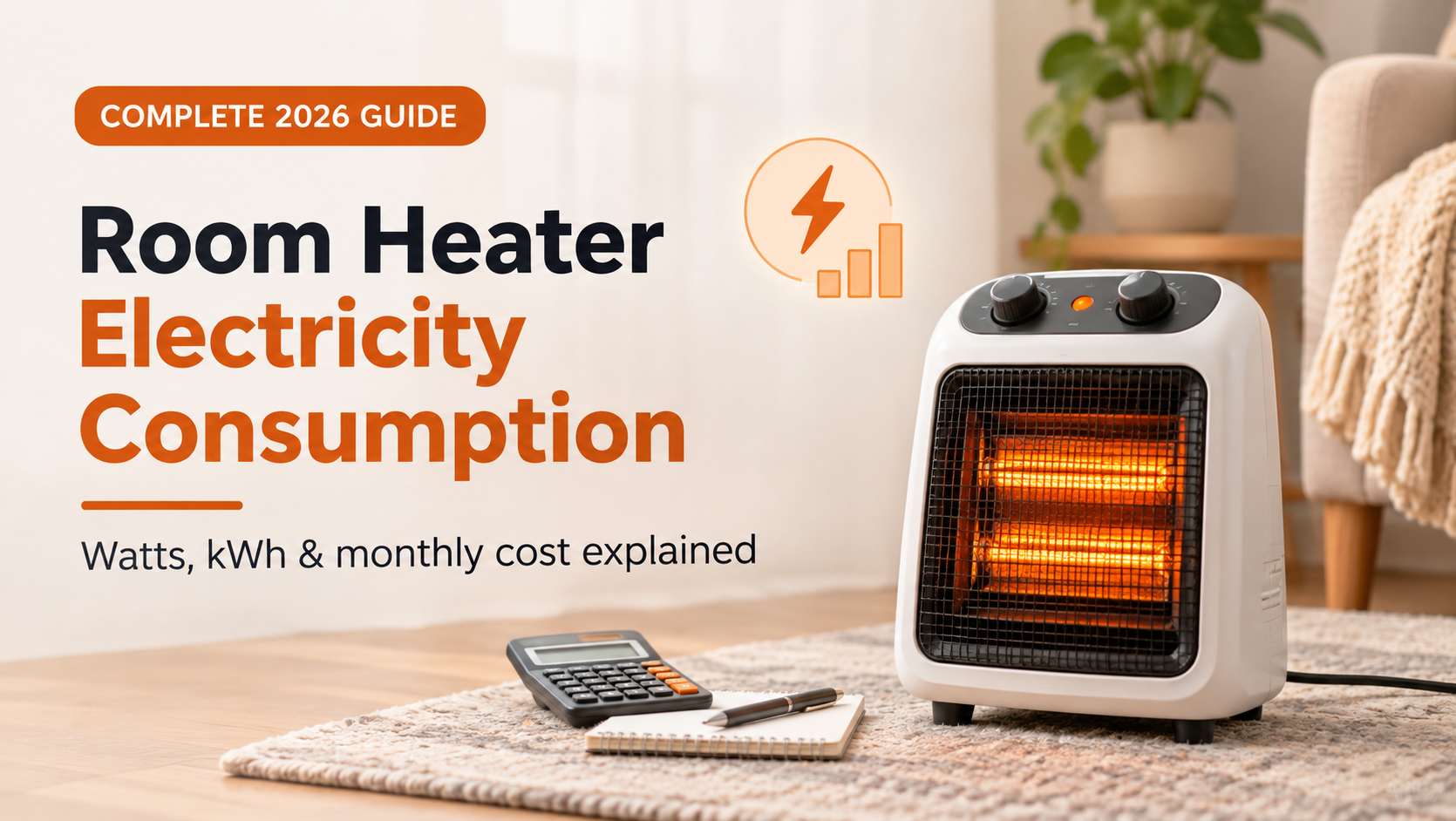

Room Heater Electricity Consumption: How Much Power Does a Heater Use?
When the temperature drops, a portable room heater is often the quickest way to get comfortable. But when the electricity bill arrives, many people are surprised. A heater that feels harmless can quietly become the biggest power user in your home. Understanding room heater electricity consumption helps you pick the right model, run it smartly and keep your winter bill under control.
In this complete guide you will learn how many watts a room heater uses, how to calculate the exact running cost, what the real monthly bill looks like, how different heater types compare and which proven tricks can cut your consumption without leaving you cold.
Quick Answer: How Much Electricity Does a Room Heater Use?
Most portable room heaters are rated between 500 and 2,000 watts. The most common size is 1,500 watts (1.5 kW). A 1,500-watt heater running continuously for one hour uses 1.5 kWh of electricity. At an example rate of $0.16 per kWh, that is about $0.24 per hour, or roughly $57.60 per month if it runs 8 hours a day for 30 days at full power.
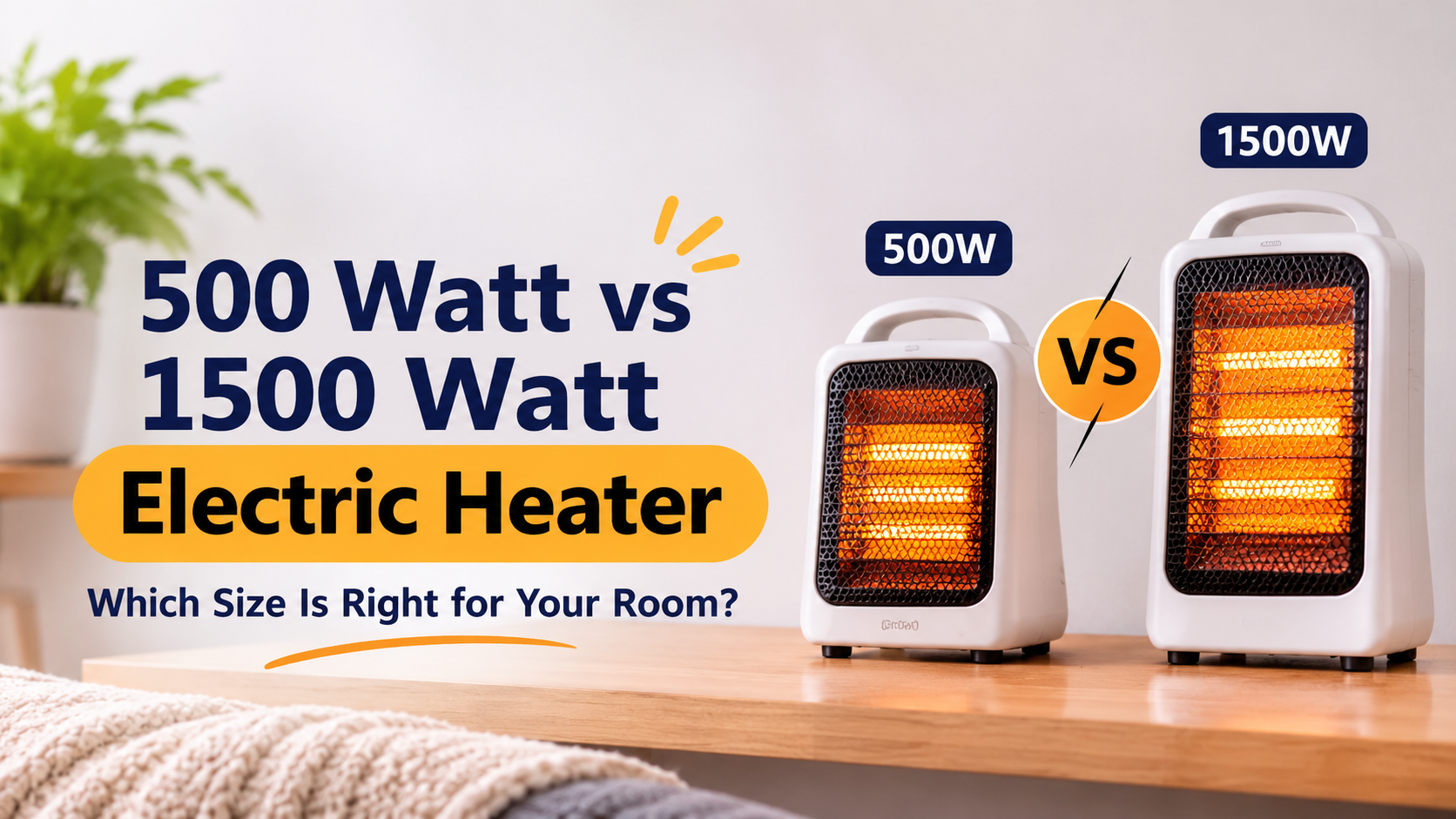
- Small heater (500 W): 0.5 kWh per hour
- Medium heater (1,000 W): 1 kWh per hour
- Standard heater (1,500 W): 1.5 kWh per hour
- Large heater (2,000 W): 2 kWh per hour
Understanding Watts, Kilowatts and kWh
Three terms come up again and again when you read about heater power use.
- Watt (W): the rate at which a device draws power at any moment. It is printed on the heater label.
- Kilowatt (kW): 1,000 watts. A 1,500 W heater is a 1.5 kW heater.
- Kilowatt-hour (kWh): the amount of energy used when 1 kW runs for one hour. This is the unit your electricity company bills you for. It appears as “units” on many bills.
The key point is that a heater has no “economy” wattage by default. A 1,500 W heater uses 1,500 W whenever its heating element is on. The only way to use less energy is to run it for fewer hours, use a lower power setting or let a thermostat switch it off when the room is warm enough.
How to Calculate Room Heater Electricity Cost
You do not need special tools. Three simple steps give you the cost of any heater.

- Convert watts to kilowatts: divide the wattage by 1,000.
- Find the energy used: multiply kilowatts by the number of hours the heater runs. The result is in kWh.
- Find the cost: multiply kWh by your electricity price per unit.
Example: A 1,500 W heater runs for 4 hours a day.
- 1,500 ÷ 1,000 = 1.5 kW
- 1.5 kW × 4 hours = 6 kWh per day
- 6 kWh × $0.16 = $0.96 per day
- $0.96 × 30 days = $28.80 per month
Replace $0.16 with the rate on your own electricity bill. Rates differ widely between countries, cities and time-of-use plans, so always use your local figure for an accurate result.
Room Heater Power Consumption by Wattage
The table below shows daily energy use and cost for common heater sizes, assuming an example rate of $0.16 per kWh and continuous heating while switched on.
| Heater Wattage | kWh per Hour | Cost per Hour | 4 Hours / Day | 8 Hours / Day |
|---|---|---|---|---|
| 500 W | 0.5 | $0.08 | $0.32 | $0.64 |
| 1,000 W | 1.0 | $0.16 | $0.64 | $1.28 |
| 1,500 W | 1.5 | $0.24 | $0.96 | $1.92 |
| 2,000 W | 2.0 | $0.32 | $1.28 | $2.56 |
Monthly Cost of Running a Room Heater
Daily numbers look small, but they add up. Over a 30-day month the difference between a small heater and a large one, and between a few hours and a full workday of heating, becomes obvious.

| Heater Wattage | Monthly kWh (4 h/day) | Monthly Cost (4 h/day) | Monthly kWh (8 h/day) | Monthly Cost (8 h/day) |
|---|---|---|---|---|
| 500 W | 60 | $9.60 | 120 | $19.20 |
| 1,000 W | 120 | $19.20 | 240 | $38.40 |
| 1,500 W | 180 | $28.80 | 360 | $57.60 |
| 2,000 W | 240 | $38.40 | 480 | $76.80 |
These figures are the worst case, where the heater element stays on the entire time. In real life, a heater with a thermostat cycles on and off, so actual consumption is often lower, as explained next.
Why Your Real Heater Bill Can Be Lower Than the Label Suggests
The wattage on the label is the maximum power draw. Most modern heaters include a thermostat. Once the room reaches the temperature you set, the heating element switches off and only turns back on when the room cools. This is called cycling.
If a 1,500 W heater only needs to be actively heating for half of the time during an 8-hour evening, it uses about 6 kWh instead of 12 kWh. At $0.16 per kWh, that is roughly $0.96 instead of $1.92 for the day, or about $28.80 per month instead of $57.60.
How much cycling you get depends on room size, insulation, outdoor temperature and the thermostat setting. In a small, well-sealed room the heater will switch off often. In a large, drafty room it may run almost non-stop.
Electricity Consumption by Room Heater Type
Different heater technologies use different amounts of power and deliver heat in different ways. Importantly, almost all electric resistance heaters convert nearly 100 percent of the electricity they use into heat. That means a 1,500 W oil-filled radiator and a 1,500 W ceramic fan heater put the same amount of heat energy into your room. The difference lies in how that heat feels, how quickly it arrives and how long it lingers.

Ceramic Fan Heaters
Ceramic fan heaters usually range from 750 to 1,500 W. They warm up in seconds and push warm air around, which makes them ideal for quick heating of small spaces such as a bathroom, a home office or a bedroom before bed. The downside is that the heat stops almost immediately when the unit switches off.
Oil-Filled Radiators
These typically use 600 to 1,500 W. They take longer to heat up, but the oil inside stores warmth and keeps radiating it after the element turns off. Because of this stored heat, oil-filled radiators are quiet and work well for long, steady use in bedrooms and living rooms. Thermostat cycling is more effective with this design.
Convection Panel Heaters
Panel heaters generally run from 750 up to 2,000 W. They heat the air gently through natural convection and suit larger rooms. They are slower than fan heaters, but they are silent and can be wall mounted.
Infrared and Quartz Heaters
Rated around 400 to 1,500 W, infrared heaters warm objects and people directly rather than heating all the air. They feel warm almost instantly when you sit in front of them, which makes them useful for spot heating at a desk or sofa. They are less effective for heating a whole room evenly.
Halogen Heaters
Halogen heaters usually draw 400 to 1,200 W and produce instant radiant warmth. They are compact and affordable, but like other radiant units they heat the person in front of them rather than the whole space.
Micathermic Panel Heaters
Micathermic heaters, often 750 to 1,500 W, combine radiant and convection heating in a slim, lightweight body. They heat up faster than oil radiators and are quiet in operation.
What Determines How Much Power Your Heater Really Uses?
- Heater wattage: a higher rating means more kWh for every hour of operation.
- Hours of use: this is the biggest factor you control directly.
- Room size: larger spaces need more energy to reach and hold a comfortable temperature.
- Insulation and sealing: gaps around windows, doors and floors let warm air escape, so the heater must work harder.
- Outdoor temperature: the colder it is outside, the longer your heater must run.
- Thermostat setting: each extra degree you ask for increases how often the heater runs.
- Electricity price: the same kWh can cost very different amounts depending on your tariff.
What Size Room Heater Do You Need?
A common rule of thumb is that you need around 10 watts of heating power per square foot (about 100 watts per square metre) in a room with average insulation. Using this guide:
- Up to about 50 sq ft (5 sq m): around 500 W
- Up to about 100 sq ft (9 sq m): around 1,000 W
- Up to about 150 sq ft (14 sq m): around 1,500 W
- Larger or poorly insulated rooms: 2,000 W or more, or more than one heater
Buying an oversized heater does not automatically waste electricity, because a thermostat will cycle it off. However, an undersized heater will run constantly and still fail to warm the room. Choosing the correct size gives the best comfort and the lowest running time.
Electrical Load and Safety: Current in Amps
Power in watts is related to current in amps by the formula: amps = watts ÷ volts.
- A 1,500 W heater on a 120 V supply draws about 12.5 amps.
- A 1,500 W heater on a 230 V supply draws about 6.5 amps.
- A 2,000 W heater on a 230 V supply draws about 8.7 amps.
Because heaters draw a large current, always plug them directly into a wall socket that is in good condition. Avoid sharing the same circuit with other high-power appliances such as kettles, irons or air conditioners. Follow the manufacturer instructions about extension cords. In most cases, using a heater on a cheap or overloaded extension cord is not recommended, because cables and plugs can overheat.
How to Reduce Room Heater Electricity Consumption
1. Heat Only the Room You Are Using
Close the door and heat the space where you actually sit or sleep. Heating a whole house with portable heaters is the fastest way to a huge bill.
2. Use the Thermostat and Set a Sensible Temperature
Setting your heater to around 18 to 21 °C (64 to 70 °F) is comfortable for most people. Every extra degree increases energy use, so a small reduction makes a noticeable difference over a month.
3. Use a Timer
Many heaters have a built-in timer. Set it to warm the room before you go to bed or before you start working, and turn it off automatically afterward. This prevents forgotten heaters from running all night or all day.
4. Seal Drafts
Weatherstripping around doors and windows, draft stoppers at the bottom of doors and thick curtains can cut heat loss significantly. Every bit of warm air you keep inside is energy you do not need to buy again.
5. Use Rugs and Heavy Curtains
Bare floors feel cold and allow heat to escape. Rugs add comfort and insulation. Close curtains at night to hold warmth, and open them on sunny days to let natural heat in.
6. Pick the Right Heater for the Job
Use an infrared or halogen heater for short spot heating at your desk, a ceramic fan heater for a quick warm-up and an oil-filled or panel heater for longer, steady heating. Matching the type to the task avoids wasted power.
7. Layer Up and Use Warm Bedding
Warm clothes, blankets and a good duvet let you set the thermostat lower without feeling cold. Staying warm through insulation is far cheaper than producing warmth with electricity.
8. Place the Heater Correctly
Keep the heater on a flat, hard surface, away from curtains, furniture and bedding. Make sure nothing blocks airflow. Good placement improves heat distribution and is a basic fire safety rule.
9. Keep the Heater Clean
Dust on grilles and inside fan heaters can reduce airflow and cause unpleasant smells or overheating. Unplug the heater and clean it gently before each season.
Is a Room Heater Cheaper Than Central Heating or an Air Conditioner?
It depends on what you are heating. For a single occupied room, a thermostat-controlled portable heater can be cheaper than heating an entire house. For several rooms or the whole home, a central system is usually more efficient and comfortable.
A modern heat pump or inverter air conditioner in heating mode can deliver around two to four units of heat for every unit of electricity, because it moves heat from outside rather than creating it directly. A simple resistance room heater delivers about one unit of heat for each unit of electricity. For regular daily heating in a cold climate, a heat pump often has lower running costs, though it costs more to buy and install.
Room Heater vs. Other Heating Options: Quick Comparison
| Option | Best For | Running Cost | Upfront Cost |
|---|---|---|---|
| Portable electric room heater | One small or medium room, short periods | Moderate to high | Low |
| Heat pump / inverter AC | Regular heating of one or more rooms | Low | High |
| Central heating | Whole home | Depends on fuel type | High |
| Electric blanket or heated throw | Personal warmth in bed or on a sofa | Very low | Low |
Common Myths About Room Heater Electricity Use
- Myth: Oil-filled heaters use less electricity. A 1,500 W oil-filled heater uses the same energy as a 1,500 W fan heater when both are running. The advantage is stored warmth and quieter operation, not lower wattage.
- Myth: “Energy saving” heaters create more heat for less power. A plug-in resistance heater cannot beat the basic laws of physics. Savings come from better control, such as thermostats, timers and eco modes.
- Myth: Leaving a heater on low all day is cheaper than turning it on and off. For a room you are not using, switching the heater off saves energy because you are not paying to heat an empty space.
- Myth: A heater uses a lot of power while on standby. Standby draw is very small compared to heating mode. The real cost comes from running the element.
Frequently Asked Questions
How many units does a room heater consume per hour?
A room heater consumes units equal to its kilowatt rating for each hour it heats. A 1,000 W heater uses 1 unit (1 kWh) per hour, a 1,500 W heater uses 1.5 units per hour and a 2,000 W heater uses 2 units per hour.
How much electricity does a 1,500-watt heater use in 24 hours?
If it ran at full power for 24 hours, it would use 36 kWh. In practice a thermostat switches the element off for part of the time, so real consumption is usually lower.
Is it expensive to run a room heater all night?
Running a 1,500 W heater for 8 hours at full power uses 12 kWh, which is about $1.92 at $0.16 per kWh. With thermostat cycling and a smaller room, the bill can be much lower. Safety is also important, so choose a model with tip-over and overheat protection if you plan to use it overnight.
Which room heater uses the least electricity?
Lower-wattage heaters, such as 500 to 1,000 W models, draw less power per hour. The most economical choice overall is the one that is correctly sized for the room, has a good thermostat and a timer, and is used together with proper insulation.
Does a room heater use more electricity than an air conditioner?
A resistance room heater usually draws more power than a cooling-only air conditioner of similar size. A heat pump air conditioner used in heating mode is often cheaper to run than a resistance heater, because it delivers more heat per unit of electricity.
How can I measure my heater’s real power use?
Plug it into a plug-in energy monitor (watt meter) and run it for a typical evening. The monitor shows the exact kWh used, so you can multiply by your electricity rate and see your real cost.
Is a 2,000-watt heater too much for a normal home socket?
Most household circuits can support a single 2,000 W heater, but you should check the circuit rating and avoid running other heavy appliances at the same time. When in doubt, ask a qualified electrician.
Safety Checklist for Using a Room Heater
- Keep at least one metre (three feet) of clear space around the heater.
- Never cover the heater or use it to dry clothes.
- Choose a model with tip-over shutoff and overheat protection.
- Plug directly into a wall socket and check the plug and cord for damage.
- Do not leave a heater running in an empty room or around young children and pets without supervision.
- Keep working smoke alarms in the home.
Final Thoughts
Room heater electricity consumption comes down to a simple idea: wattage × hours × price per unit. A typical 1,500 W heater uses 1.5 kWh each hour at full power, which can mean anywhere from about $29 to $58 per month depending on how long it runs and how often the thermostat cycles it off. By choosing the right size and type, using the thermostat and timer, sealing drafts and heating only the room you need, you can stay warm all winter while keeping the electricity bill firmly under control.
Before you buy a new heater, check the wattage, thermostat features, safety protections and your own local electricity rate. A few minutes of calculation now can save you a surprising amount of money over the cold months ahead.