
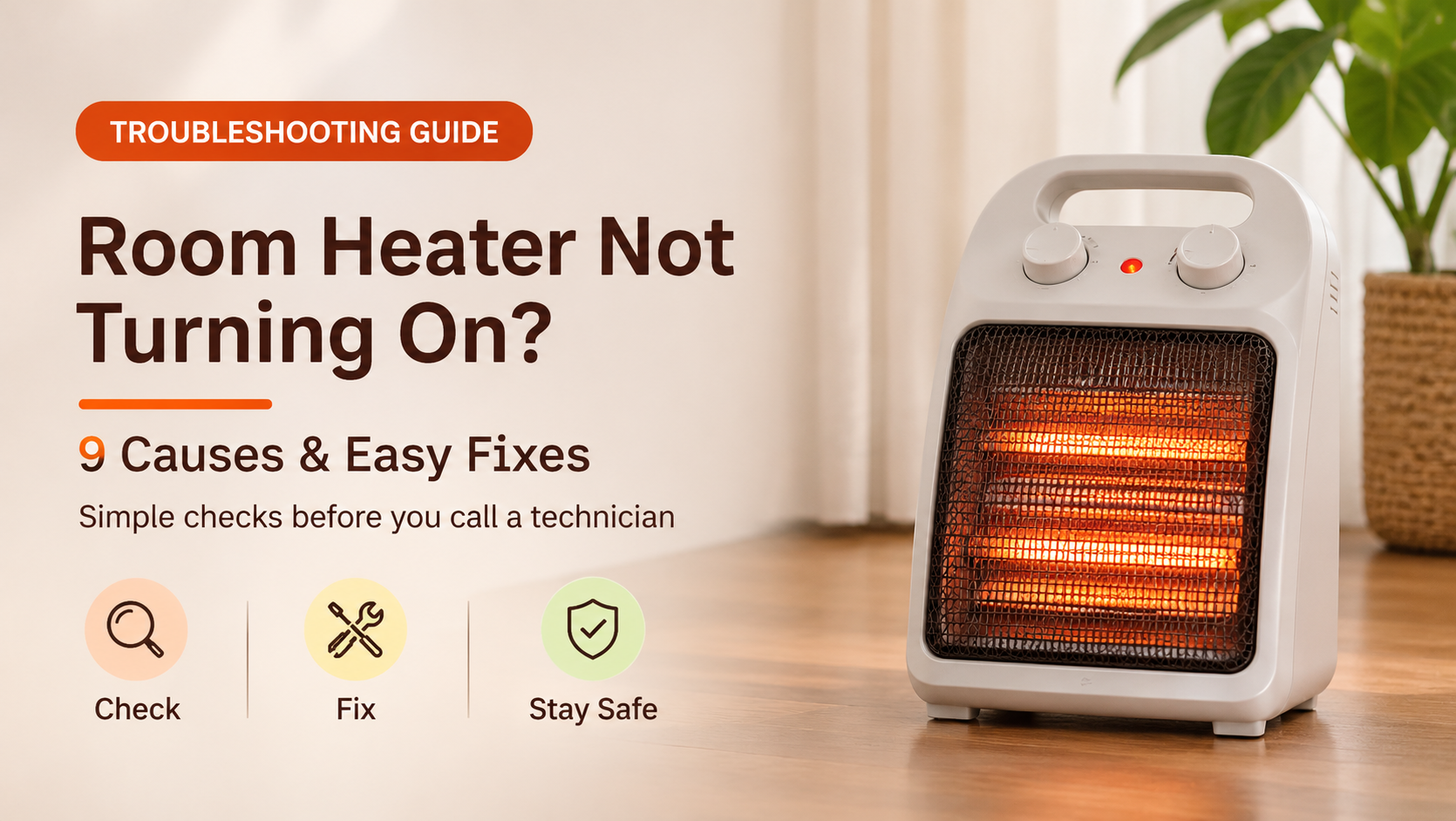
You flip the switch, nothing lights up, and the room stays cold. A room heater that is not turning on is frustrating, especially on a winter night. The good news is that many heaters are not broken at all. The problem is often a socket, a safety switch, or a setting you can check in minutes.
This guide explains why a heater will not start, nine common causes with fixes, a quick diagnosis table, safety rules, when to replace it, and what to look for in a new heater.
How a Heater Gets Power
For an electric heater to start, electricity must travel from the wall socket, through the plug and cord, past the fuse and safety switches, through the controls and thermostat, and finally to the heating element. If any stage is broken, the heater looks completely dead. That is why a methodical check works better than guessing.
9 Reasons Your Room Heater Will Not Turn On
1. Dead wall socket or tripped breaker
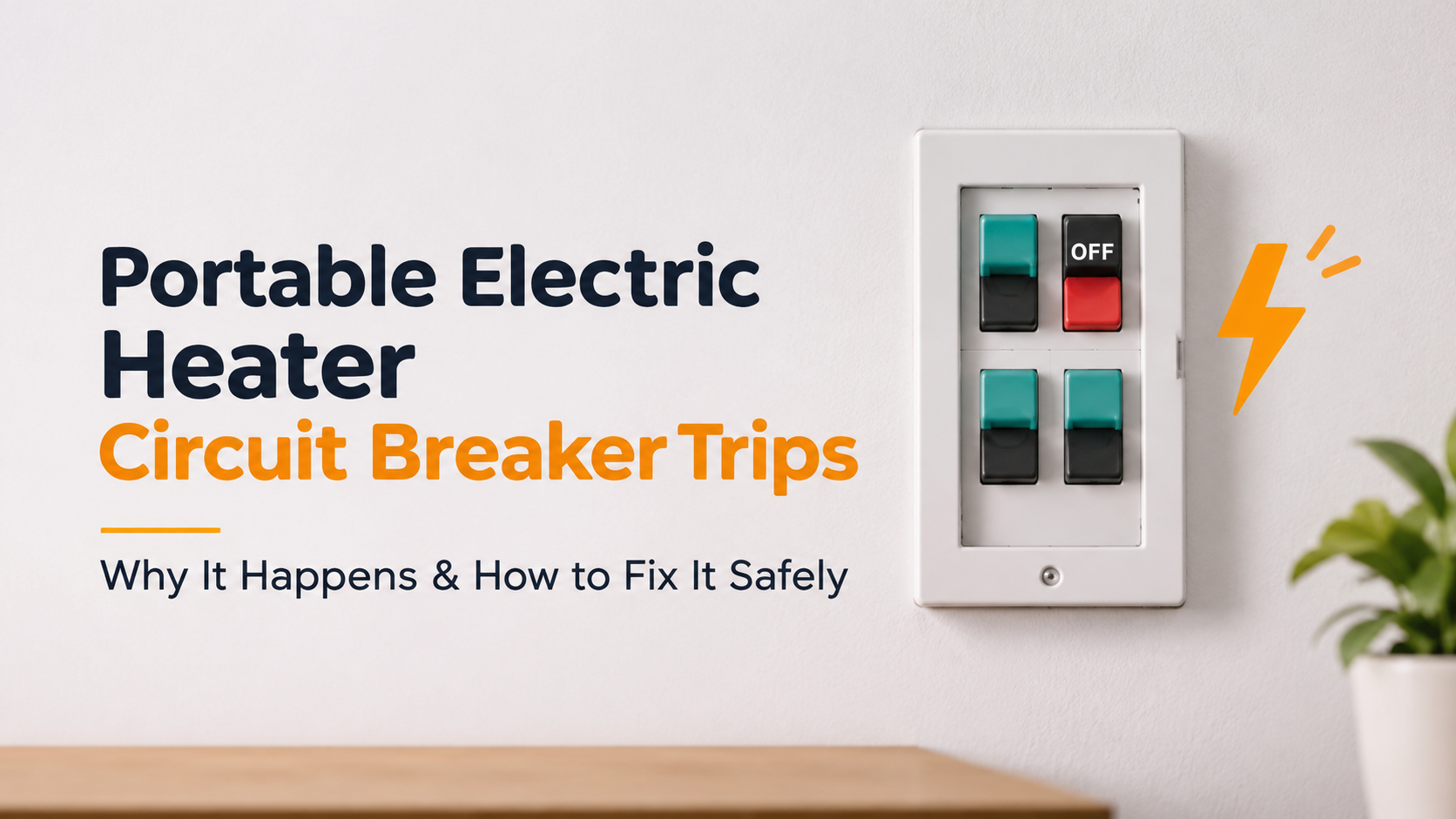
Why it happens: The simplest cause is no electricity at the socket. Heaters draw 1000 to 2000 watts, and an overloaded circuit often trips its breaker or RCD.
How to fix it: Test the socket with a lamp or phone charger. Reset the breaker, then plug the heater into a different wall socket. If the breaker trips again at once, stop and call an electrician.
2. Damaged power cord or loose plug
Why it happens: Cords bend, fray and overheat near the plug over time. A loose connection can stop power completely or make the heater switch on and off.
How to fix it: Inspect the full cord. Look for cracks, burn marks, a warm plug or a loose fit. A damaged cord must be replaced by a qualified technician, never taped.
3. Blown fuse
Why it happens: Some plugs have a small fuse, and many heaters have an internal thermal fuse. When it blows, the heater is completely dead with no light or fan.
How to fix it: Check the plug fuse and replace it with the exact same rating if it is blown. An internal thermal fuse needs a technician.
4. Tip-over safety switch activated
Why it happens: Heaters have a switch that cuts power when tilted or knocked over. If the unit sits on carpet, a sloped floor or a wobbly surface, it may refuse to start.
How to fix it: Place the heater upright on a flat, hard surface. Lift and set it down firmly, then try again. Check that nothing is jamming the switch at the base.
5. Overheat protection tripped
Why it happens: Blocked vents, dust or a covered heater cause overheating. The thermal cut-off then shuts the unit down, and some models will not restart until cooled or reset.
How to fix it: Unplug, wait 30 minutes, and clean the vents. Press the reset button if your model has one. Keep 3 feet of clear space around the heater.
6. Thermostat set too low or faulty
Why it happens: If the room is already warm or the dial is on minimum, the heater will not start heating. A faulty thermostat can also stay open and block power to the element.
How to fix it: Turn the thermostat to maximum. If nothing happens even in a cold room, the thermostat likely needs replacing.
7. Faulty power switch, selector, remote or control board
Why it happens: Worn rocker switches, mode selectors and digital control boards can fail. Remote-controlled models also fail when the remote battery is dead or the display is locked.
How to fix it: Try every mode, replace the remote battery, and check for a child-lock or timer setting. If controls are unresponsive, a repair of the switch or board is needed.
8. Burnt wiring or heating element
Why it happens: Old heaters can develop a broken element or burnt internal wire. The fan may run but heat never arrives, or the whole unit may stay dead.
How to fix it: Look for a burning smell or scorch marks near the vents. Do not use the heater. Internal wiring and elements are a job for a technician or a replacement unit.
9. Extension cord, low voltage or overload
Why it happens: Thin extension cords and shared multi-plugs cannot carry a heater’s load. Low mains voltage or surge protectors can also cut power.
How to fix it: Plug directly into a wall socket. Avoid sharing the circuit with an air conditioner, geyser or iron at the same time.
Quick Symptom Diagnosis Table
| Symptom | Most Likely Cause | What to Do |
|---|---|---|
| No light, no sound, nothing | No power, cord, plug or fuse | Test socket, check breaker, inspect cord and fuse |
| Light on but no heat | Thermostat or heating element | Turn thermostat to maximum, then see a technician |
| Starts then shuts off quickly | Overheat protection | Clean vents, allow cooling, give it space |
| Will not start on carpet or slope | Tip-over switch | Use a flat, hard surface |
| Remote or display does nothing | Remote battery or control board | Change batteries, check child-lock, test manual controls |
| Breaker trips instantly | Short circuit or overload | Stop using it and call an electrician |
Step-by-Step Checklist
- Unplug and wait. Allow 30 minutes for any overheat protection to reset.
- Test the socket. Plug in a lamp or charger to confirm it has power.
- Check the breaker or RCD. Reset it if tripped.
- Inspect the cord and plug. Look for burns, cracks, loose pins or heat damage.
- Check the plug fuse. Replace only with the same rating.
- Place the heater on a flat surface. This frees the tip-over switch.
- Set controls correctly. Thermostat to maximum, mode on heat, timer off, child-lock off.
- Clean the vents. Remove dust so overheat protection does not trigger.
- Call a professional. If it is still dead, do not open it yourself.
DIY Fix or Professional Repair?
| You Can Do It Yourself | Leave to a Professional |
|---|---|
| Testing the socket and breaker | Replacing a damaged cord |
| Cleaning vents and filter | Replacing the thermostat or switch |
| Changing remote batteries | Internal thermal fuse or wiring |
| Resetting the overheat button | Heating element or control board |
| Moving to a flat surface | Any burning smell or sparks |
Repair or Replace?
Replace the heater if it is older than 5 to 7 years, the cord or casing is damaged, there is a burning smell, or the repair would cost more than half of a new unit. Repair makes sense for newer heaters, heaters under warranty, or when the problem is a simple fuse or switch.
What to Look for When Buying a New Room Heater
- Tip-over and overheat protection as standard safety features.
- Adjustable thermostat for steady, energy-efficient heating.
- Correct wattage: about 1000 W for small rooms, 1500 W for medium rooms, and 2000 W for large living rooms.
- Thick, quality power cord with a well-fitted plug.
- Multiple heat settings, timer and indicator light for convenience and easy diagnosis.
- Quiet operation for bedrooms and study rooms.
- Trusted certification marks and a good warranty.
How to Prevent Start-Up Problems
- Plug directly into a wall socket, not an extension cord.
- Do not wrap the cord tightly around the heater while it is still warm.
- Keep the heater on a stable, flat surface.
- Store it in a dry place at the end of winter, preferably in its original box.
- Test it before the first cold night, not on it.
Frequently Asked Questions
Why is my room heater completely dead?
No light or sound usually means no power is reaching it. Check the socket, breaker, plug fuse and cord first.
Why does my heater not turn on after being knocked over?
The tip-over switch has probably activated. Place the heater upright on a flat surface, unplug it for a few minutes, and try again.
Does a heater have a reset button?
Many models do. It sits at the back or bottom and resets the overheat protection once the unit has cooled down.
Why does my heater turn off by itself?
Common reasons are overheating from blocked vents, a timer setting, a faulty thermostat or a loose plug.
Can I use an extension cord with a room heater?
It is best avoided. If you must, use a heavy-duty cord rated above the heater’s wattage, fully unrolled, and never a thin multi-plug.
Is it safe to repair a heater myself?
Checking the socket, fuse, settings and cleaning are safe. Opening the casing or touching internal wiring is not and should be left to a qualified technician.
Conclusion
When your room heater is not turning on, work through the power path in order: socket, plug and cord, fuse, safety switches, controls, then the element. Most of the time the cause is outside the heater or a safety switch that needs a flat surface and a cool-down. If it still refuses to start, or you notice burning smells or sparks, stop using it and get professional help or replace it. A well-chosen heater with solid safety features and regular care will keep you warm all winter.