





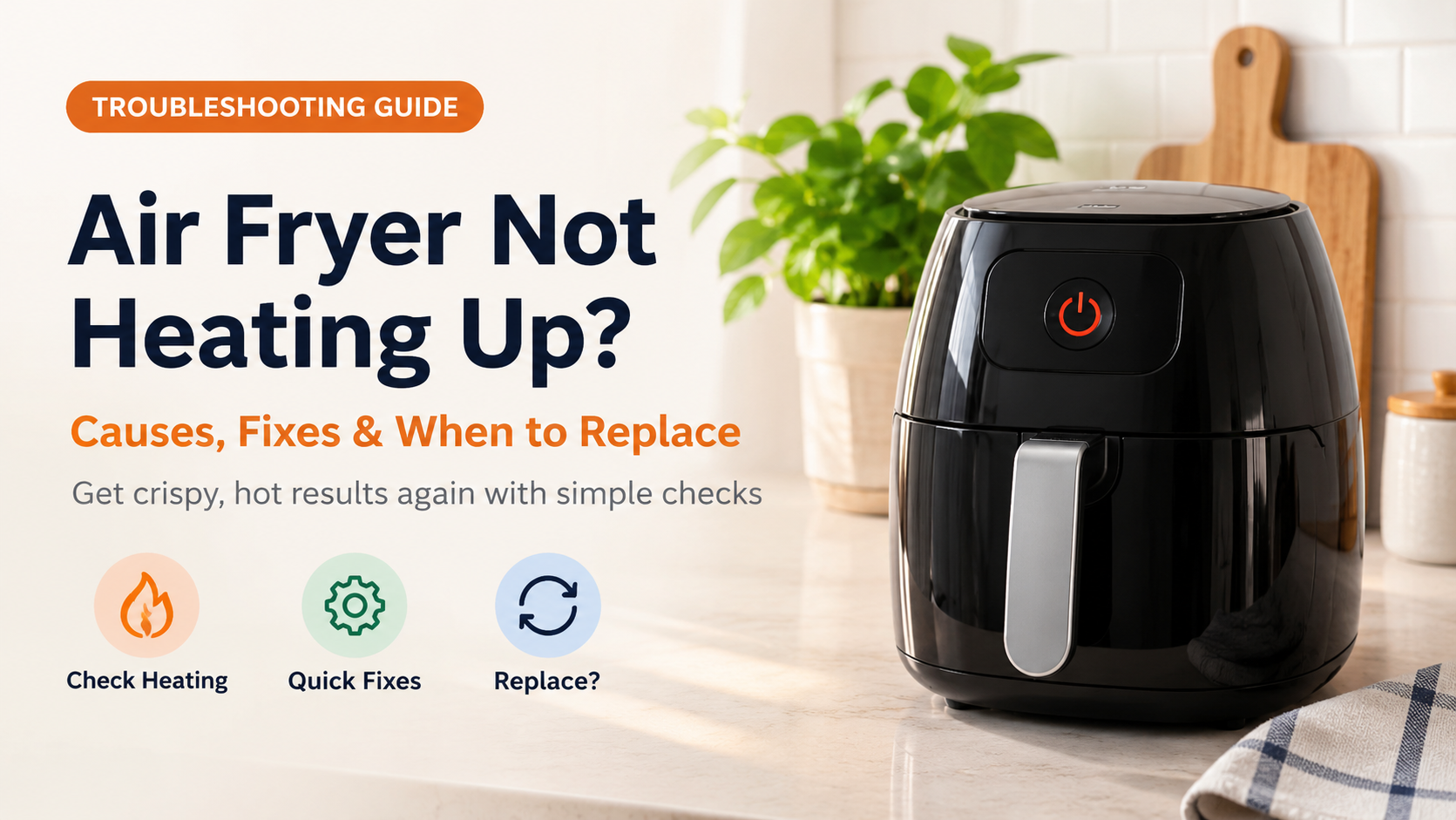

The fan is humming, the display is lit, and the timer is counting down, but your food is coming out pale, soft, or cold in the middle. When an air fryer is not heating up, it can feel like the whole appliance has let you down.
The good news is that this problem is often caused by something simple: a setting, a poorly seated basket, an overloaded drawer, or a dirty fan. Only a smaller share of cases come down to a failed heating element or thermostat. This guide covers every likely cause in the order you should check it, so you can fix the problem quickly, or know for sure when it is time to repair or replace the unit.
Quick Answer: Why Is My Air Fryer Not Heating Up?
An air fryer usually stops heating properly because of incorrect settings or no preheating, a basket that is not fully seated, an overloaded basket that blocks airflow, blocked vents or a greasy fan, or weak power from an extension cord. If all of those are ruled out, the likely culprit is a failed heating element, thermostat, temperature sensor, or thermal fuse.
Safety first: Always unplug the air fryer and let it cool completely before you clean it or look inside. Never open the housing, touch the heating element while it is hot, or use the appliance if you notice a burning smell, sparks, or a damaged cord. Keep the control panel and plug completely dry.
Table of Contents
- How an air fryer actually heats
- Check the settings and preheat
- Seat the basket properly
- Do not overload the basket
- Clean the fan, vents, and heating area
- Check the power supply
- Reset overheat protection
- Test the temperature and inspect the element
- Check the warranty and contact support
How an Air Fryer Actually Heats Your Food
An air fryer is a compact convection oven. A heating element near the top creates heat, a fan pushes that hot air down and around the food, and a thermostat or temperature sensor switches the element on and off to hold your chosen temperature. A built-in safety switch also stops the heater if the basket is not in place.
If any one of these parts is blocked, dirty, or failing, you will notice weak heat, uneven cooking, or no heat at all. Knowing this chain makes troubleshooting much easier.

Common Symptoms of an Air Fryer Not Heating
- The fan runs and the display works, but the air stays cool or only lukewarm.
- Food comes out pale, soggy, or undercooked, even after the full cooking time.
- The air fryer heats for a minute or two and then stops.
- Only one side of the food browns.
- The unit takes much longer than before to reach the temperature.
Fix 1: Check the Settings and Preheat
Before suspecting a fault, make sure the basics are right. Confirm that you selected the correct temperature, not just a time. On some models a preset such as “Dehydrate” or “Keep Warm” uses very low heat, so a food that should be crisp barely warms up.
- Set both the temperature and the timer, then press start.
- Preheat for 3 to 5 minutes, especially for frozen foods, breaded items, and thick cuts of meat.
- Check that you are not using a low-temperature mode by accident.
- Do not open the basket repeatedly. Every time the drawer opens, a lot of heat escapes.
Fix 2: Seat the Basket Properly
Air fryers have a safety switch that only lets the heater work when the basket is completely inserted. If it is slightly out of position, the fan may run while the heating element stays off.
- Pull the basket out completely, then push it back in firmly until it clicks.
- Check that the basket sits flat in its tray and that the handle is attached securely.
- Look for crumbs, grease, or foil that might stop the drawer from closing fully.
- For oven-style models, make sure the door is fully shut and the latch is engaged.
Fix 3: Do Not Overload the Basket
An air fryer cooks with moving hot air. When the basket is packed, the air cannot circulate, and the food steams instead of crisping. This feels like a heating problem, even though the appliance is working normally.
- Fill the basket no more than about two-thirds full.
- Spread food in a single, loose layer wherever possible.
- Cook large amounts in two batches rather than one crowded one.
- Avoid covering the whole basket floor with foil or parchment, as it blocks airflow. Use only liners made for air fryers, with holes.
- Pat food dry and shake the basket halfway through cooking.

Fix 4: Clean the Fan, Vents, and Heating Area
Grease and food residue build up over time on the fan, the vents, and around the element. A heavy layer can block airflow, trigger overheat protection, and cause weak or uneven cooking.
- Unplug the air fryer and let it cool for at least 30 minutes.
- Remove the basket and wash it with warm, soapy water. Dry it fully.
- Turn the unit upside down and gently wipe the heating element and surrounding area with a damp, soft cloth or a soft brush.
- Clear the air vents on the back and top with a dry brush.
- Let everything dry completely before plugging the unit back in.
Do not use abrasive pads, metal tools, or harsh chemicals on the heating element. Never pour water into the unit.
Fix 5: Check the Power Supply
Air fryers use a lot of electricity, usually 1,400 to 1,800 watts. If the power reaching the unit is weak, the fan may run normally while the element struggles to heat.
- Plug the air fryer straight into a wall outlet, not an extension cord or power strip.
- Avoid sharing the circuit with a microwave, kettle, toaster, or other heavy appliance while cooking.
- Test a different outlet, ideally on a separate circuit.
- Check the plug and cord for damage, discoloration, or looseness. If you see any, stop using the unit.
Fix 6: Reset the Overheat Protection
Most air fryers include an overheat or thermal protection feature. If the unit gets too hot, because of blocked vents, grease buildup, or back-to-back batches, it can cut power to the heater while the fan keeps running.
- Unplug the air fryer.
- Remove the basket and let the unit cool for at least 30 minutes.
- Make sure the unit has about 5 inches (13 cm) of free space on all sides, especially behind it.
- Plug it back in and run a short empty test.
If the heat returns, the protection feature had tripped. Keep the vents clear and avoid cooking in tight spaces or under low cabinets.

Fix 7: Test the Temperature and Inspect the Element
If everything above checks out, it is worth testing the actual heat output. A cheap oven-safe thermometer makes this easy.
- Place an oven-safe thermometer in the empty basket, away from the sides.
- Set the air fryer to 350°F (180°C) and run it for 5 to 10 minutes.
- Carefully check the reading once the cycle ends and the unit has paused, using an oven mitt.
A reading far below the set temperature, or no rise at all, points to a weak or failed heating element, thermostat, or temperature sensor. Because the thermometer sits near the basket rather than the sensor, expect small differences, but a large gap is a warning sign.
You can also inspect the element when the unit is unplugged and cool. Look for a broken coil, blistered or flaking areas, or dark burn spots. Any visible damage means the air fryer should not be used again until it is repaired or replaced. Do not try to bend, repair, or replace the element yourself.
Fix 8: Check the Warranty and Contact Support
When you have ruled out all the simple causes, the fault is almost certainly internal: a failed heating element, thermostat, temperature sensor, thermal fuse, or control board. These parts are not made to be serviced at home, and opening the casing can void your warranty and is unsafe.
- Find your receipt, order confirmation, or serial number.
- Check whether the unit is still under warranty. One to two years is common.
- Contact the manufacturer and describe what you have already tried.
- Ask for a repair, replacement, or refund if your model is covered.
Symptom Guide: What Your Air Fryer Is Telling You
| Symptom | Most Likely Cause | What to Try |
|---|---|---|
| Fan runs, air stays cool | Basket unseated or failed element | Reseat the basket, then test with a thermometer |
| Food is pale or soggy | Overloaded basket or no preheating | Cook smaller batches and preheat |
| Heats, then stops | Overheating or blocked vents | Cool down 30 minutes and clear vents |
| Slow to reach temperature | Weak power or dirty element | Use a wall outlet and clean the unit |
| Uneven browning | Poor airflow or food crowded | Shake the basket and leave space |
| Error code on display | Sensor or temperature fault | Check the manual and restart the unit |
| Burning smell or sparks | Electrical fault | Unplug immediately and stop using it |
When to Repair and When to Replace Your Air Fryer
Most air fryers are affordable, sealed appliances, so a professional repair is often close to the price of a new one. If the unit is out of warranty and the repair would cost more than half the price of a comparable new model, replacing it usually makes more sense.
Replace it right away if you notice a burning smell, melted plastic, sparks, a damaged cord, or a visibly broken heating coil.

How to Keep Your Air Fryer Heating Properly
- Wipe it down regularly. Clean the basket after each use and the inside every few uses.
- Preheat when needed. A few minutes makes a big difference for frozen and breaded foods.
- Avoid overcrowding. Food should have room for air to move around it.
- Keep the vents clear. Leave at least 5 inches of space around the unit.
- Use the right accessories. Use only liners and racks designed for air fryers.
- Skip extension cords. Plug directly into a wall outlet.
- Do not spray aerosol cooking sprays on the basket. Propellants can damage nonstick coatings and leave sticky residue.
- Handle the basket gently. Dropping or bending it can stop it from seating properly.
What to Look for in a Replacement Air Fryer
If your air fryer has reached the end of its life, use it as a chance to choose one that fits the way you cook:
- Capacity: 2 to 3 quarts suits one or two people, 4 to 6 quarts suits most families, and 7 quarts or more suits batch cooking.
- Wattage: Look for 1,500 watts or more for fast preheating and strong, even heat.
- Temperature range and accuracy: A wide range, usually up to about 400°F (200°C), gives you more cooking options.
- Safety features: Automatic shut-off, overheat protection, and a cool-touch handle matter.
- Easy cleaning: Dishwasher-safe, nonstick baskets make regular cleaning simple.
- Controls: Dials are simple and durable, while digital panels offer presets and precise control.
- Warranty and support: A longer warranty and responsive customer service are strong quality signs.
- Style: Basket models are compact, while oven-style units offer more racks and functions.
Frequently Asked Questions
Why is my air fryer on but not heating?
The most common reasons are an unseated basket, wrong settings, a very full basket, or tripped overheat protection. If all of those are fine, the heating element, thermostat, or temperature sensor may have failed.
Why is my air fryer blowing cold air?
Cold air usually means the fan is working but the heating element is not. Check that the basket is fully inserted, let the unit cool and reset, and plug it directly into a wall outlet. If it still blows cold air, contact the manufacturer.
Why does my air fryer not get hot enough to cook food?
Common reasons include skipping the preheat, overloading the basket, blocked vents, weak power from an extension cord, or a worn thermostat. Try smaller batches and a short preheat first.
Can I fix an air fryer heating element myself?
It is not recommended. The heating element sits inside the sealed housing and involves high-wattage wiring. Opening the unit is unsafe and can void the warranty, so leave repairs to the manufacturer or a qualified technician.
How do I know if my air fryer heating element is bad?
Signs include a running fan with no heat, food that stays raw, a visibly broken coil, or burn marks. A thermometer test showing little or no temperature rise also points to a failing element or sensor.
The fan is humming, the display is lit, and the timer is counting down, but your food is coming out pale, soft, or cold in the middle. When an air fryer is not heating up, it can feel like the whole appliance has let you down.
The good news is that this problem is often caused by something simple: a setting, a poorly seated basket, an overloaded drawer, or a dirty fan. Only a smaller share of cases come down to a failed heating element or thermostat. This guide covers every likely cause in the order you should check it, so you can fix the problem quickly, or know for sure when it is time to repair or replace the unit.
Quick Answer: Why Is My Air Fryer Not Heating Up?
An air fryer usually stops heating properly because of incorrect settings or no preheating, a basket that is not fully seated, an overloaded basket that blocks airflow, blocked vents or a greasy fan, or weak power from an extension cord. If all of those are ruled out, the likely culprit is a failed heating element, thermostat, temperature sensor, or thermal fuse.
Safety first: Always unplug the air fryer and let it cool completely before you clean it or look inside. Never open the housing, touch the heating element while it is hot, or use the appliance if you notice a burning smell, sparks, or a damaged cord. Keep the control panel and plug completely dry.
Table of Contents
- How an air fryer actually heats
- Check the settings and preheat
- Seat the basket properly
- Do not overload the basket
- Clean the fan, vents, and heating area
- Check the power supply
- Reset overheat protection
- Test the temperature and inspect the element
- Check the warranty and contact support
How an Air Fryer Actually Heats Your Food
An air fryer is a compact convection oven. A heating element near the top creates heat, a fan pushes that hot air down and around the food, and a thermostat or temperature sensor switches the element on and off to hold your chosen temperature. A built-in safety switch also stops the heater if the basket is not in place.
If any one of these parts is blocked, dirty, or failing, you will notice weak heat, uneven cooking, or no heat at all. Knowing this chain makes troubleshooting much easier.
Common Symptoms of an Air Fryer Not Heating
- The fan runs and the display works, but the air stays cool or only lukewarm.
- Food comes out pale, soggy, or undercooked, even after the full cooking time.
- The air fryer heats for a minute or two and then stops.
- Only one side of the food browns.
- The unit takes much longer than before to reach the temperature.
Fix 1: Check the Settings and Preheat
Before suspecting a fault, make sure the basics are right. Confirm that you selected the correct temperature, not just a time. On some models a preset such as “Dehydrate” or “Keep Warm” uses very low heat, so a food that should be crisp barely warms up.
- Set both the temperature and the timer, then press start.
- Preheat for 3 to 5 minutes, especially for frozen foods, breaded items, and thick cuts of meat.
- Check that you are not using a low-temperature mode by accident.
- Do not open the basket repeatedly. Every time the drawer opens, a lot of heat escapes.
Fix 2: Seat the Basket Properly
Air fryers have a safety switch that only lets the heater work when the basket is completely inserted. If it is slightly out of position, the fan may run while the heating element stays off.
- Pull the basket out completely, then push it back in firmly until it clicks.
- Check that the basket sits flat in its tray and that the handle is attached securely.
- Look for crumbs, grease, or foil that might stop the drawer from closing fully.
- For oven-style models, make sure the door is fully shut and the latch is engaged.
Fix 3: Do Not Overload the Basket
An air fryer cooks with moving hot air. When the basket is packed, the air cannot circulate, and the food steams instead of crisping. This feels like a heating problem, even though the appliance is working normally.
- Fill the basket no more than about two-thirds full.
- Spread food in a single, loose layer wherever possible.
- Cook large amounts in two batches rather than one crowded one.
- Avoid covering the whole basket floor with foil or parchment, as it blocks airflow. Use only liners made for air fryers, with holes.
- Pat food dry and shake the basket halfway through cooking.
Fix 4: Clean the Fan, Vents, and Heating Area
Grease and food residue build up over time on the fan, the vents, and around the element. A heavy layer can block airflow, trigger overheat protection, and cause weak or uneven cooking.
- Unplug the air fryer and let it cool for at least 30 minutes.
- Remove the basket and wash it with warm, soapy water. Dry it fully.
- Turn the unit upside down and gently wipe the heating element and surrounding area with a damp, soft cloth or a soft brush.
- Clear the air vents on the back and top with a dry brush.
- Let everything dry completely before plugging the unit back in.
Do not use abrasive pads, metal tools, or harsh chemicals on the heating element. Never pour water into the unit.
Fix 5: Check the Power Supply
Air fryers use a lot of electricity, usually 1,400 to 1,800 watts. If the power reaching the unit is weak, the fan may run normally while the element struggles to heat.
- Plug the air fryer straight into a wall outlet, not an extension cord or power strip.
- Avoid sharing the circuit with a microwave, kettle, toaster, or other heavy appliance while cooking.
- Test a different outlet, ideally on a separate circuit.
- Check the plug and cord for damage, discoloration, or looseness. If you see any, stop using the unit.
Fix 6: Reset the Overheat Protection
Most air fryers include an overheat or thermal protection feature. If the unit gets too hot, because of blocked vents, grease buildup, or back-to-back batches, it can cut power to the heater while the fan keeps running.
- Unplug the air fryer.
- Remove the basket and let the unit cool for at least 30 minutes.
- Make sure the unit has about 5 inches (13 cm) of free space on all sides, especially behind it.
- Plug it back in and run a short empty test.
If the heat returns, the protection feature had tripped. Keep the vents clear and avoid cooking in tight spaces or under low cabinets.
Fix 7: Test the Temperature and Inspect the Element
If everything above checks out, it is worth testing the actual heat output. A cheap oven-safe thermometer makes this easy.
- Place an oven-safe thermometer in the empty basket, away from the sides.
- Set the air fryer to 350°F (180°C) and run it for 5 to 10 minutes.
- Carefully check the reading once the cycle ends and the unit has paused, using an oven mitt.
A reading far below the set temperature, or no rise at all, points to a weak or failed heating element, thermostat, or temperature sensor. Because the thermometer sits near the basket rather than the sensor, expect small differences, but a large gap is a warning sign.
You can also inspect the element when the unit is unplugged and cool. Look for a broken coil, blistered or flaking areas, or dark burn spots. Any visible damage means the air fryer should not be used again until it is repaired or replaced. Do not try to bend, repair, or replace the element yourself.
Fix 8: Check the Warranty and Contact Support
When you have ruled out all the simple causes, the fault is almost certainly internal: a failed heating element, thermostat, temperature sensor, thermal fuse, or control board. These parts are not made to be serviced at home, and opening the casing can void your warranty and is unsafe.
- Find your receipt, order confirmation, or serial number.
- Check whether the unit is still under warranty. One to two years is common.
- Contact the manufacturer and describe what you have already tried.
- Ask for a repair, replacement, or refund if your model is covered.
Symptom Guide: What Your Air Fryer Is Telling You
| Symptom | Most Likely Cause | What to Try |
|---|---|---|
| Fan runs, air stays cool | Basket unseated or failed element | Reseat the basket, then test with a thermometer |
| Food is pale or soggy | Overloaded basket or no preheating | Cook smaller batches and preheat |
| Heats, then stops | Overheating or blocked vents | Cool down 30 minutes and clear vents |
| Slow to reach temperature | Weak power or dirty element | Use a wall outlet and clean the unit |
| Uneven browning | Poor airflow or food crowded | Shake the basket and leave space |
| Error code on display | Sensor or temperature fault | Check the manual and restart the unit |
| Burning smell or sparks | Electrical fault | Unplug immediately and stop using it |
When to Repair and When to Replace Your Air Fryer
Most air fryers are affordable, sealed appliances, so a professional repair is often close to the price of a new one. If the unit is out of warranty and the repair would cost more than half the price of a comparable new model, replacing it usually makes more sense.
Replace it right away if you notice a burning smell, melted plastic, sparks, a damaged cord, or a visibly broken heating coil.
How to Keep Your Air Fryer Heating Properly
- Wipe it down regularly. Clean the basket after each use and the inside every few uses.
- Preheat when needed. A few minutes makes a big difference for frozen and breaded foods.
- Avoid overcrowding. Food should have room for air to move around it.
- Keep the vents clear. Leave at least 5 inches of space around the unit.
- Use the right accessories. Use only liners and racks designed for air fryers.
- Skip extension cords. Plug directly into a wall outlet.
- Do not spray aerosol cooking sprays on the basket. Propellants can damage nonstick coatings and leave sticky residue.
- Handle the basket gently. Dropping or bending it can stop it from seating properly.
What to Look for in a Replacement Air Fryer
If your air fryer has reached the end of its life, use it as a chance to choose one that fits the way you cook:
- Capacity: 2 to 3 quarts suits one or two people, 4 to 6 quarts suits most families, and 7 quarts or more suits batch cooking.
- Wattage: Look for 1,500 watts or more for fast preheating and strong, even heat.
- Temperature range and accuracy: A wide range, usually up to about 400°F (200°C), gives you more cooking options.
- Safety features: Automatic shut-off, overheat protection, and a cool-touch handle matter.
- Easy cleaning: Dishwasher-safe, nonstick baskets make regular cleaning simple.
- Controls: Dials are simple and durable, while digital panels offer presets and precise control.
- Warranty and support: A longer warranty and responsive customer service are strong quality signs.
- Style: Basket models are compact, while oven-style units offer more racks and functions.
Frequently Asked Questions
Why is my air fryer on but not heating?
The most common reasons are an unseated basket, wrong settings, a very full basket, or tripped overheat protection. If all of those are fine, the heating element, thermostat, or temperature sensor may have failed.
Why is my air fryer blowing cold air?
Cold air usually means the fan is working but the heating element is not. Check that the basket is fully inserted, let the unit cool and reset, and plug it directly into a wall outlet. If it still blows cold air, contact the manufacturer.
Why does my air fryer not get hot enough to cook food?
Common reasons include skipping the preheat, overloading the basket, blocked vents, weak power from an extension cord, or a worn thermostat. Try smaller batches and a short preheat first.
Can I fix an air fryer heating element myself?
It is not recommended. The heating element sits inside the sealed housing and involves high-wattage wiring. Opening the unit is unsafe and can void the warranty, so leave repairs to the manufacturer or a qualified technician.
How do I know if my air fryer heating element is bad?
Signs include a running fan with no heat, food that stays raw, a visibly broken coil, or burn marks. A thermometer test showing little or no temperature rise also points to a failing element or sensor.
Can a dirty air fryer stop it from heating?
Yes. Grease buildup on the fan, vents, and element reduces airflow and can trigger overheat protection, leading to weak or uneven heat. Regular cleaning prevents this.
How long does an air fryer last?
With proper care, most air fryers last about three to five years, and often longer. Regular cleaning, sensible loading, and good ventilation help extend their life.
Final Thoughts
An air fryer that is not heating up is usually fixable. Start with the easy checks: settings, preheating, basket position, and load size. Then clean the fan and vents, use a wall outlet, and let the unit cool down. If it still will not heat, rely on your warranty or choose a replacement instead of attempting an unsafe repair.
With a little care and the right habits, your air fryer will keep delivering crispy, golden, perfectly cooked meals for years to come.
Disclaimer: This article is for general information only. Always follow your air fryer’s user manual and consult the manufacturer or a qualified technician for electrical repairs.