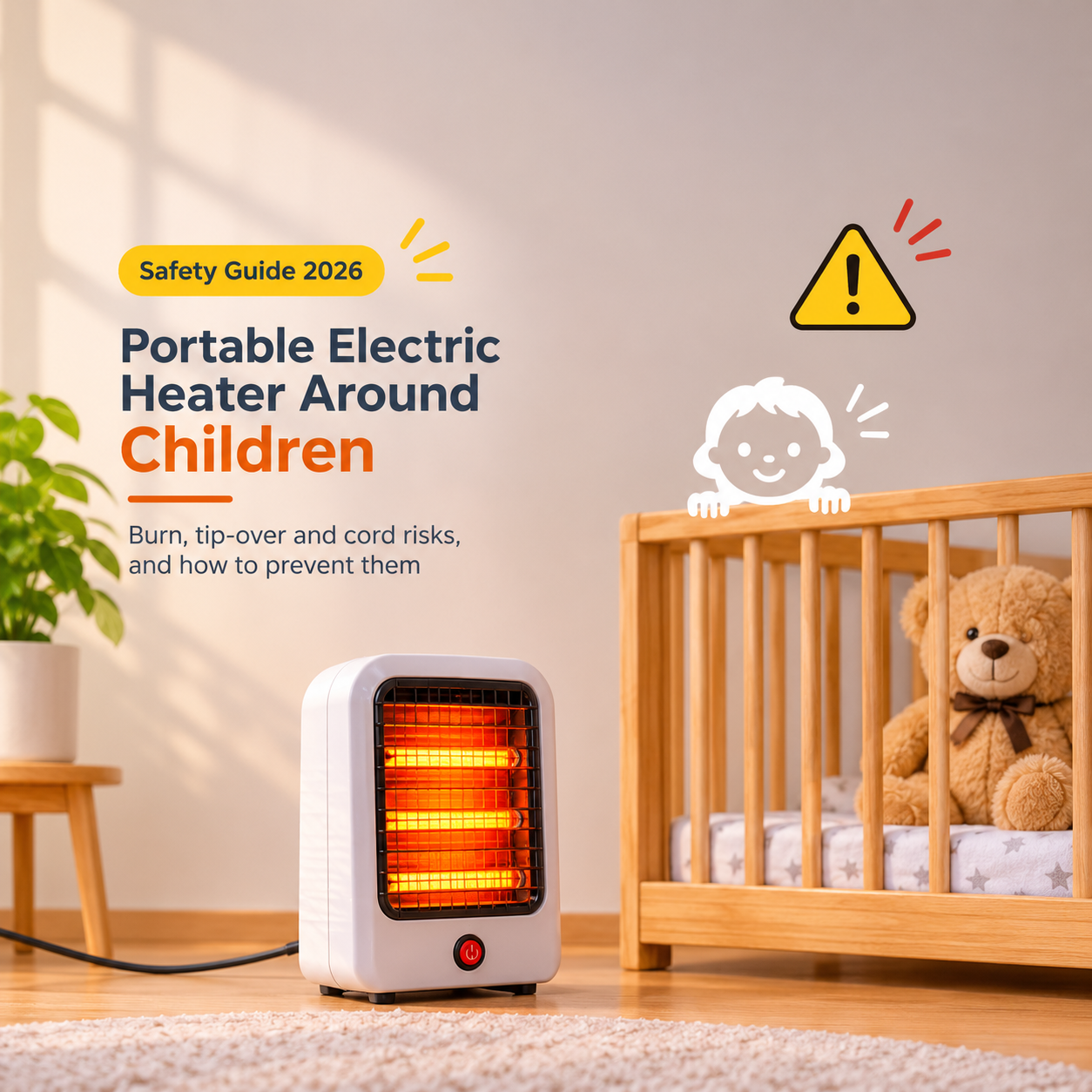
Keeping a home warm is important, especially when little ones are around. But a portable heater and a curious child can be a risky mix. Young children touch, grab, pull and climb, and they do not understand why a hot surface is dangerous. Learning about portable electric heater safety around children helps you protect your family from burns, tip-overs and fires.
This guide explains the main hazards, how to choose a child-conscious heater, how to set up barriers, and what to do if something goes wrong.
Why Heaters Are Dangerous Around Children
- Burns: Many heater surfaces and grilles become hot enough to burn skin quickly, and a child’s skin burns more easily than an adult’s.
- Tip-overs: A child bumping, pulling or climbing on a heater can knock it over.
- Cords: Dangling cords can be pulled, chewed or tripped over, and they may bring the heater down.
- Objects and fabric: Toys, blankets and clothes pushed against a heater can overheat or ignite.
- Controls: Buttons and dials are tempting, and children can change settings without knowing the risks.
What Do Safety Experts Say?
Fire and child-safety organizations recommend keeping heaters well away from children and flammable items, using a barrier where possible, and never leaving a heater running unattended. Many heater manuals also specify minimum clearances and placement rules, which you should follow exactly.
Does the Heater Type Make a Difference?
| Heater type | Child-safety notes | Suitability |
|---|---|---|
| Oil-filled radiator | Surface can still be hot, but no glowing element | Often chosen for family homes, still needs a barrier |
| Convection / panel heater | Lower surface temperature on some models | Reasonable choice, check surface heat in the manual |
| Wall-mounted heater | Off the floor, out of reach when mounted high | Good option, needs correct installation |
| Ceramic fan heater | Hot air outlet and grille can burn | Use with a barrier, keep out of reach |
| Infrared / quartz | Glowing element, very hot surface | Not suited to homes with young children |
Choosing a heater with a cooler surface lowers the risk but does not remove it. Treat every heater as hot and keep it out of reach.
Safety by Age Group
| Age group | Typical risk | What to do |
|---|---|---|
| Babies and crawlers (0-1 year) | Reach everything at floor level, cannot understand danger | Keep heaters out of the room or fully behind a fixed barrier; avoid overheating the baby’s sleep space |
| Toddlers (1-3 years) | Curious, grab and pull, fast on their feet | Use a secured safety gate or guard; never leave alone with a heater |
| Preschoolers (3-5 years) | Understand simple rules but forget them | Teach ‘hot, do not touch’ and keep barriers in place |
| School-age children | Can follow rules, may play or dry things near the heater | Reinforce the clear zone and no-drying rule |
Setting Up a Child-Safe Heating Area
1. Choose a stable location
Place the heater on a flat, hard, level surface away from walkways, doors and play areas. Avoid carpet, beds and sofas.
2. Add a secure barrier
Use a sturdy safety gate or heater guard that a child cannot move, climb or squeeze through. Check it regularly and make sure it does not touch the heater itself.
3. Manage the cord
Route the cord along a wall, out of reach, and never across a path. Avoid extension cords and power strips, and unplug the heater when it is not in use.
4. Keep the zone clear
Remove toys, blankets, clothes, pillows and paper from within 3 feet of the heater.
5. Teach simple rules
Teach older children that heaters are hot and not for touching, and explain that nothing should be placed on or near them. Reinforce the message often.
6. Supervise closely
Never leave young children alone with a running heater, even for a moment. Switch it off if you must leave the room.
Features to Look For in a Child-Conscious Heater
No feature replaces supervision and a barrier. Treat these as extra layers, and check your heater’s manual for specifics such as surface temperature and clearance.
Safer Ways to Warm Rooms Used by Children
- Pre-warm the room before children enter, then switch the heater off if the manual and room conditions allow.
- Seal drafts around windows and doors to hold heat in.
- Use layered clothing and bedding instead of overheating the room.
- Consider wall-mounted or central heating in rooms where children play often.
- Keep thermal curtains well away from any heater.
If a Child Is Burned
For a minor burn, cool the area under cool running water for about 20 minutes, remove tight clothing or jewelry near the area if it is not stuck to the skin, and cover loosely with a clean non-stick covering. Do not use ice, butter or creams. Seek urgent medical help for large, deep or blistering burns, burns on the face, hands, feet or genitals, or any burn on a baby or young child. If you are unsure, contact a healthcare provider or emergency services.
Common Mistakes to Avoid
- Relying on a tip-over switch instead of a barrier.
- Placing a heater where toys or blankets can reach it.
- Letting children play with the cord or controls.
- Leaving the heater on in a child’s room without supervision.
- Using old or damaged heaters with frayed cords.
Frequently Asked Questions
Is it safe to use a space heater in a child’s room?
It can be done carefully, but it carries risks. Use a heater with strong safety features, keep it behind a secure barrier, place it on a hard level surface, and never leave a child alone with it running. Many parents prefer to heat the room before the child enters.
Can I leave a heater on in a nursery overnight?
Fire safety groups advise turning heaters off when sleeping. Overheating is also a concern for infants. Warm the room beforehand, dress the baby in appropriate layers, and ask your pediatrician about the right room temperature.
What is the safest type of heater for kids?
No portable heater is risk-free. Oil-filled radiators and lower-surface-temperature convection models with tip-over and overheat protection are often chosen over glowing-element designs, and wall-mounted units keep hot surfaces out of reach.
How do I stop my toddler touching the heater?
Use a sturdy safety gate or heater guard that cannot be moved or climbed, keep the heater at least 3 feet from play areas, hide or secure the cord, and consider a model with a child lock.
What should I do if a child touches a hot heater?
For a minor burn, cool the area under cool running water for about 20 minutes and keep the child comfortable. Seek urgent medical help for burns that are large, deep, blistered, on the face, hands or genitals, or on a young child, and call emergency services if you are unsure.
Final Thoughts
Using a portable electric heater around children takes planning but is manageable. Choose a heater with strong safety features, set it on a hard level surface, add a secure barrier, keep a clear 3-foot zone, manage cords, and supervise closely. Whenever you can, warm rooms in advance and turn the heater off before children play or sleep, so everyone stays warm and safe.
Disclosure: Some affiliate sites earn a commission from qualifying purchases at no extra cost to readers. Add your own disclosure text here as required. This article offers general safety information, not medical advice. Consult your pediatrician or local emergency services for specific concerns.