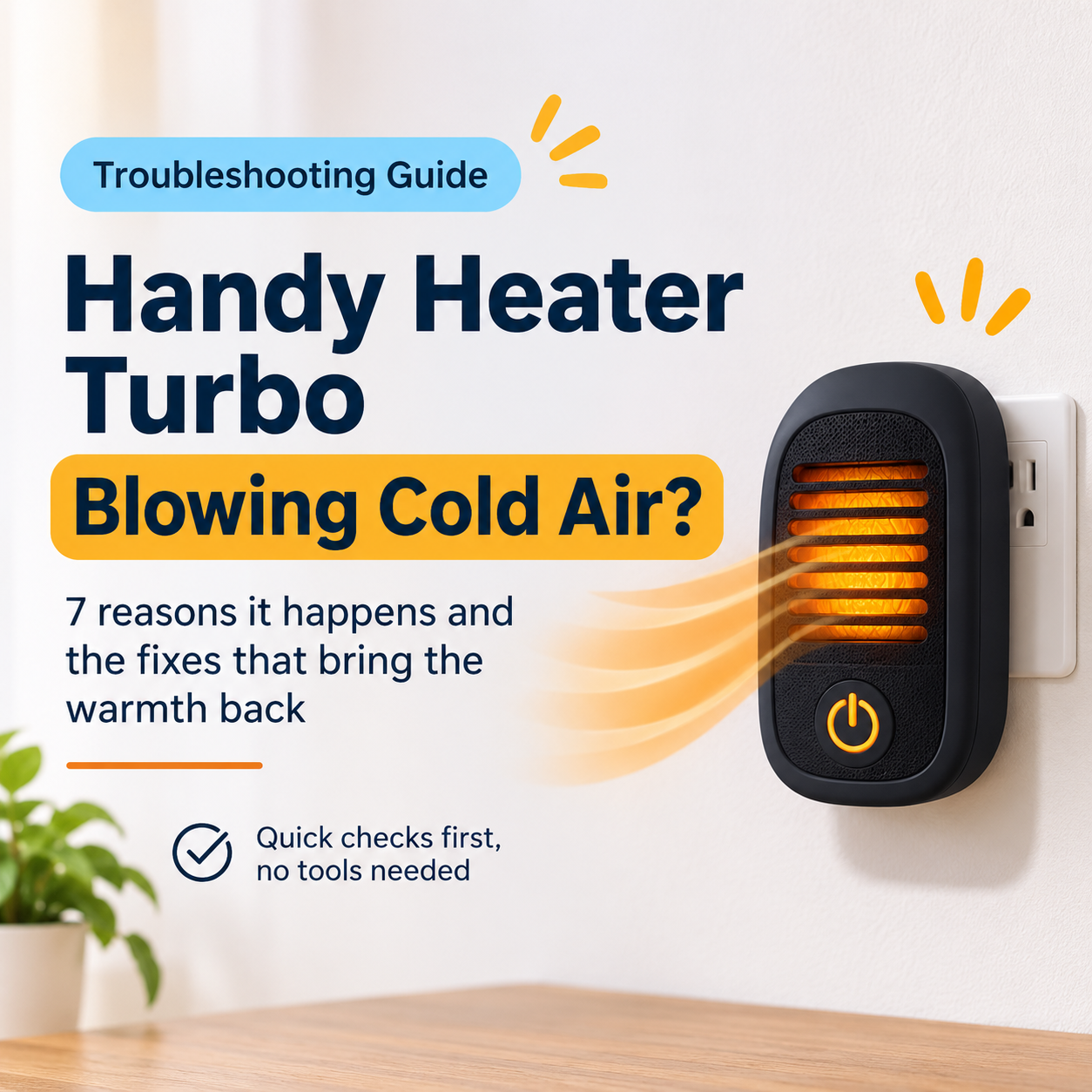
You switch on your heater, hold your hand in front of it and feel… nothing warm. The fan runs, the lights are on, but the air coming out is cold or barely lukewarm. If your Handy Heater Turbo is blowing cold air, it is easy to assume the unit is broken. In many cases, though, the problem is a setting, a short warm-up delay or a simple airflow issue that you can fix in a few minutes.
This guide walks you through every common cause, from the easiest checks to the more serious faults. You will also learn how to tell a normal warm-up from a real problem, how to choose the right heater size for your room, and when it is better to replace the unit.
A heater usually blows cold air because it is set to Fan, Cool or Eco mode, the thermostat is set too low, it is still warming up, or dust is blocking airflow and triggering overheat protection. Check the mode, raise the temperature, wait five minutes, then unplug, cool and clean the vents. If the fan runs but the air stays cold, the heating element or thermal fuse may have failed.
How a small heater actually makes warm air
Understanding the basics makes troubleshooting much easier. A compact room heater has two main jobs working together:
- The heating element. Usually a ceramic or metal element that gets hot when electricity passes through it.
- The fan. It pulls room air across the hot element and pushes it back into the room.
Because these parts work separately, the fan can run perfectly while the element is off. That is why a heater can look and sound normal and still blow cold air. A thermostat, mode selector and safety sensors control when the element is allowed to switch on, so the problem is almost always in one of those controls or in the element itself.
First, check whether your heater is just warming up
Many people switch off a perfectly healthy heater because the first few seconds feel cool. The fan often starts before the element is fully hot. Here is what a normal start usually looks like.
If you are within the first minute or two, just wait. If you have been running the heater on Heat mode for more than five minutes and the air is still cold, move on to the causes below.
7 reasons your Handy Heater Turbo is blowing cold air
1. The wrong mode is selected
Many compact heaters have more than one mode, such as Heat, Fan, Cool or Eco. In Fan or Cool mode, the heating element is switched off on purpose. Eco mode may also keep heat output low to save power.
Fix: select the Heat or High setting on the control panel, then wait a couple of minutes. Check the manual to confirm which button controls the mode on your model.
2. The thermostat is set too low
The thermostat compares the room temperature with your target. If the target is lower than the current room temperature, the element stays off. The fan may still run, so the air feels cool.
Fix: raise the set temperature well above the current room temperature, for example by 5 to 8 degrees Celsius. If the heater starts producing warm air, the thermostat was the reason.
3. The heater is still in its normal warm-up
As explained above, a short warm-up is normal. Very cold rooms and cold power lines can make the first minute feel a little longer.
Fix: hold your hand a few inches from the outlet after two to three minutes. Warm air confirms the heater is healthy.
4. Blocked airflow triggers overheat protection
Dust, pet hair or a covered vent traps heat inside the heater. The overheat sensor then cuts power to the element to protect the unit, but the fan often keeps running. You feel cold air and think the heater has failed.
Typical sign: the heater blew warm air at first, then turned cold after a few minutes, and the case feels hot.
Fix: unplug the heater, wait 30 minutes, vacuum the intake and outlet with a brush attachment, then move it away from walls and furniture. Test again on Heat mode.
5. Weak or unstable power supply
A heating element needs a lot of power. A thin extension cord, a power strip, a worn socket or an overloaded circuit may deliver enough power for the fan and display but not enough for the element. The result is a heater that looks alive but produces little heat.
Fix: plug directly into a wall socket. Try a different socket and avoid using other high-power appliances on the same line.
If the plug, cord or socket feels hot, smells of plastic or shows brown marks, unplug the heater immediately and have the socket checked by a qualified electrician.
6. The room is too big for the heater
Sometimes the heater works exactly as designed, but the room is simply too large, too drafty or too cold. Warm air leaving the outlet mixes with a lot of cold air and feels cool a short distance away. This is especially common in rooms with high ceilings, large windows or bare floors.
Fix: move the heater closer to where you sit, close doors and curtains, seal obvious drafts and consider a heater with a higher rated wattage for larger spaces.
7. A failed heating element or blown thermal fuse
If the fan runs but the air is cold in every mode, at every temperature and from a clean, properly powered heater, the heating element or a thermal fuse has probably failed. Cheap components, constant daily use, power surges and dust can all shorten their life.
Typical sign: no warmth at all, no change when you adjust the thermostat, and no clicking sound from the controls.
Fix: do not open the heater. Contact the seller or manufacturer while the product is under warranty, or replace the unit.
Diagnose the problem in four questions
Use this simple chart to find the cause without guessing.
Symptoms and what they usually mean
| What you notice | Most likely cause | What to do |
|---|---|---|
| Cold for the first minute, then warm | Normal warm-up | Nothing. Wait |
| Fan only, no heat, display normal | Wrong mode or low thermostat | Select Heat and raise the temperature |
| Warm at first, then cold, case is hot | Overheat protection | Cool down and clean the vents |
| Warm air but the room stays cold | Heater too small or drafty room | Use a bigger heater, seal drafts |
| Weak heat, plug feels warm | Power supply issue | Use a wall socket, check the circuit |
| Cold in every mode, no changes at all | Failed element or thermal fuse | Stop, claim warranty or replace |
| Burning smell, sparks, buzzing | Serious fault | Unplug immediately |
Step-by-step fix you can do in 10 minutes
- Select Heat mode. Confirm that the heater is not set to Fan, Cool or Eco.
- Raise the thermostat. Set the temperature clearly above the room temperature.
- Wait five minutes. Give the element time to reach full temperature.
- Check the power connection. Plug straight into a wall socket and make sure the plug is fully inserted.
- Clean the vents. Unplug the heater, let it cool for 30 minutes and vacuum the intake and outlet.
- Try another socket. If the heater works elsewhere, the original socket or circuit is the problem.
- Test again. Run it on Heat for at least ten minutes while you stay in the room.
Prevent cold air problems in the future
- Vacuum the vents every two to four weeks during the heating season.
- Keep at least 3 feet (about 90 cm) of free space around the heater.
- Avoid extension cords and power strips.
- Do not use the heater on thick carpet or soft surfaces.
- Store it clean and dry at the end of the season.
- Do not leave it running for many hours unattended.
When to stop troubleshooting
Unplug the heater and stop using it if you notice a burning smell, scorch marks, a melted or discoloured plug, sparks, crackling sounds or a damaged cord. If the heater is still within its warranty period, contact the seller with your order details and a short description of the problem. Never open the casing yourself.
Should you replace it? What to look for in a new heater
If your heater blows cold air in every mode after you have worked through every step above, repair is rarely worth it for a low-cost compact unit. A replacement is usually cheaper and safer. Compare these points before you buy:
- Rated wattage that matches your room. See the sizing chart above. Honest listings clearly show the wattage.
- Adjustable thermostat. It keeps the temperature steady and avoids constant cycling.
- Tip-over and overheat protection. Both are essential safety features.
- Recognised safety certification. Look for marks such as UL, ETL or CE on the product or packaging.
- Clear warranty and return policy. It protects you if the heater fails early.
- Real customer reviews. Read recent reviews that mention long-term use, not only first impressions.
Be careful with listings that promise to heat an entire house with a tiny device using very little electricity. A heater that produces a lot of heat must draw a lot of power. Realistic claims are a good sign of a trustworthy product.
Frequently asked questions
Why is my Handy Heater Turbo blowing cold air right after I turn it on?
Most heaters start the fan a moment before the heating element reaches full temperature, so the first 30 to 60 seconds can feel cool. If the air is still cold after about five minutes on Heat mode, check the mode, the thermostat setting and the power connection.
Can the thermostat make a heater blow cold air?
Yes. When the room reaches the temperature you set, the element switches off and the fan may keep running to cool the unit down. Raise the target temperature to make the heater heat again.
Does a dirty filter or vent cause cold air?
It can. Blocked airflow makes the inside of the heater run hot, and the overheat protection may switch the element off while the fan continues to run. Cleaning the vents often restores normal heating.
Is it safe to keep using a heater that only blows cold air?
It is not dangerous in itself, but it means a safety device has acted or a part has failed. Do not use it if you notice burning smells, discoloured plugs or unusual noises.
Can I repair a failed heating element myself?
No. Opening a heater exposes you to mains voltage and usually voids the warranty. Contact the seller or manufacturer, or replace the unit.
How do I know if the heater is too small for my room?
If the air at the outlet feels warm but the room never gets comfortable, the heater is probably undersized, or the room is losing heat through drafts. Compare the heater’s rated wattage with your room size.
Final thoughts
When a Handy Heater Turbo blows cold air, do not panic. Start with the simple checks: confirm Heat mode, raise the thermostat, allow a few minutes for warm-up, plug directly into the wall and clean the vents. These steps solve the majority of cases. If the fan still blows only cold air, the problem is likely a failed heating element or thermal fuse, and the safest choice is to use your warranty or replace the heater.
Whatever you decide, never bypass safety features or open the heater yourself. A properly sized, certified and well-maintained heater will keep your room comfortable and your home safe.
Disclaimer: This article is for general information only. Always follow the instructions in your product manual and consult a qualified electrician or the manufacturer for repairs. Some pages on this site may earn a commission from qualifying purchases at no extra cost to you.