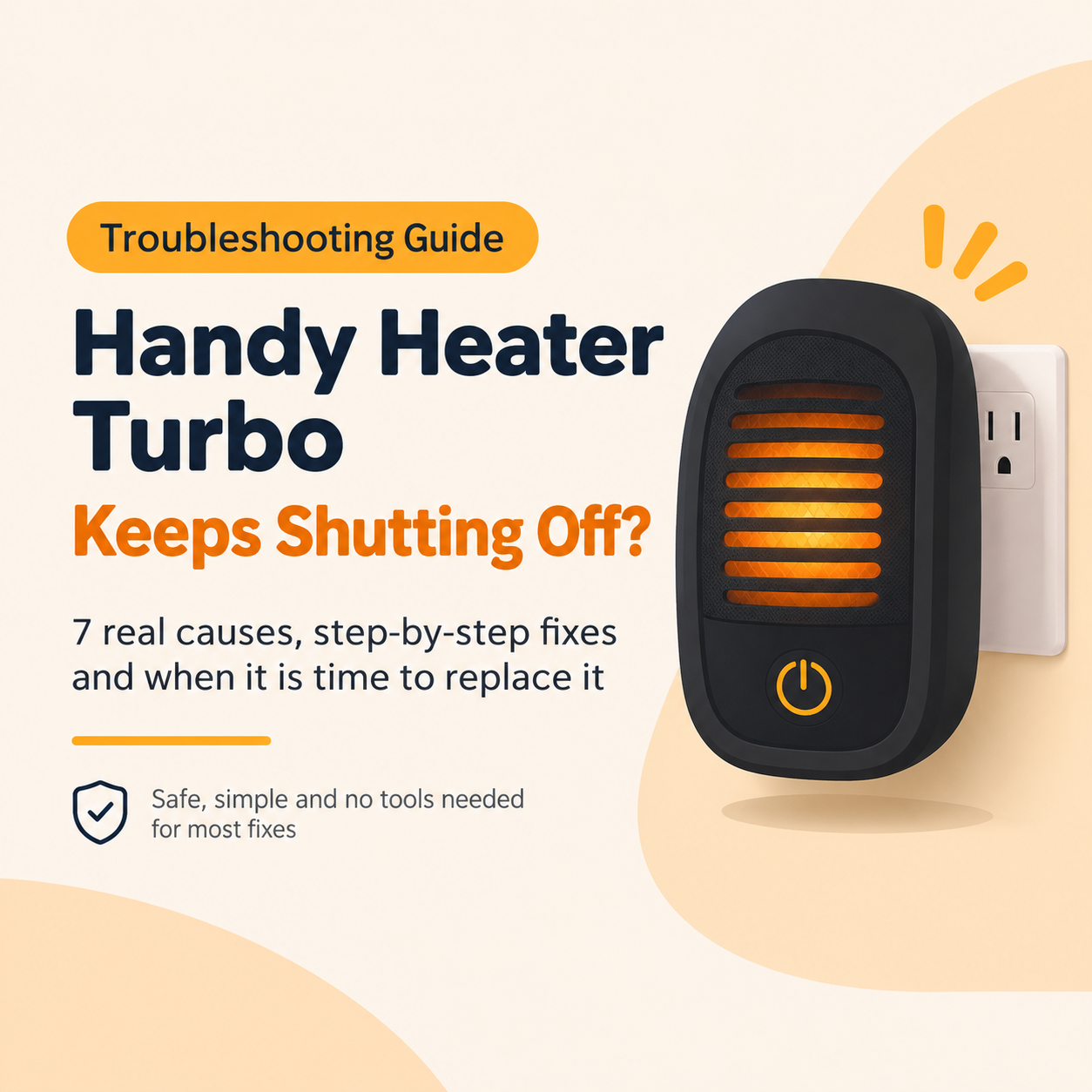
You switch your heater on, the room starts to warm up, and then, without any warning, the heater clicks off. You press the button again. It runs for a few minutes and shuts down once more. If this sounds familiar, you are not alone. A Handy Heater Turbo that keeps shutting off is one of the most common complaints with compact room heaters, and in most cases the cause is simple and fixable at home.
This guide explains exactly why it happens, how to find the real cause in a few minutes, how to fix it safely, and how to decide whether it is time to replace the heater. Everything here is written in plain language, so you do not need any technical knowledge.
In most cases a compact heater shuts off because of blocked airflow (dust on the intake or vents), a tilted or soft surface that triggers the tip-over switch, or a poor power connection such as an extension cord. Unplug the heater, let it cool for 30 minutes, clean the vents, place it on a hard flat surface and plug it directly into a wall socket. If it still shuts off, the cause is likely an internal fault.
Why a heater shuts itself off in the first place
It helps to understand one thing before you start: a heater that turns itself off is usually doing its job. Modern portable heaters include several safety features designed to cut the power the moment something looks unsafe. The three you will meet most often are:
- Overheat protection. A temperature sensor or thermal fuse switches the heater off when the internal temperature rises too high.
- Tip-over protection. A small switch at the base cuts power if the unit is knocked, tilted or not sitting level.
- Thermostat control. A thermostat turns the heating element off when the room reaches the temperature you selected, then turns it on again when the room cools.
So the real question is not “why is my heater broken?” but “which safety feature is being triggered, and why?” The rest of this article helps you answer exactly that.
7 common reasons your Handy Heater Turbo keeps shutting off
1. Blocked airflow and dust build-up
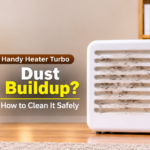
This is the number one cause. Heaters pull air in, pass it over a hot element and push it out. Dust, pet hair, lint and fibres collect on the intake grille and inside the vents. When airflow drops, heat has nowhere to go, the internal temperature climbs and the overheat sensor switches the heater off.
Typical sign: the heater runs for one to three minutes, turns off, and works again after it cools down. The outer case often feels very hot.
Fix: unplug the heater, wait 30 minutes, then clean the intake and outlet with a vacuum cleaner and a soft brush. Make sure nothing is covering or sitting close to the vents.
2. Tip-over switch triggered
The tip-over switch is a safety device that detects when the heater is no longer upright. On a thick carpet, a rug, a bed or an uneven floor, a small tilt may be enough to activate it. Sometimes the switch gets stuck from dust or a previous knock.
Typical sign: the heater stops when you walk past, when the floor vibrates or when you move the unit.
Fix: move the heater to a hard, flat surface such as tile or wood. Gently lift it and set it down again. If it works on a hard floor but not on carpet, the switch is simply doing its job.
3. Weak or unstable power supply
Heaters use much more power than most household devices. A thin extension cord, a multi-socket power strip, a worn socket or a socket shared with other appliances can reduce the voltage that reaches the heater. Some units will shut off to protect themselves when the supply is unstable.
Typical sign: the plug or cord feels warm, the lights flicker when the heater starts, or the heater works in one room but not in another.
Fix: plug the heater straight into a wall socket. Try a different socket on a different circuit. Do not run other high-power devices on the same line while the heater is on.
If the plug, cord or socket feels hot, smells of plastic or shows discoloration, stop using the heater immediately. A hot plug is a fire risk and needs a professional check.
4. The thermostat is doing its normal job
Many people think the heater is faulty when it is actually working perfectly. When the room reaches the temperature set on the thermostat, the heating element turns off. The fan may continue to run for a short time. When the room cools by a few degrees, the heater turns back on.
Typical sign: the room already feels warm, and the heater switches on and off in a regular pattern.
Fix: raise the thermostat setting or move the heater further away from the temperature sensor’s line of sight if your model lets you adjust it. If the room is still cold when it shuts off, this is not the cause.
5. Timer, eco or auto-off mode is active
Many compact heaters have a timer or an energy-saving mode that turns the unit off after a fixed period. If it was set by accident, the heater will appear to shut down at random.
Typical sign: the heater always stops after about the same amount of time, for example 30 minutes, one hour or two hours.
Fix: check the display or control panel and cancel the timer. Read the manual to learn which button controls the timer and eco mode on your unit.
6. Tripped breaker, GFCI or protected outlet
Sometimes the heater is not the problem at all. An overloaded circuit may trip the breaker, and some outlets have built-in protection that cuts power when they detect a fault or heavy load.
Typical sign: other devices on the same socket or in the same room lose power at the same time as the heater.
Fix: check your breaker panel and any reset buttons on nearby sockets. If the breaker trips repeatedly, ask a qualified electrician to inspect the circuit.
7. Internal fault or worn components
If you have cleaned the heater, moved it, changed the socket and checked every setting, the cause may be inside the unit. Thermal fuses age, fan motors slow down, connections loosen and thermostats drift over time. Cheap components and heavy daily use make this more likely.
Typical sign: the heater shuts off within seconds, makes a buzzing, rattling or clicking sound, gives off a burning smell, or the fan does not spin properly.
Fix: do not open the heater yourself. Contact the seller or manufacturer while the product is still under warranty, or replace the unit.
Normal behaviour or a real problem?
Use this table to quickly tell the difference between a heater that is working normally and one that needs attention.
| What you notice | Most likely meaning | What to do |
|---|---|---|
| Turns off when the room feels warm | Thermostat reached the set temperature | Nothing. This is normal |
| Turns off after a fixed time, always the same | Timer or auto-off mode | Cancel the timer |
| Turns off after 1 to 3 minutes and the case is hot | Blocked airflow and overheat protection | Clean intake and vents |
| Turns off when moved or on carpet | Tip-over switch | Use a hard flat surface |
| Plug or cord is warm, lights flicker | Weak or overloaded power supply | Use a wall socket, change circuit |
| Burning smell, buzzing, sparks | Serious internal fault | Unplug at once and stop using it |
Step-by-step fix: the 5-step reset routine
- Unplug and cool down. Disconnect the heater from the wall and leave it for at least 30 minutes. This resets the overheat protection.
- Clean the vents. Use a vacuum cleaner with a brush attachment on the air intake and outlet. A can of compressed air or a soft paintbrush also works well. Never use water or liquid cleaner.
- Level the heater. Put it on a hard, flat, dry surface. Check that nothing is touching the base.
- Use a wall socket. Plug directly into the wall. Avoid extension cords and power strips.
- Test for 15 to 20 minutes. Set the heater on a medium or high setting, stay in the room and watch how it behaves. If it runs without stopping, the problem is solved.
If the heater passes this test, repeat the cleaning every two to four weeks during the heating season to prevent the problem from coming back.
Where you place the heater matters
A heater needs space to breathe. When furniture, curtains or bedding sit too close, hot air bounces back into the intake and the temperature inside the unit rises faster than it should. That can trigger repeated shut-offs even when the vents are clean.
Simple maintenance schedule to prevent shut-offs
| How often | Task | Why it matters |
|---|---|---|
| Every week (heavy use) | Wipe the case and check that the vents are clear | Stops dust from building up |
| Every 2 to 4 weeks | Vacuum the intake and outlet grilles | Keeps airflow strong and temperatures low |
| Every month | Inspect the plug and cord for heat marks or damage | Detects wiring problems early |
| Start of each season | Test the tip-over switch gently and check all settings | Confirms safety features work |
| End of each season | Clean, dry and store in a dust-free bag or its box | Prevents dust and moisture damage |
When to stop troubleshooting
Home fixes are great for dust, placement and power problems. But some situations call for immediate action. Unplug the heater and stop using it if you notice any of the following:
- A burning smell that does not disappear after cleaning
- Scorch marks, melted plastic or a discoloured plug
- Sparks, crackling or popping sounds
- A cord that is cracked, frayed or very hot
- The heater shuts off within seconds, every time, even after a full cool-down
If the heater is still within its warranty period, contact the seller with your order details and a short description of the problem. Do not try to open the casing. Doing so can void the warranty and is dangerous.
Is it time to replace it? What to look for in a new heater
Compact, low-cost heaters are designed for small spaces and short sessions. They are convenient and affordable, but they do not always handle long daily use well. If your heater keeps failing even after you have followed every step in this guide, a replacement is the safer and more economical choice than repeated repairs.
Before you buy, take a few minutes to compare the features that really affect reliability and safety.
Match the heater to the room
A very small heater will struggle in a large room. It may run non-stop at full power, overheat and shut off. As a rough guide, many people use around 10 watts of heating power per square foot of floor area. Always check the manufacturer’s recommended room size and choose a model that suits your space instead of pushing a small unit to its limit.
Choose a reputable seller
Whichever model you pick, buy from a seller with clear product details, real customer reviews and an easy return policy. Be careful with listings that make big promises, such as heating a whole house with a tiny device that uses very little electricity. Physics sets a limit: a heater that produces a lot of heat must draw a lot of power. Honest listings show the rated wattage.
Frequently asked questions
Why does my Handy Heater Turbo turn off after a few minutes?
The most common reasons are a blocked air intake that triggers the overheat sensor, a base that is tilted enough to activate the tip-over switch, or a weak power connection such as an extension cord. Clean the vents, place the unit on a hard flat surface and plug it directly into a wall socket.
Is it normal for a small heater to switch off by itself?
It is normal when the built-in thermostat shuts the heating element off because the room has reached the set temperature, or when a timer ends. It is not normal if the heater stops while the room is still cold and the thermostat is set high.
Can I reset an overheat protection switch?
Most portable heaters reset automatically once they cool down. Unplug the unit, wait at least 30 minutes, clean the vents and plug it in again. If your model has a manual reset button, press it only after the heater has fully cooled.
Should I use an extension cord with a heater?
No. Heaters draw a lot of current for their size, and thin extension cords or power strips can overheat, drop the voltage and cause shut-offs. Always use a wall socket whenever possible.
How long should a small portable heater last?
With regular cleaning and normal use, many portable heaters work for several seasons. Heavy daily use, dust, voltage problems and frequent tip-overs shorten that life.
When should I stop troubleshooting and replace it?
Stop immediately if you smell burning, see scorch marks, notice a hot or melted plug, or hear crackling. Also consider replacement if the unit still shuts off after a full clean, a socket change and a test on a different circuit.
Final thoughts
A Handy Heater Turbo that keeps shutting off is frustrating, especially on a cold day, but the cause is usually easy to find. Start with the basics: let it cool, clean the vents, put it on a hard flat surface and plug it directly into the wall. These four actions fix most cases. If the heater still turns off, check the timer and thermostat, test another socket and look for signs of a failing component.
Above all, remember that the shut-off is a safety feature. Do not bypass it, tape down a switch or keep restarting a heater that repeatedly overheats. If you cannot solve the problem safely, replacing the unit with a certified, well-reviewed model is the smartest decision for your comfort and for your home.
Disclaimer: This article is for general information only. Always follow the instructions in your product manual and consult a qualified electrician or the manufacturer for repairs. Some pages on this site may earn a commission from qualifying purchases at no extra cost to you.