Disclosure: This article may contain affiliate links in the product sections you add. If you buy through them, we may earn a small commission at no extra cost to you. This guide is independent and is not affiliated with the heater’s manufacturer.
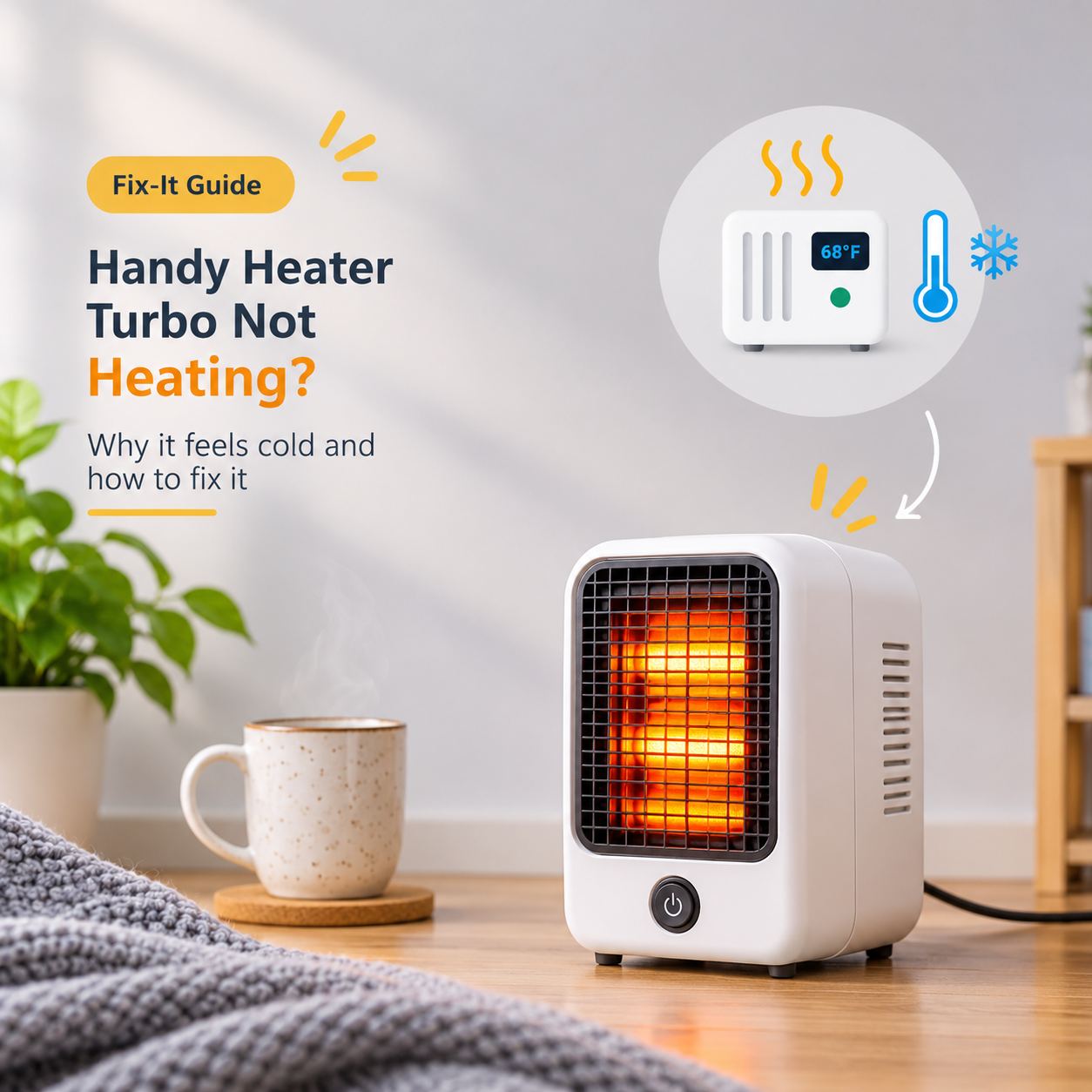
Your Handy Heater Turbo powers on, the display lights up, but the room just does not get warm. Or the air coming out feels barely warmer than the room. It is frustrating, but this problem is usually easier to solve than a heater that will not turn on at all.
In this guide you will learn why a Handy Heater Turbo may not be heating, how to tell a real fault from normal behavior, how to fix each cause, and when it is time to replace the unit or choose a stronger heater.
If the display is on but there is no warmth, first raise the set temperature well above the current room temperature, because the heater stays idle when the room already meets the setting. If it does warm the air but the room stays cold, the 800 watt output is probably too small for the space. Clean the vents, close doors, seal drafts and use it in a small room. If there is no warm air even at the maximum setting after 10 minutes, the unit may be faulty.
Table of Contents
- “Not Heating” vs. “Not Turning On”
- What to Expect From an 800 Watt Plug-In Heater
- Quick Checks
- Troubleshooting Flowchart
- Cause 1: Thermostat Set Too Low
- Cause 2: The Room Is Too Big or Too Cold
- Cause 3: Blocked Vents and Dust
- Cause 4: Overheat Protection
- Cause 5: Drafts and Heat Loss
- Cause 6: Weak Outlet Connection
- Cause 7: A Faulty Element or Imitation Unit
- Symptom Guide
- 8 Ways to Get More Warmth
- Warranty and Safety
- Should You Choose a Stronger Heater?
- Frequently Asked Questions
- Final Verdict
“Not Heating” vs. “Not Turning On”
These are two different problems. If the display stays dark, the issue is usually power, such as a dead outlet. If the display is on but the heater is not warming the room, the problem is usually the thermostat setting, the size of the space, airflow or the heating element. This article focuses on the second situation.
What to Expect From an 800 Watt Plug-In Heater
The Handy Heater Turbo, commonly sold as the Turbo 800, is a compact plug-in ceramic heater generally described as an 800 watt unit with a digital display, adjustable thermostat, timer and auto shut-off. Features vary by version, so check your manual.
Eight hundred watts produces about 2,730 BTU of heat per hour. That is useful for a small personal space, but it is far below what a typical 1,500 watt heater delivers. Marketing often suggests it can warm rooms of 250 square feet or more, but a common rule of thumb of about 10 watts per square foot points to roughly 80 square feet. That gap between expectation and reality is the single most common reason people feel the heater is “not working.”
Quick Checks
- Raise the temperature setting several degrees above the room temperature.
- Wait 5 to 10 minutes. Small heaters need time.
- Hold your hand a few inches in front of the vent, without touching it, to feel for warm air.
- Use a room thermometer to see if the room is actually warming over 20 to 30 minutes.
- Check the timer and clear any setting that may be turning it off.
- Try a different outlet.
Troubleshooting Flowchart
Cause 1: Thermostat Set Too Low
A heater with a thermostat only runs the heating element when the room is colder than the setting. If you set it to 65°F and the room is already 68°F, the heater will sit idle, with the display on and no heat at all. This is very common and easy to fix.
- Set the temperature at least 5 to 10 degrees above the room reading to test.
- Remember that the heater senses the air around itself, which may be warmer than the rest of the room.
- Once you feel warm air, you can lower the setting to a comfortable level.
Do not mistake normal cycling for a fault. When the heater reaches the set temperature, it switches off for a while and comes back on when the air cools. That is how a thermostat works.
Cause 2: The Room Is Too Big or Too Cold
If you can feel warm air at the vent but the room stays chilly, the heater may simply be too small for the job. A plug-in 800 watt heater struggles in large, open or poorly insulated rooms, and in very cold weather.
- Use it in a smaller room or a closed space such as a small bedroom, bathroom or office nook.
- Sit closer to the heater to feel the warmth directly.
- Close the door to stop warmth escaping into the rest of the house.
- If the space is large, choose a higher-wattage heater instead of running this one harder.
Cause 3: Blocked Vents and Dust
Dust and lint can block airflow, so less warm air reaches the room and the unit may overheat. Furniture, curtains and bedding in front of the heater can do the same.
- Unplug the heater and let it cool completely first.
- Gently remove dust from the vents with a soft brush or a vacuum on a low setting.
- Keep at least 3 feet (1 meter) of clear space in front of and around the heater.
- Never cover the heater or use it to dry clothes.
Cause 4: Overheat Protection
The heater has automatic shut-off protection. If it overheats because of blocked airflow, a hot environment or a poor outlet connection, it may cut off heating or the whole unit. It may restart only after it cools down.
- Unplug it and let it cool for at least 30 minutes.
- Clean the vents and make sure airflow is clear.
- Do not use it in a closed cabinet or behind furniture.
- If it keeps shutting off, treat that as a warning and stop using it.
Cause 5: Drafts and Heat Loss
If heat escapes as fast as the heater makes it, the room will not warm up. Gaps under doors, single-pane windows and uninsulated walls all drain warmth.
- Close doors and windows in the room you are heating.
- Use a draft stopper at the door and weatherstripping around windows.
- Hang thick curtains, keeping them well clear of the heater.
- Add a rug over cold floors.
Cause 6: Weak Outlet Connection
Because the heater plugs directly into the wall, a worn or loose outlet can reduce contact and cause the unit to behave erratically. Other devices on the same circuit drawing power can also play a role.
- Try a different outlet on a different circuit.
- Make sure the plug is pushed in fully and sits firmly.
- Plug the heater straight into the wall, not into a power strip or extension cord.
- If the plug or outlet feels hot, unplug it and stop using that outlet.
- Have worn outlets replaced by a qualified electrician.
Cause 7: A Faulty Element or Imitation Unit
If the display is on, the heater is set well above room temperature, and there is still no warm air at the vent after 10 minutes, the heating element or an internal safety part may have failed. Cheap imitations sold under similar names can also deliver weaker heat than genuine units.
- Do not open the heater or try to bypass any safety component.
- Look for visible damage, discoloration or a burning smell. If you notice any, stop using it.
- Contact the seller or manufacturer about a replacement or refund.
Symptom Guide
| Symptom | Likely Cause | What To Do |
|---|---|---|
| Display on, vent air is cool | Set temperature is below the room reading, or the element has failed | Raise the setting well above the room temperature, wait 5 minutes |
| Warm air, but room stays cold | Heater is too small, or the room is drafty or large | Use it in a smaller space, close doors, seal drafts |
| Heats, then shuts off quickly | Thermostat reached its setting, or overheat protection | Raise the setting, clean the vents, let it cool |
| Weak warmth only near the heater | Normal for a small 800 W unit | Sit closer, or use a higher-wattage heater for bigger spaces |
| Heating stops after a while | Timer ended or overheat shut-off | Check the timer, clear dust, unplug and cool |
| Never warms, even at max setting and after 10 minutes | Possible faulty element or imitation unit | Stop troubleshooting and use the warranty or return |
8 Ways to Get More Warmth
Warranty and Safety
- Check your receipt for return and warranty terms, which differ between sellers.
- Do not repair it yourself. Opening a heater is unsafe and can void the warranty.
- Stop using it immediately if you notice a burning smell, melted plastic, sparks, a hot outlet or damage to the plug or housing.
- Do not leave it running unattended or while you sleep unless your model is designed for that.
- Keep flammable items away and keep children and pets clear.
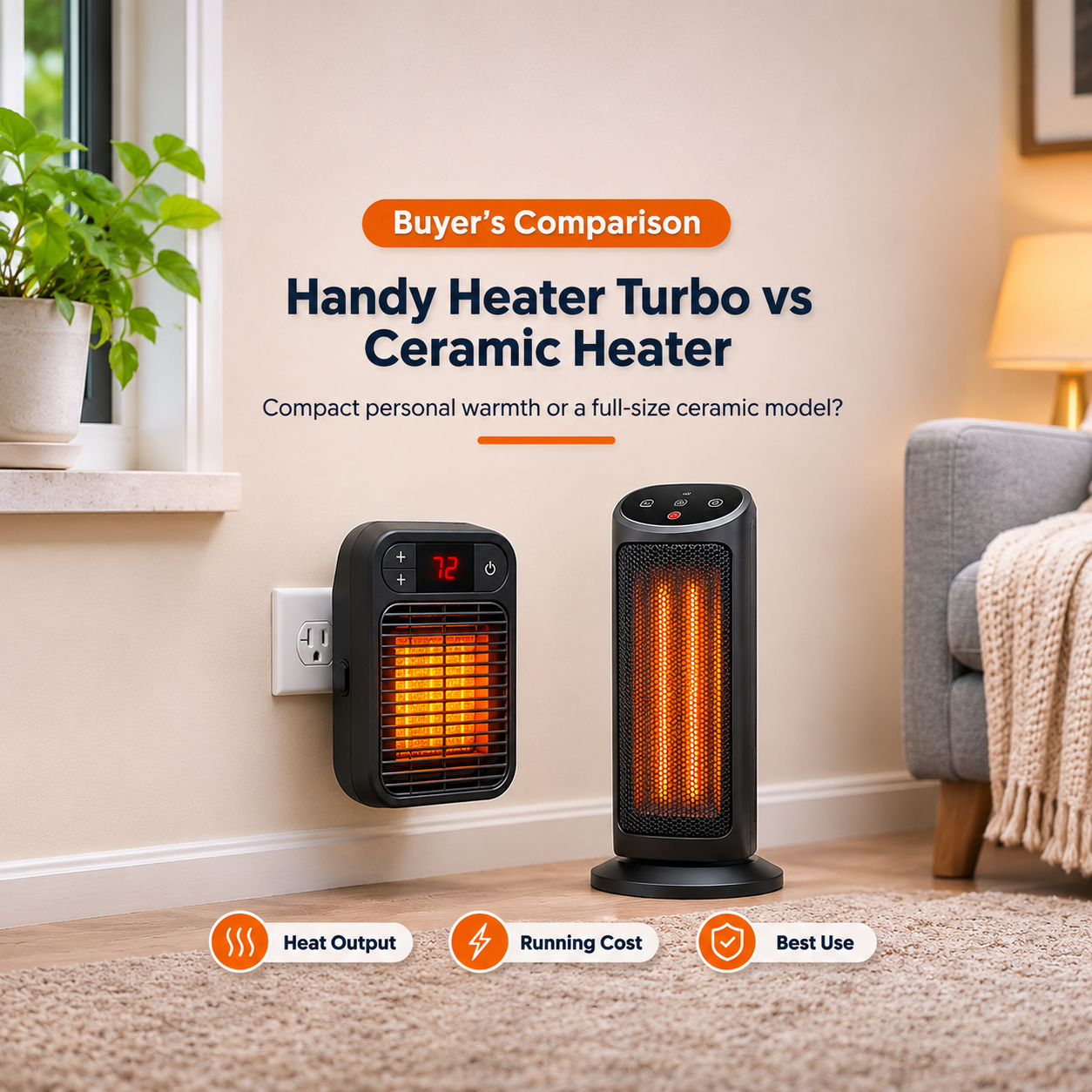
Should You Choose a Stronger Heater?
If the Handy Heater Turbo works but does not warm your space, the best fix may be a different heater. Match the wattage to your room using about 10 watts per square foot as a guide.
| Option | Typical Power | Good For |
|---|---|---|
| Plug-in ceramic (like this one) | About 800 W | Desks, small bathrooms, very small rooms |
| Ceramic fan heater | 750 W to 1,500 W | Small to medium rooms with quick warm-up |
| Oil-filled radiator | Up to about 1,500 W | Bedrooms and steady, quiet heat |
| Infrared heater | Often 300 W to 1,500 W | Spot heating where you sit |
When shopping, look for a recognized safety certification, tip-over and overheat protection, an adjustable thermostat, a timer, enough wattage for your room, and clear return terms.
Frequently Asked Questions
Why is my Handy Heater Turbo blowing cold air?
The most common reason is that the set temperature is below the room temperature, so the heating element is not running. Raise the setting and wait a few minutes. If it is still cold, the element may be faulty.
How long does it take to heat a room?
A small 800 watt heater can take a long time to noticeably warm even a small room, and it may never warm a large one. You should feel warm air at the vent within a few minutes.
Is it normal for it to turn off and on?
Yes, a thermostat cycles the heater on and off to hold the set temperature. Very rapid cycling with little warmth can point to blocked vents or a poor outlet connection.
Can it heat a large room?
Not well. It is best suited to very small spaces and personal warmth. For larger rooms, use a higher-wattage heater.
Why is the air only slightly warm?
Small ceramic heaters deliver warm, not hot, air, and an 800 watt unit has limited output. Warm air that mixes with a cold room feels weaker the farther you are from the heater.
Does a dirty vent affect heating?
Yes. Dust reduces airflow and can cause overheating and shut-offs. Clean the vents regularly while the heater is unplugged and cool.
Can the outlet affect heating?
Yes. A loose or worn outlet, or a shared overloaded circuit, can cause weak or erratic performance. Try another outlet.
How much does it cost to run?
At full power, an 800 watt heater uses 0.8 kWh per hour. At $0.15 per kWh, that is about $0.12 per hour. A thermostat reduces that when the heater cycles off.
When should I replace it?
If it produces no warm air at the maximum setting after you have checked the settings, vents and outlet, or if it shows any warning signs, replace it or use your warranty.
Final Verdict
When a Handy Heater Turbo is not heating, the cause is often simpler than a broken part. Check the thermostat setting first, give the heater a few minutes, clean the vents, test another outlet, and make sure the room is small and sealed against drafts. Keep expectations realistic: an 800 watt plug-in heater is built for small spaces.
If there is still no warm air at the maximum setting, stop using it and seek a replacement or refund rather than attempting a repair. Use the comparison above to choose a heater with enough power for your room, and add your recommended products to this article to help readers find the right one.