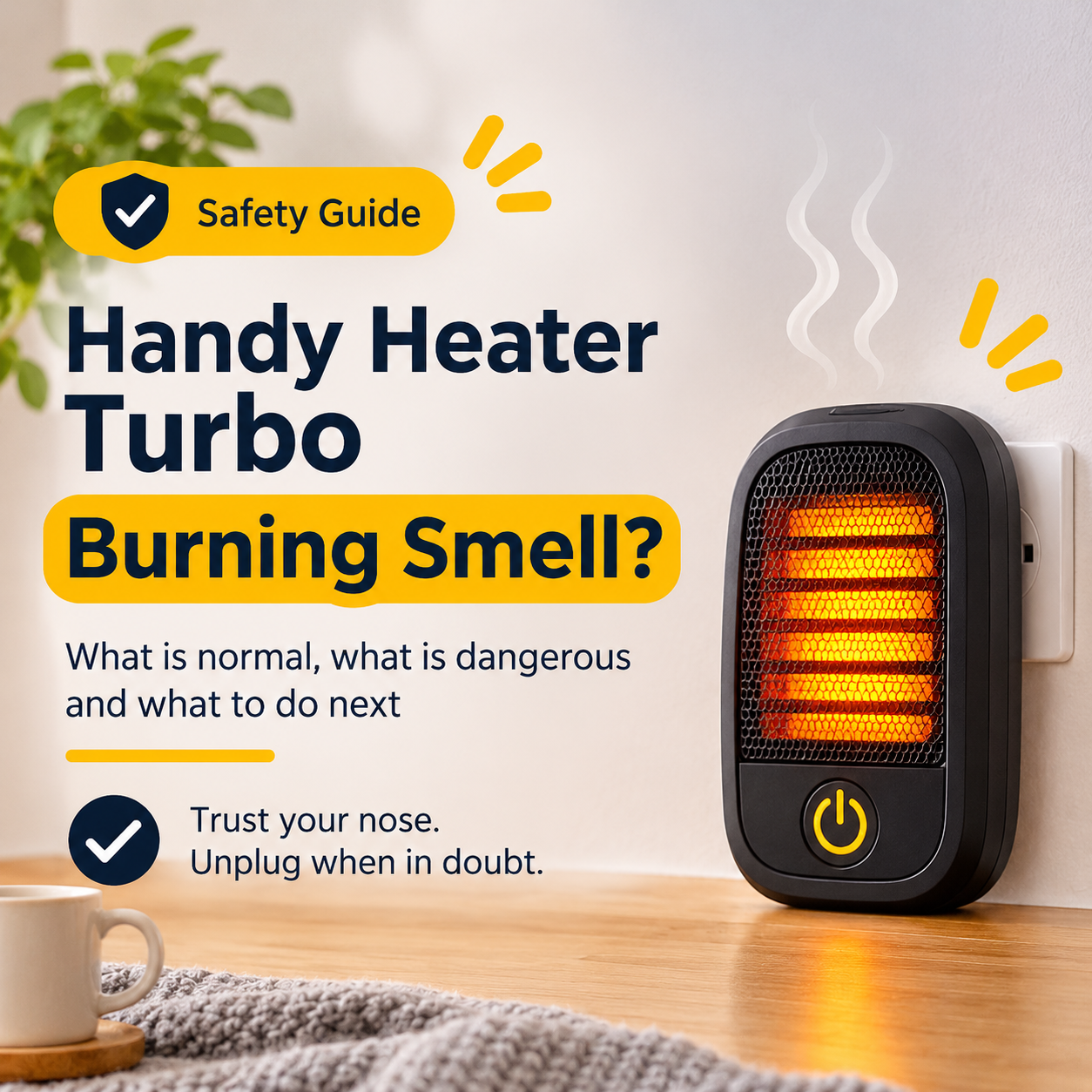
You switch on your heater and a few minutes later you notice it: a smell of burning. It could be a harmless whiff of dust, or it could be the first sign of something serious. If your Handy Heater Turbo has a burning smell, the most important thing is to work out which situation you are in, quickly and calmly.
This guide helps you tell a normal, short-lived smell from a real warning sign. You will learn the seven most common causes, how to read different smells, what to do immediately, how to run in a new heater safely, and when it is time to stop using the heater for good.
If you smell burning plastic, rubber or chemicals, see smoke or sparks, hear crackling, or find a hot plug or cord, switch the heater off and unplug it immediately. If you see flames or smoke, leave the room and call your local emergency number. Do not use water on an electrical fire.
A light dusty or toasty smell that fades within 10 to 30 minutes is usually normal, especially with a new heater or one taken out of storage. A smell of melting plastic, burnt rubber or chemicals, or any smell with smoke, sparks or a hot plug, is a warning. Unplug the heater, let it cool, check the vents, plug and cord, and stop using it if the smell returns.
Why heaters sometimes smell of burning
Every heater has a heating element that gets very hot. Anything that touches that hot surface, such as dust, lint, hair, manufacturing residue or a stray piece of fabric, can burn and create a smell. At the same time, if plastic parts, wiring insulation or the fan motor get too hot, they also produce a smell. The skill is to recognise which smell belongs to which situation.
Smell decoder: what your nose is telling you
Smells are not an exact science, but this chart gives you a safe starting point. When you are unsure, treat the smell as a warning and unplug the heater.
Is it safe to keep using it? A traffic light check
7 reasons your Handy Heater Turbo smells of burning
1. Dust burning off the element
This is the most common and the least worrying cause. During storage or long periods without use, dust settles on the element and inside the vents. When you switch the heater on, the dust heats up and gives off a dry, toasty smell.
Typical sign: a mild smell at the start of the season or after a long break that fades within minutes.
Fix: ventilate the room, run the heater while you are present, and clean the vents regularly. Vacuum the grilles before the first use of the season.
2. Factory residue on a new heater
New heaters can have a thin protective coating or manufacturing residue on the element and metal parts. The first hours of use burn this off and create a light chemical or "new product" smell.
Fix: follow the first-time use routine described below. If the smell is strong, causes headaches or does not fade after a few sessions, stop using the heater and contact the seller.
3. Blocked vents and trapped heat
When vents are clogged or covered, heat has nowhere to go. Dust and even plastic parts get hotter than they should, and you may notice a baked or plastic smell together with a very hot casing and automatic shut-offs.
Fix: unplug the heater, let it cool for at least 30 minutes, vacuum the intake and outlet and keep 3 feet (about 90 cm) of clear space around it.
4. Debris inside or near the heater
Lint, pet hair, paper or fabric fibres can be drawn towards the heater and land on or near the element. A burning smell appears quickly, and in the worst case this material can ignite.
Fix: switch off and unplug at once. Remove loose debris through the grille with a soft brush and vacuum once the heater is fully cool. If you cannot reach it, do not use the heater.
5. Hot plug, cord or socket
A burning plastic smell near the wall can be a sign of a loose plug, a damaged cord, a thin extension cord or an overloaded circuit. These problems create resistance and heat at the connection, and they are among the most common causes of electrical fires.
Typical sign: the plug or socket feels hot, has brown marks, or is discoloured.
Fix: unplug the heater, do not use that socket again and have it checked by a qualified electrician. Replace the heater if the plug or cord is damaged.
A burning smell at the plug or socket is never normal. Stop using both the heater and the socket until an electrician has checked them.
6. Strained or failing fan motor
When the fan motor is jammed by dust, worn out or overloaded, it overheats and gives off a smell like hot rubber or a hot electric motor. The fan may slow down, make noise or stop.
Fix: unplug the heater and let it cool. If the fan is slow, noisy or silent, or the smell returns after cleaning, use your warranty or replace the heater.
7. Electrical fault inside the heater
Damaged wiring, failing circuit parts or worn insulation can overheat and produce a sharp chemical, fishy or acrid smell. Sometimes you will also hear buzzing or crackling, or see the heater switch off by itself.
Fix: unplug the heater and stop using it. Do not open it. Contact the seller or manufacturer, or replace it.
What to do immediately if you smell burning
- Switch the heater off using its power button or switch.
- Unplug it by pulling the plug, not the cord, if it is safe to approach.
- Ventilate the room. Open a window or door to clear the smell.
- Move people, pets and flammable items away from the heater.
- Let it cool completely on a hard surface, away from fabrics.
- Inspect it once cool: look at the plug, cord, vents and casing for marks, melting or damage.
- Decide: if you find damage or the smell was strong, do not use the heater again. If it was only dust, clean it and test carefully.
How to run in a new heater safely
A new heater, or one that has been stored for months, often gives off a mild smell on first use. You can reduce it and check that everything is working by following a simple routine.
If the smell is strong, causes eye or throat irritation, or does not fade after a few sessions, stop using the heater and contact the seller.
Normal smell or problem? Quick reference
| Situation | Is it normal? | What to do |
|---|---|---|
| Light dusty smell at the start of the season | Yes, if it fades quickly | Ventilate and clean the vents |
| Mild chemical smell on a new heater | Usually, for the first uses | Run it supervised in a ventilated room |
| Smell comes back after every use | No | Clean the vents, inspect and test again |
| Smell of hot or melting plastic | No | Unplug and stop using it |
| Burning smell near the plug or socket | No | Unplug, avoid that socket, call an electrician |
| Smoke, sparks or crackling | No, an emergency | Unplug if safe, leave the room, call emergency services |
How to prevent burning smells
- Vacuum the intake and outlet every two to four weeks during the heating season.
- Clean the heater before storing it and keep it covered or boxed in a dry place.
- Keep 3 feet (about 90 cm) of clear space around the heater at all times.
- Plug it straight into a wall socket and avoid extension cords and power strips.
- Never leave a heater running while you sleep or when nobody is home.
- Check the plug and cord regularly for heat marks, cracks or loose fit.
- Do not use the heater in dusty construction areas or places with fumes or flammable vapours.
When to stop using the heater for good
Replace the heater instead of repairing it if the plug, cord or casing is melted or discoloured, if the burning smell returns after cleaning, if the fan has failed, or if you hear crackling or see sparks. Compact heaters are not designed for home repair, and opening them is unsafe. If the heater is still under warranty, contact the seller with your order details and a short description of the problem.
What to look for in a safer replacement heater
- Overheat and tip-over protection built in.
- Adjustable thermostat so the heater cycles instead of running at full power all the time.
- Recognised safety certification such as UL, ETL, CE or the local equivalent.
- Easy-to-clean vents and a sturdy plug and cord.
- Clear wattage and specifications. Be careful with listings that promise whole-house heat from a tiny, low-power device.
- Warranty and return policy of at least 12 months, if possible.
- Recent reviews that mention smell, build quality and long-term use.
Frequently asked questions
Is a burning smell from a new heater normal?
A light, dusty or slightly chemical smell during the first hours of use is common, because factory residue and dust on the element burn off. It should fade within a short time. A strong smell, smoke or a smell that does not fade is not normal.
Why does my heater smell like burning dust?
Dust settles on the heating element and vents while the heater is stored or switched off. When you turn it on, that dust heats up and burns. Cleaning the vents before and during the season reduces this smell.
What does a burning plastic smell mean?
It can mean that part of the heater, the plug or the cord is overheating or touching something hot. Unplug the heater at once and check for melted or discoloured parts. Do not use it again until it has been inspected or replaced.
Can a heater catch fire if it smells like burning?
A persistent burning smell is an early warning of overheating or an electrical fault, and these can lead to fire. That is why you should stop using the heater and unplug it whenever the smell is strong, unusual or does not fade.
How long should the burning smell last on a new heater?
Usually only a short time, such as the first 20 to 30 minutes of use, and it often becomes weaker with each session. If the smell stays strong after a few uses, stop and contact the seller.
Is it safe to open the heater to find the cause?
No. Heaters contain high-power electrical parts, and opening the casing can cause electric shock and void your warranty. Limit yourself to cleaning the outside vents and contact the seller or a qualified technician for anything inside.
Final thoughts
A faint dusty smell the first time you use a heater is common and usually harmless. A persistent, sharp or plastic smell is a different story. Learn to tell them apart, use the traffic light check, and always err on the side of caution. Unplug the heater, ventilate the room, look for the cause and do not keep using a heater that smells of burning without finding out why.
Your safety is worth far more than any heater. If you are unsure, stop using it, use your warranty or replace it with a certified model from a reputable seller.
Disclaimer: This article is for general information only and is not a substitute for the manufacturer’s instructions or professional advice. Always follow your product manual and consult a qualified electrician or the manufacturer for repairs. Some pages on this site may earn a commission from qualifying purchases at no extra cost to you.