


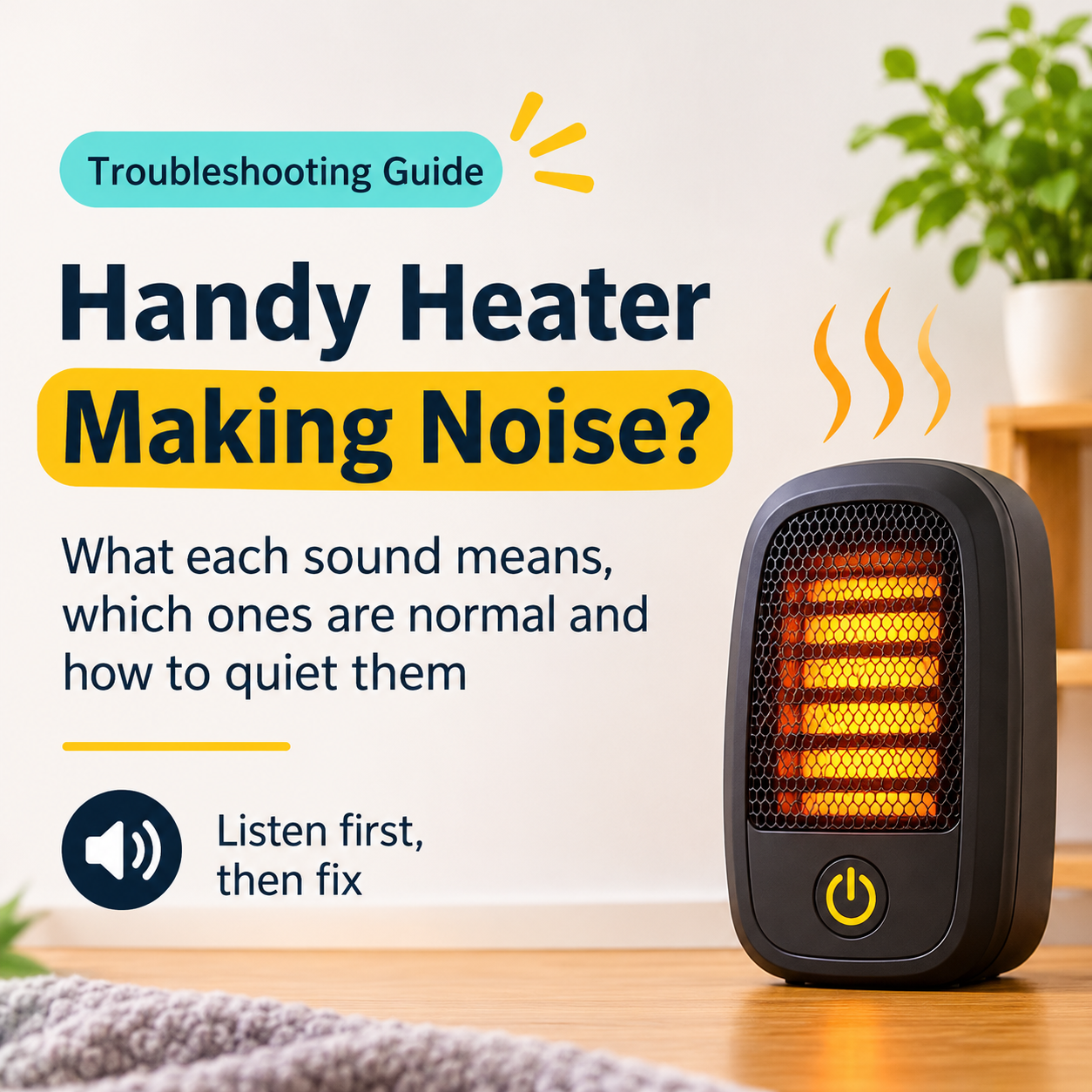
A heater should warm your room quietly in the background. When it starts to buzz, rattle, squeal or crackle, it is natural to worry. If your Handy Heater Turbo is making noise, the good news is that many sounds are harmless or easy to fix. The important thing is to know which sounds are normal, which need a quick check, and which mean you should unplug the heater and stop using it.
This guide helps you identify the sound, find the likely cause, fix what can be fixed at home and decide when to replace the heater. You do not need any technical knowledge, and you will not need to open the heater.
A soft whoosh or occasional click is normal. Rattling, buzzing, whistling or squeaking is usually caused by dust, an uneven surface, blocked vents or worn fan bearings. Grinding, loud banging, crackling or popping, or any noise with a burning smell, smoke or sparks, is a warning: unplug the heater and stop using it.
Always unplug the heater and let it cool for at least 30 minutes before you touch it, clean it or look inside the grille. Never open the casing, and never oil or spray anything on the fan or motor.
What sounds are normal for a heater?
Before you troubleshoot, it helps to know what a healthy heater sounds like. Most compact fan heaters make three kinds of normal sounds:
- A soft whoosh or hum from the fan moving air. It is steady, and it gets louder on the high setting.
- Light ticking or pinging as metal and plastic parts expand while the heater warms up and shrink while it cools.
- An occasional click when the thermostat switches the heating element on or off.
If your heater only makes these sounds, and they are not loud, there is nothing to fix. The problem begins when a sound is new, getting louder, harsh, or changes when you move the heater.
Sound decoder: what each noise means
How worried should you be?
7 reasons your Handy Heater Turbo is making noise
1. Normal operating sounds
As explained above, a soft whoosh, light ticking and occasional clicks are part of normal operation. Fan speed, room size and how hard the heater is working change how loud it sounds.
What to do: nothing. If the sound is stable and not harsh, the heater is fine.
2. Dust and debris on the blades
Dust builds up unevenly on the fan blades. This makes them slightly unbalanced, so the fan vibrates and produces a buzz, hum or light rattle. Hair or lint can also touch the housing and create a scraping or ticking sound.
Typical sign: a noise that appeared gradually over weeks, often worse at high fan speed.
Fix: unplug the heater, wait 30 minutes and vacuum the intake and outlet. Use a soft brush to remove dust you can see through the grille.
3. Uneven or soft surface
A heater standing on carpet, a rug, a wobbly table or a tilted floor can vibrate against the surface and amplify even small motor sounds into a loud buzz or rattle.
Typical sign: the noise changes or disappears when you move the heater or press lightly on it.
Fix: place the heater on a hard, flat, stable floor. Never place it on a bed, sofa or soft rug.
4. Loose parts on the outside
Vibration over time can loosen the grille, knobs or the base so they rattle against the housing. This is a common cause of a metallic rattle or buzz.
Typical sign: a rattle that stops when you gently press on one part of the casing.
Fix: with the heater unplugged, check that the grille, knobs and base sit firmly. Do not open the casing or remove internal screws. If the rattle comes from inside, use your warranty or replace the heater.
5. Worn or dry fan bearings
The bearings that support the fan shaft wear out over time. This produces a high squeak, a whine or a rough, grumbling hum. The noise often gets worse as the heater warms up.
Typical sign: a squeal or whine that is steady, gets worse over weeks and does not go away after cleaning.
Fix: cleaning helps only if dust is the cause. Worn bearings mean the fan motor is near the end of its life, and for most compact heaters replacement is the practical solution.
6. Airflow problems and whistling
When the vents are partly blocked or the air has to squeeze through a narrow gap, it can whistle or produce a loud rushing sound. High fan speed makes this more noticeable. Poor airflow also raises the heater’s internal temperature.
Fix: clean and uncover the vents, keep 3 feet (about 90 cm) of clear space around the heater and try a lower fan speed.
7. Motor or electrical fault
Grinding, scraping, loud banging, crackling, popping or a loud electrical buzz can point to a damaged motor, rubbing blades, loose wiring or arcing. These are the most serious causes. They often come with a burning smell, smoke, sparks or a heater that switches off.
Fix: unplug the heater immediately. Do not use it again. Use your warranty or replace the heater.
Crackling, popping, sparking or grinding sounds are never normal. Unplug the heater at once. If you see smoke or flames, leave the room and call your local emergency number.
Step-by-step: how to quiet a noisy heater
- Unplug and cool. Wait at least 30 minutes.
- Change the surface. Move the heater to a hard, flat, stable floor.
- Clean the vents. Vacuum the intake, outlet and grille with a soft brush attachment.
- Check the outside. Make sure the grille, knobs and base are firm. Do not open the heater.
- Change the setting. Try a lower fan speed or a different mode to see if the noise changes.
- Test and listen. Run the heater for about ten minutes while you stay nearby. Note when the noise appears: at start-up, when warm, or all the time.
If the noise disappears, you have found the cause. If it stays or gets worse, it comes from inside the heater.
Quick reference table
| Noise | Easy to fix at home? | Best action |
|---|---|---|
| Soft whoosh, light ticks | Nothing to fix | Normal operation |
| Buzz or rattle that changes when you move it | Yes | Use a hard, flat surface |
| Humming that grows over weeks | Often | Clean blades and vents |
| Whistling | Often | Clear the vents, lower fan speed |
| Squeal or whine | Rarely | Clean once, replace if it returns |
| Grinding or scraping | No | Unplug and replace or claim warranty |
| Crackling, popping, sparks | No | Unplug at once and stop using |
How to keep a heater quiet
- Vacuum the vents every two to four weeks during the heating season.
- Always use the heater on a hard, flat surface.
- Do not move or drop the heater while it is hot or running.
- Store it in its box or a dust-free bag after winter.
- Check the grille and base for looseness at the start of every season.
- Avoid dusty places such as workshops or construction areas.
Repair, warranty or replacement?
For compact, low-cost heaters, opening the unit to repair the motor or wiring is rarely worth it and is unsafe. Follow this order instead:
- If the noise was caused by dust, a surface or a loose grille: fix it and keep using the heater.
- If the noise comes from inside and the heater is under warranty: contact the seller with your order details and a short video of the sound.
- If the heater grinds, crackles or smells of burning: stop using it and replace it.
What to look for in a quieter replacement heater
- Quiet-operation rating or low decibel figure when it is stated on the product page.
- Multiple fan speeds so you can use a gentler setting at night or in small rooms.
- Stable, wide base that reduces vibration.
- Overheat and tip-over protection for safety.
- Recognised safety certification such as UL, ETL, CE or the local equivalent.
- Real customer reviews that mention noise after a few weeks of use, not only on day one.
- Honest wattage and specifications. Be careful with listings that promise whole-house heat from a tiny, low-power device.
- Clear warranty and return policy in case the heater turns out to be louder than expected.
Frequently asked questions
Is it normal for a Handy Heater Turbo to make some noise?
Yes. A fan heater moves air, so a soft whoosh or hum is normal. Occasional light clicks or ticks are also common as the thermostat switches or as plastic and metal parts expand while warming up and contract while cooling.
Why is my heater buzzing or humming loudly?
The usual causes are an uneven or soft surface that amplifies vibration, dust on the blades, a loose grille or housing, or a fan motor that is struggling. Move it to a hard flat surface, clean the vents and listen again. A loud buzz together with a burning smell means you should unplug it.
What does a squeaking or squealing heater mean?
Squeaking usually points to dry or worn bearings in the fan motor. Cleaning can reduce it for a while, but if the squeal returns, the motor is wearing out and the heater should be replaced.
Why does my heater make a clicking sound?
Short, occasional clicks are normal and come from the thermostat or from parts expanding as they heat. Constant fast clicking, or clicking together with the heater switching on and off repeatedly, suggests an overheating or thermostat problem.
Is a crackling or popping noise dangerous?
It can be. Light popping when you first use a dusty heater can be dust burning off. Repeated crackling, popping or sparking can mean arcing from damaged wiring or a loose connection. Unplug the heater immediately and stop using it.
Can I oil the fan to stop the noise?
No. Opening the heater is unsafe, and oil near a hot element is a fire risk. Limit yourself to cleaning the outside vents and, if the noise remains, use your warranty or replace the heater.
Final thoughts
Most heater noises have simple explanations. A soft whoosh and the occasional click are part of normal life. Buzzing, rattling and whistling usually come from dust, an uneven surface, loose outer parts or blocked vents, and you can fix these in a few minutes. Squeaks that keep coming back mean a worn fan motor, and grinding, crackling or popping noises mean it is time to unplug the heater and stop using it.
Trust your ears, but do not take chances. When the sound is harsh, new and getting worse, treat it as a warning. Use your warranty or replace the heater with a certified, well-reviewed model.
Disclaimer: This article is for general information only and is not a substitute for the manufacturer’s instructions or professional advice. Always follow your product manual and consult a qualified electrician or the manufacturer for repairs. Some pages on this site may earn a commission from qualifying purchases at no extra cost to you.