


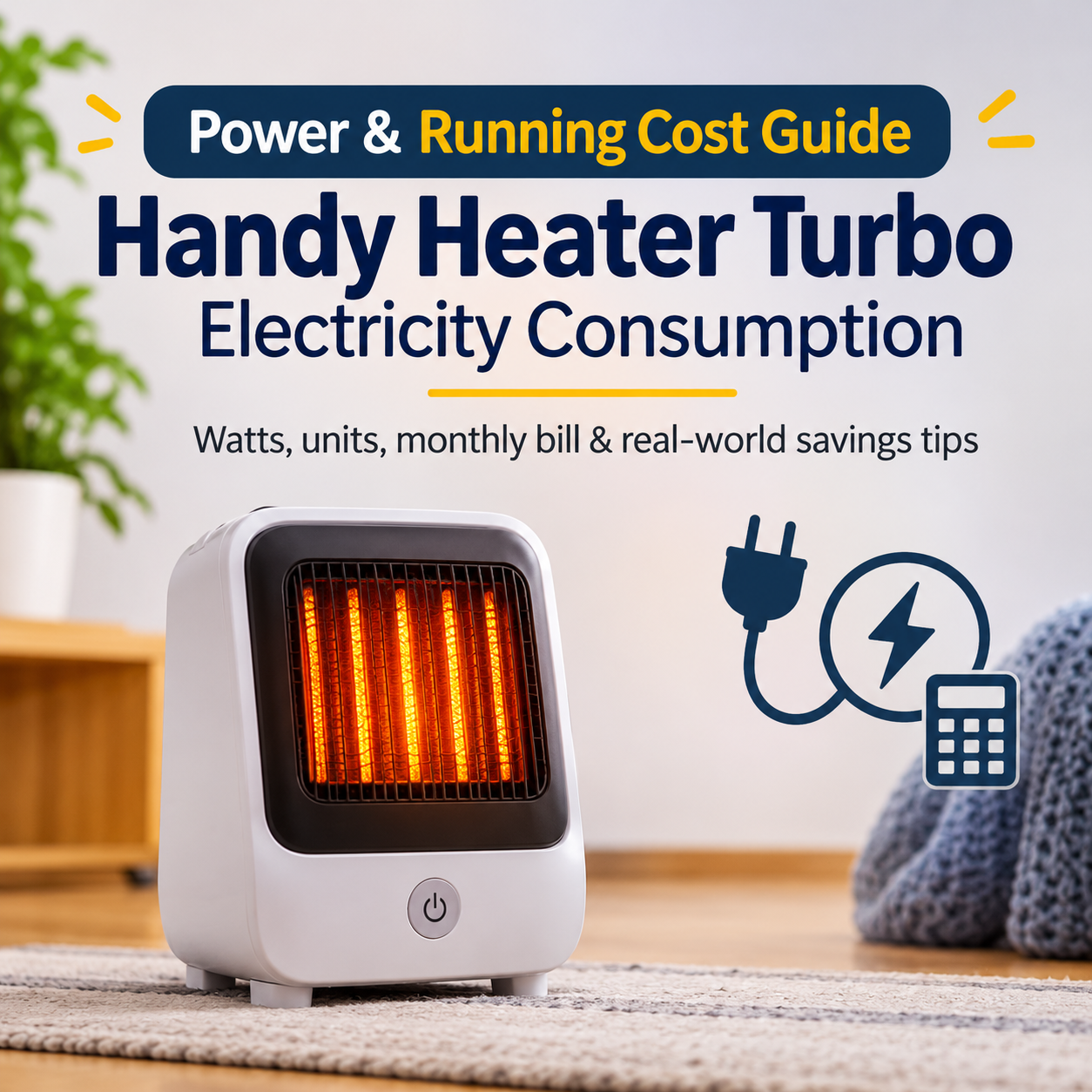
Winter is the season when electricity bills quietly climb, and a small plug-in heater like the Handy Heater Turbo looks like an easy, cheap fix. But how much power does it actually use, and what will it cost you every month? This guide breaks down the Handy Heater Turbo electricity consumption in plain numbers so you can decide with confidence.
What Is the Handy Heater Turbo?
The Handy Heater Turbo is a compact, plug-in personal heater. It is sold as a small ceramic-style unit that warms a limited area quickly, and it is usually promoted as a low-wattage alternative to bulky room heaters. It is designed for desks, bedrooms, bathrooms and small offices rather than large living spaces.
How Many Watts Does It Use?
Most versions of this style of heater are marketed at around 400 watts. Because models and sellers vary, always confirm the exact rating printed on the label of your unit or in its manual. All the calculations below use 400 W, and you can simply replace that figure with your own.
The key point: a lower wattage means lower consumption, but also lower heat output. That is why this heater suits small spaces and personal warmth rather than whole-room heating.
The Simple Formula to Calculate Electricity Use
Electricity is billed in kilowatt-hours (kWh), often called “units”. Use this formula:
Units (kWh) = Watts ÷ 1000 × Hours used
Cost = Units × your price per unit
Example: 400 W ÷ 1000 = 0.4 kW. Running it for 5 hours gives 0.4 × 5 = 2 units.
Monthly Consumption at Different Usage Levels
| Daily use | Units per day | Units per month (30 days) |
|---|---|---|
| 1 hour | 0.4 kWh | 12 kWh |
| 3 hours | 1.2 kWh | 36 kWh |
| 5 hours | 2.0 kWh | 60 kWh |
| 8 hours | 3.2 kWh | 96 kWh |
Estimated Monthly Cost
Your cost depends on your local tariff. The table shows sample prices per unit so you can find the closest match to your own bill.
| Price per unit | 1 hr/day | 3 hrs/day | 5 hrs/day | 8 hrs/day |
|---|---|---|---|---|
| $0.10 | $1.20 | $3.60 | $6.00 | $9.60 |
| $0.15 | $1.80 | $5.40 | $9.00 | $14.40 |
| $0.25 | $3.00 | $9.00 | $15.00 | $24.00 |
Even at 8 hours a day, a 400 W heater adds a modest amount to the bill compared with a 1500 W heater, which would use almost four times as much energy over the same hours.
Is It Really a “Money Saver”?
Honest answer: it depends. Many ads claim big savings, but no heater can create heat from nothing. A 400 W heater uses less electricity than a 1500 W one simply because it produces less heat. It saves money when:
- You only need to warm one person or one small area.
- You would otherwise heat an entire room or house.
- You lower the central heating or large heater while using it.
It will not replace a large heater in a big, cold room. In that case it may run for hours and still feel weak.
Pros and Cons
Advantages
- Low power draw, so a small increase in your bill
- Compact, lightweight and easy to carry
- Plugs straight into a wall socket
- Quick warmth for personal space
- Suitable for desk, bedroom, bathroom or office use
Limitations
- Not powerful enough for large rooms
- Heat output is modest, so results depend on room size and insulation
- Needs proper placement and supervision for safe use
Tips to Reduce Your Heater’s Electricity Use
- Close doors and windows to keep warm air inside.
- Use it in a small space where it can make a real difference.
- Place it close to you, not across the room.
- Use a timer or switch off when you leave the room.
- Seal gaps under doors and around windows.
- Wear warm clothing so you need less heat.
Safety Tips
- Plug directly into a wall socket, avoiding loose extension cords.
- Keep it away from curtains, bedding, paper and other flammable items.
- Never cover the heater while it is on.
- Do not leave it running while you sleep or when nobody is home.
- Keep it away from water, and from children and pets.
- Stop using it if the plug, cord or casing feels unusually hot or damaged.
Who Should Buy It?
It is a good fit for students, home-office workers, small bedrooms, bathrooms and anyone who wants quick personal warmth without a big power draw. If you need to heat a large living room or hall, a higher-wattage or oil-filled heater is a better match.
Frequently Asked Questions
How much electricity does the Handy Heater Turbo use per hour?
At 400 W it uses about 0.4 units (kWh) per hour. Check the label on your unit to confirm the exact rating.
Will it increase my electricity bill a lot?
Not much for moderate use. Five hours a day uses roughly 60 units a month, which is small compared with a 1500 W heater.
Can it heat a whole room?
It is best for small spaces and personal warmth. Large or poorly insulated rooms will not warm up well.
Can I leave it on all night?
It is not recommended. Like any heater, it should not run unattended or while you sleep.
Does it use less electricity than an AC or geyser?
Yes, a 400 W heater typically draws far less than an air conditioner or water heater, which commonly run at 1000 W or more.
Final Verdict
The Handy Heater Turbo electricity consumption is low, around 0.4 units per hour, which makes it an affordable way to stay warm in a small space. Treat it as a personal heater rather than a whole-room solution, use it sensibly and safely, and it can be a practical addition to your winter setup without a shock on the bill.