Disclosure: This article is for information. If you buy a product after reading it, the site owner may earn a small commission at no extra cost to you.
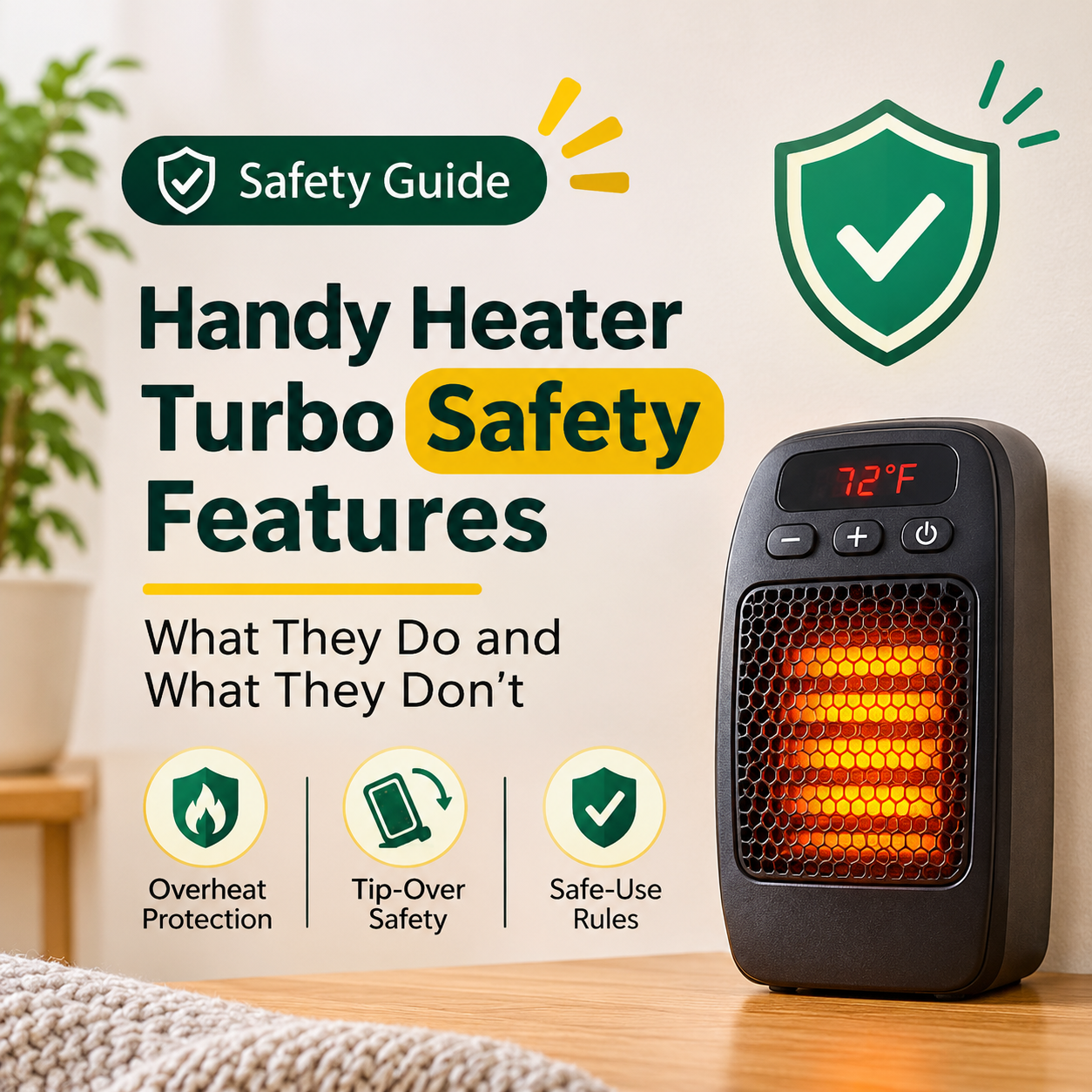
Space heaters are among the more hazardous small appliances in a home, so it is smart to ask about safety before you plug one in. If you are researching the Handy Heater Turbo safety features, this guide covers what the manufacturer and retailers say the heater includes, how each feature works, where the limits are, and what you still need to do yourself to use it safely.
Safety Features at a Glance
| Feature | What It Does | Good To Know |
|---|---|---|
| Automatic overheat shut-off | Cuts power if the unit overheats | Unplug and let it cool about 30 minutes before reuse, as per the manual |
| Tip-over protection | Turns the heater off if it is not upright | Listed in the manual’s troubleshooting section as a possible cause of shut-off |
| Stay-cool housing | Keeps the body from becoming very hot | The front grille still gets hot, so do not touch it |
| ETL listing | Shows testing by an independent laboratory | Stated in retailer listings; check your unit for the mark |
| 12-hour timer | Switches the heater off after 1 to 12 hours | A convenience feature, not a substitute for supervision |
| Thermostat | Cycles the heater off at the target temperature | Range is 60°F to 90°F; may reset to 90°F after a power cut |
| 180° rotatable plug | Lets the heater sit upright in different outlets | Make sure it is fully seated and does not sag |
Each Safety Feature Explained
1. Automatic Overheat Shut-Off
Heating elements and fans can overheat if the vents are blocked, dust builds up, or the heater sits too close to furniture or fabric. The Handy Heater Turbo has an automatic shut-off that activates if the unit overheats. According to the manual, you should unplug it and allow it to cool before trying again, and it suggests waiting about 30 minutes when the heater will not turn on after a shut-off.
If the heater shuts off repeatedly, do not treat it as a nuisance. It is telling you something is wrong. Check for blocked vents and poor placement, and if it keeps happening, replace the unit.
2. Tip-Over Protection
Tip-over protection switches a heater off if it is no longer in its normal upright position. The Turbo 800 manual lists “tip-over safety activated” as one reason the heater may turn itself off. Because this heater is mounted directly in the wall outlet, tilting usually happens when the outlet is loose or the plug orientation is wrong. If the heater sags or leans, do not ignore it. Rotate the plug so the heater sits upright, or use a different outlet.
3. Stay-Cool Housing
The manual describes the housing as cool-touch, which helps reduce accidental burns on the body of the unit. It also states clearly that the front grille becomes hot during operation. Keep fingers, children and pets away from the grille while the heater is on, and let it cool before cleaning or moving it.
4. ETL Listing
Several retailer listings describe the Handy Heater Turbo 800 as ETL listed, and one retailer’s specification table also states that it is not UL listed. ETL is a mark from an independent testing laboratory showing that a product has been tested against recognised safety standards. UL is another well-known mark of the same kind. A listing does not make a product risk-free, and listings on retail pages can be wrong or out of date. Check your own unit and packaging for the actual certification mark instead of relying on a web page.
5. 12-Hour Timer and Auto Shut-Off
The programmable timer, from 1 to 12 hours, turns the heater off when the set time ends. This is useful for stopping a heater you might forget about. It is not a safety system in the strict sense, so do not leave the heater running while you sleep or when nobody is home, and do not assume the timer will prevent every problem.
6. Thermostat Control
The thermostat keeps the heater from running endlessly at full power once the room is warm. Be careful with one detail from the manual: after a power interruption, the temperature may default to 90°F. If you do not check the display, the heater could run hotter than you intended once power returns.
What Safety Features Cannot Do
The manual we reviewed does not mention some features that you may find on other heaters, such as a child lock, a remote control or an enhanced safety plug. That does not mean the heater is unsafe, but it does mean you should not assume features that are not listed.
The Plug-In Design: The Safety Question Most People Miss
A plug-in heater has no power cord. The whole unit hangs from the socket, and 800 watts of power flows through that one connection. That makes the condition of the wall outlet critical.
- A worn, loose or damaged outlet can overheat, even if the heater’s own protections work properly.
- Extension cords, power strips and surge protectors are not allowed by the manual, because they can overheat under load.
- A heater that sags, tilts or wobbles in the socket has a poor connection and should not be used in that outlet.
- Adaptors are a particular problem. A consumer testing organisation in Australia reported exposed pins and a loose, sagging fit when a version of this heater was used with an adaptor, and criticised it for compliance and safety. This heater is designed for 120V US-style outlets, so do not use travel adaptors.
Safe-Use Rules From the Manual
| Rule | Why It Matters |
|---|---|
| Plug directly into a 120V wall outlet | Extension cords and strips can overheat |
| Keep 3 feet (0.9 m) of clearance | Prevents fabric, furniture and paper from igniting |
| Keep the vents clear | Blocked vents cause overheating |
| Indoor use only | The heater is not designed for outdoor conditions |
| No bathrooms, laundry rooms or wet areas | Water and electricity are a dangerous combination |
| Do not touch the front grille | It gets hot during use |
| Keep children and pets away | Hot surfaces and a plug-in connection are hazards |
| Reset the temperature after a power cut | It may default to 90°F |
A Note on Bathroom Marketing Claims
Some retailer pages describe this heater as suitable for bathrooms or kitchens, while the manufacturer’s own manual says not to use it in bathrooms, laundry rooms or anywhere water may be present. When the two disagree, follow the manual. It is the safer instruction and the one that applies to your product.
Safety Checklist Before Every Use
- Inspect the heater and the outlet for cracks, burn marks or discoloration.
- Confirm the plug fits snugly and the heater sits upright.
- Check that 3 feet around the unit is clear, with the vents unblocked.
- Look at the display and set the temperature you want.
- Stay in the room or the home while it runs.
- Turn it off and unplug it when you finish.
Warning Signs: When to Stop Using It
Safety Features to Look For in Any Space Heater
Whether you keep the Handy Heater Turbo or decide to look at other options, use this checklist when comparing heaters.
| Feature | Why You Want It |
|---|---|
| Independent safety certification (UL, ETL or CSA) | Shows testing to recognised standards |
| Overheat protection | Shuts the heater off before parts become dangerously hot |
| Tip-over protection | Reduces fire risk if the heater is knocked over |
| Cool-touch exterior or guarded grille | Reduces burn risk |
| Proper power cord or secure plug design | Takes strain off the wall outlet |
| Reliable thermostat and timer | Prevents continuous running |
| Child lock (optional) | Prevents accidental changes |
If you want to heat a larger space, or want a heater with a cord and a stand, consider a ceramic tower heater or an oil-filled radiator from an established brand with clear certification marks and good support.
Frequently Asked Questions
Does the Handy Heater Turbo have overheat protection?
Yes. The manual describes an automatic shut-off that activates if the unit overheats, and retailer listings also mention overheat protection.
Does it shut off if it tips over?
The manual lists tip-over safety as a reason the heater may turn off. Because it plugs into the wall, make sure it is upright and fully seated.
Is the Handy Heater Turbo ETL or UL listed?
Retailer listings state that it is ETL listed, and one lists it as not UL listed. Check the label on your own unit and packaging to confirm the mark.
Is it safe for kids and pets?
The manual tells you to keep children and pets away because the front grille gets hot. It also requires 3 feet of clearance from pets.
Is it safe to leave on overnight or while I am away?
No. Do not rely on the timer or auto shut-off as a replacement for supervision. Turn the heater off and unplug it when you sleep or leave the house.
Can I use it with an extension cord or power strip?
No. The manual says to plug it directly into a wall outlet and not to use extension cords, power strips or surge protectors.
Can I use it in a bathroom?
No. The manual says not to use it in bathrooms, laundry rooms or any area where water may be present, even though some retailers suggest otherwise.
What should I do if the plug gets hot?
Unplug the heater, stop using it, and have the outlet checked by a qualified electrician.
Why does the heater keep shutting off?
Common reasons are reaching the set temperature, the timer ending, overheating from blocked vents, or tip-over protection from a tilted unit. If it keeps happening with clear vents and a secure outlet, stop using it.
Final Thoughts
The Handy Heater Turbo comes with sensible built-in protections: overheat shut-off, tip-over protection, a stay-cool body, a timer and, according to retailers, an ETL listing. But those protections only work alongside good habits. Use a secure outlet, keep 3 feet of space, avoid damp rooms, never leave it unattended and reset the temperature after power cuts. Treat it as a small supplementary heater, and choose a certified, corded model if you need more power or more peace of mind.
Features, certifications and instructions can vary by version and region, and retailer descriptions can be inaccurate. Always follow the manual supplied with your heater and check the markings on the product. This article is general information, not professional electrical or fire-safety advice.