



Fan Heater vs Convection Heater: Which One Is Better for Your Room?
Walk into any appliance store or scroll through an online listing, and you will see two of the most popular budget-friendly electric heaters side by side: the fan heater and the convection heater. They look different, they feel different when you switch them on, and they behave very differently over a long winter evening. Yet many buyers pick one based on price alone and end up with a heater that is too noisy, too slow or too costly to run.
This guide explains the real differences in plain language. You will learn how each type works, how fast it warms a room, how much noise it makes, what it costs to run, how safe it is and which rooms suit it best. At the end you will find a buying checklist and answers to the most common questions, so you can choose with confidence.
Quick Answer
- Choose a fan heater for fast, short bursts of heat in small spaces such as a bathroom (if rated), a desk area or a cold corner you only use for a short time.
- Choose a convection heater for quiet, steady heating over several hours in a closed bedroom, home office or living room.
- At the same wattage, both use the same electricity per hour. The real saving comes from using the right type for the right job.
What Is a Fan Heater?
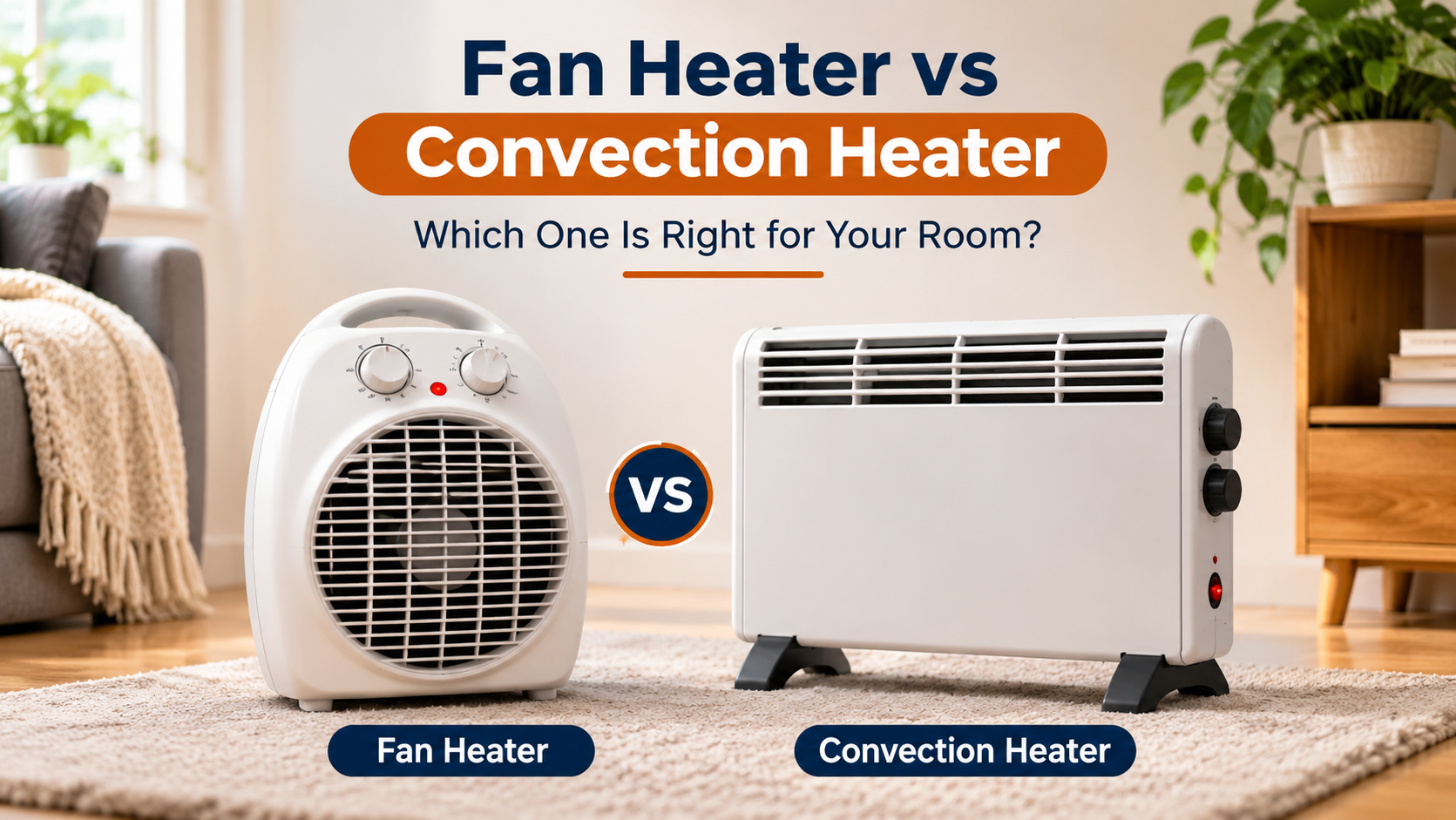
A fan heater is a compact electric heater with a heating element (usually a metal coil or ceramic element) and a built-in fan. The fan pulls room air in, pushes it across the hot element and blows the warmed air straight back out. That forced airflow is why you feel warmth within seconds when you stand in front of one.
Fan heaters are known for being small, light, portable and low in price. Most have two or three heat settings and a cool-air mode for summer. Better models add a thermostat, a timer, oscillation and tip-over protection.
What Is a Convection Heater?
A convection heater warms the air using natural air movement. Cool air enters through vents at the bottom, passes over a heated element, becomes warmer and lighter, and rises out of the top vent. Cooler air from the room is then drawn in to replace it. This steady loop, called a convection current, gradually raises the temperature of the entire room.
Most convection heaters have no fan, which makes them almost silent. Many are wall-mounted or freestanding panels with an adjustable thermostat, a timer and several power levels. Some models add a small fan to speed up the airflow, which gives you a mix of both approaches.
How They Work: Forced Air vs Natural Air Flow
Fan Heater vs Convection Heater: Side-by-Side Comparison
| Feature | Fan Heater | Convection Heater |
|---|---|---|
| How it heats | Fan blows air over a hot element | Warm air rises naturally, cool air flows in |
| Warm-up speed | Very fast, you feel heat in seconds | Slower, the room warms gradually |
| Noise level | Fan hum, can be noticeable | Silent or very quiet |
| Heat distribution | Directional, strongest in front of the heater | Even across the whole room |
| Heat after switch-off | Stops almost immediately | Stops almost immediately, panels with thicker bodies hold a little warmth |
| Best for | Small spaces, short use, quick boosts | Closed rooms, long hours of use |
| Portability | Very light and compact | Moderate, many are slim panels or wall-mounted |
| Typical power | 1,000 W to 2,000 W | 500 W to 2,500 W |
| Dust and air feel | Stirs dust, air can feel dry | Little dust movement, air feels more natural |
| Typical price | Lower | Medium |
| Lifespan | Fan motor can wear out sooner | No moving parts, usually longer-lasting |
Warm-Up Speed and Comfort
The fan heater wins the race to the first bit of warmth. The moment you switch it on, hot air hits you. That makes it perfect when you step into a cold bathroom, sit down at a freezing desk or need a quick blast of heat while getting dressed.
The convection heater plays a longer game. It has to warm the air, and the air has to circulate, so a cold room can take a while to feel comfortable. Once it gets there, though, the warmth is even and stable: no hot jet in one spot and cold patches in another. That makes it the more pleasant option for sitting, working or sleeping for hours.
Noise: Fan Hum vs Quiet Heat
Fan heaters make noise because of the motor and moving air. Many models are tolerable for short use, but the constant hum can be irritating in a bedroom, a study or while watching television. Convection heaters without a fan are almost silent, with only a faint click when the thermostat switches on or off. If you are a light sleeper or work from home, this difference matters a lot.
Running Cost: Which One Is Cheaper?
Electric heaters are very close to 100% efficient at turning electricity into heat, so the cost per hour depends on wattage, not on whether the heater has a fan. A 1,500 W fan heater and a 1,500 W convection heater both use 1.5 kWh of electricity every hour at full power.
What changes the bill is how you use each heater. A fan heater is cheapest for short boosts. A convection heater with a good thermostat is cheapest for long periods, because once the room is warm it switches off and on to hold the temperature instead of running at full power the whole time.
Safety: Fan Heater vs Convection Heater
Both types are safe when you choose a quality model and use it correctly. These are the points to watch.
Fan Heater Safety
- Small, lightweight bodies are easy to knock over, so tip-over protection is essential.
- Dust and lint can build up around the fan and element, which may cause overheating or a burning smell. Clean the vents regularly.
- Never block the air inlet or outlet.
Convection Heater Safety
- Panel surfaces can become hot, so keep them away from curtains, bedding and children’s reach.
- Never cover the heater or hang clothes on it. Blocked vents can cause overheating.
- Wall-mounted models reduce the risk of tipping and keep the floor clear.
- Plug it directly into a wall socket, not a cheap extension cord or multi-plug adaptor.
- Keep at least one metre of clear space around it.
- Choose a model with tip-over and overheat protection.
- Never leave a heater running unattended for long periods.
- Use a heater in a bathroom only if it is rated for that environment.
Which Room Suits Which Heater?
| Room or Situation | Better Choice | Why |
|---|---|---|
| Bedroom | Convection | Silent, steady warmth and a thermostat for the night |
| Home office or study | Convection | No fan noise during calls and work |
| Living room | Convection (or oscillating fan model for a quick boost) | Even warmth for long evenings |
| Bathroom | Fan heater rated for bathrooms | Fast heat for a short period |
| Under-desk or small corner | Fan heater | Compact and instant |
| Hallway or entrance | Convection (wall-mounted) | Keeps the space mildly warm without taking floor space |
| Rental or temporary use | Fan heater | Cheap, light and easy to move |
| Baby or elderly room | Convection with safety features | Quiet and even, with no hot air jet |
Pros and Cons at a Glance
Fan Heater
Pros
- Heats up in seconds
- Small, light and portable
- Low purchase price
- Many have a cool-air summer mode
Cons
- Noisy fan
- Uneven, directional heat
- Stirs dust and can feel drying
- Not ideal for long hours
Convection Heater
Pros
- Quiet, steady and even warmth
- Good thermostat control
- No moving parts in most models
- Great for bedrooms and offices
Cons
- Slower to warm a cold room
- Higher price than a basic fan heater
- Less suited to instant, short-term warmth
How Big a Heater Do You Need?
A common rule of thumb is about 100 watts for every square metre of floor area in a reasonably insulated room with a normal ceiling height. Poorly insulated rooms, large windows or very cold climates need more power.
Decision Chart: Fan or Convection?
Our Verdict
If you mostly need quick heat for a short time, a fan heater is the cheapest and most convenient way to get it. If you spend long hours in the same room, a convection heater is the more comfortable, quiet and economical choice thanks to its even heat and thermostat control. Many households keep a convection heater for the main room and a small fan heater for quick boosts.
Buying Guide: What to Check Before You Buy
| Feature | What to Look For | Applies To |
|---|---|---|
| Wattage | Roughly 100 W per m² of room, with adjustable power settings | Both |
| Thermostat | Adjustable, so the heater switches off when the room is warm | Both |
| Timer | Programmable on and off times, ideally up to 24 hours | Both |
| Tip-over and overheat protection | Automatic shut-off when knocked over or too hot | Both, especially fan heaters |
| Noise rating | Check reviews or decibel levels for a quiet fan | Fan heater |
| Oscillation | Spreads the airflow across more of the room | Fan heater |
| Mounting options | Wall bracket and freestanding feet for flexibility | Convection |
| Turbo or fan-assist mode | Speeds up warm-up while keeping steady heat | Convection |
| Warranty and certification | Recognised safety marks and at least a 1–2 year warranty | Both |
Tips to Use Any Heater Efficiently
- Close doors and windows so the warm air stays where you need it.
- Use the thermostat and timer to prevent the heater running at full power all day.
- Preheat, then lower the setting. A short high setting followed by a lower one saves energy.
- Seal drafts around doors and windows with weather-stripping or a draft stopper.
- Use thick curtains and rugs to cut heat loss through windows and floors.
- Clean the vents every month so air can flow freely.
- Layer your clothing so you can set the heater a degree or two lower.
Frequently Asked Questions
Is a convection heater cheaper to run than a fan heater?
Not by wattage alone. A 1,500 W fan heater and a 1,500 W convection heater use the same electricity per hour at full power. A convection heater with a good thermostat can cost less over long periods because it cycles off once the room is warm, while a fan heater is usually cheaper for short bursts.
Which heats a room faster, a fan heater or a convection heater?
A fan heater delivers warm air almost immediately, so you feel the heat faster. A convection heater takes longer to raise the temperature of the whole room but provides more even warmth once it gets there.
Is a fan heater or convection heater better for a bedroom?
A convection heater is generally the better bedroom choice because it is quiet and gives gentle, steady heat. Pick a model with a thermostat, timer and safety shut-off.
Are fan heaters safe to leave on overnight?
It is best not to leave any heater running unattended for long periods. If you must use one at night, choose a model with a timer, thermostat, tip-over switch and overheat protection, and follow the manufacturer’s instructions.
Do fan heaters dry out the air?
Electric heaters do not remove moisture from the air, but the stream of hot air from a fan heater can make your skin and eyes feel dry. A bowl of water or a humidifier in the room can help if you notice it.
What is a fan-assisted convection heater?
It is a convection heater with a small built-in fan that speeds up air circulation. You get a quicker warm-up than a standard panel and more even heat than a basic fan heater.
Can I use a fan heater in a bathroom?
Only if it is specifically designed and rated for bathroom use. Standard heaters should be kept away from water and damp areas.
Final Thoughts
The fan heater vs convection heater choice comes down to how you plan to use it. A fan heater is the sprinter: quick, cheap and portable, ideal for short bursts of warmth. A convection heater is the marathon runner: slower to start, but quiet, steady and better suited to hours of comfort in a closed room.
Whichever type you pick, choose the right wattage for your room, look for a reliable thermostat and timer, insist on tip-over and overheat protection, and combine your heater with simple habits like sealing drafts and wearing warm layers. That combination keeps your home cosy without an oversized electricity bill.