



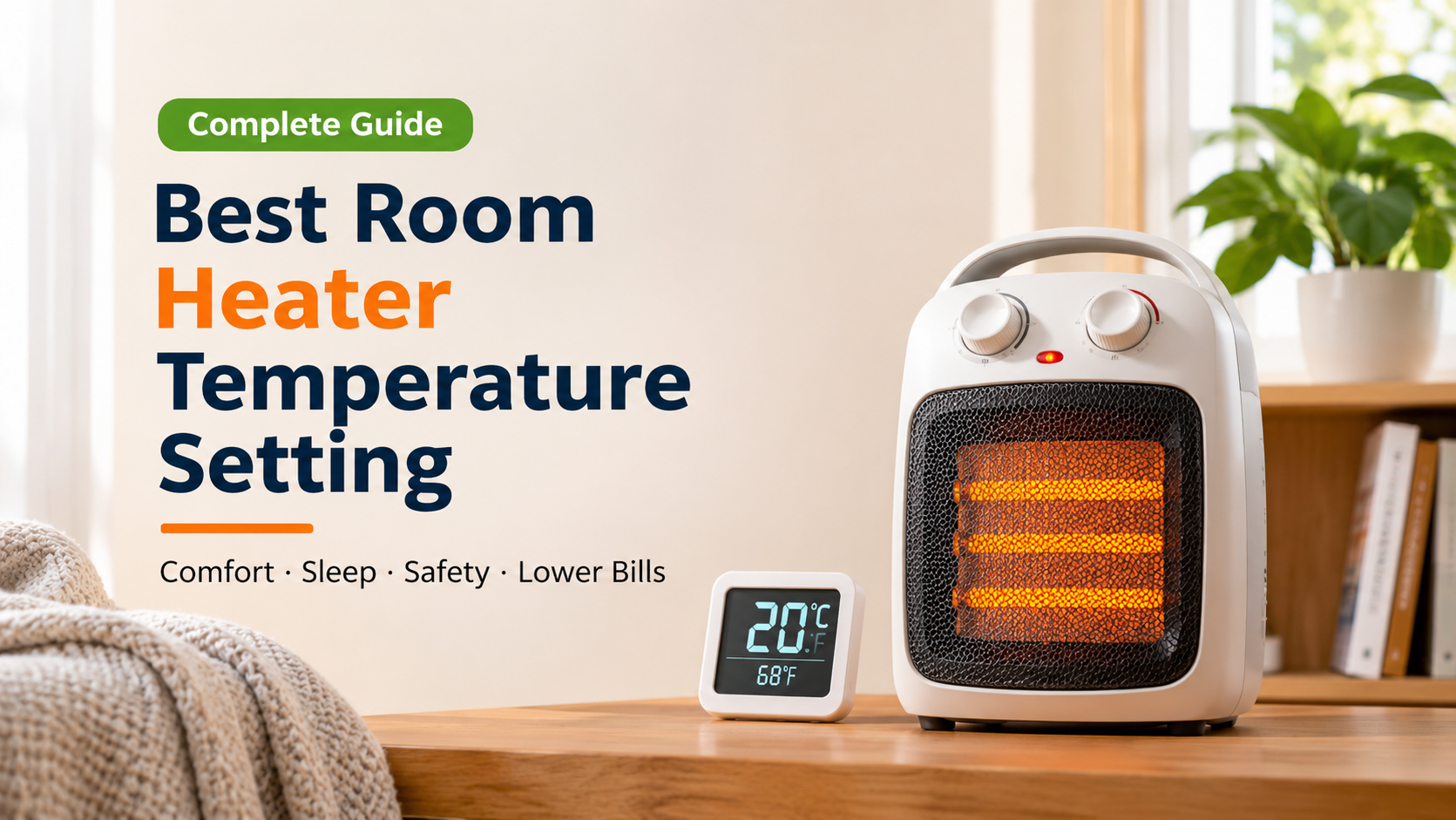
Finding the best room heater temperature setting is a balancing act. Set it too low and you shiver. Set it too high and you waste electricity, dry out the air, and open the door to uncomfortable sleep. The good news is that health and energy experts agree on a fairly narrow range that suits most people. This guide shows you the ideal temperature for every room, how to read a numbered dial, how much you can save by turning it down, and how to set a simple daily schedule.
Table of Contents
- Ideal room temperature: what the guidance says
- Best heater temperature by room
- Best temperature for sleeping
- Babies, children, and older adults
- How to set a numbered dial heater
- Thermostat, Eco, and frost protection modes
- How temperature affects your electricity bill
- A simple daily heating schedule
- Humidity and air comfort
- Safety tips
- Choosing a heater with accurate temperature control
- Frequently asked questions
- Conclusion
Ideal Room Temperature: What the Guidance Says
Public health bodies and energy agencies give broadly similar advice:
- The World Health Organization has long suggested a minimum indoor temperature of about 18°C (64°F) to protect the health of the general population in cold weather.
- Many national energy guides recommend roughly 20–21°C (68–70°F) for living rooms and about 18°C (64°F) for other rooms.
- In the United States, energy.gov style advice is to set the thermostat near 68°F (20°C) when you are home and awake, and lower it when asleep or away.
Comfort is personal. Clothing, activity level, age, and room draughts all change what feels right. Treat the numbers as a starting point, then adjust by one degree at a time.
Best Heater Temperature by Room
Different rooms have different needs. The chart below summarizes recommended ranges.
| Room | Celsius | Fahrenheit | Notes |
|---|---|---|---|
| Living room | 20–22°C | 68–72°F | Where you sit still the most |
| Home office | 20–22°C | 68–72°F | Cold hands reduce comfort and focus |
| Bedroom (sleeping) | 16–19°C | 61–66°F | Cooler rooms help most people sleep |
| Nursery | 16–20°C | 61–68°F | Use a room thermometer |
| Kitchen | 18–20°C | 64–68°F | Cooking adds heat |
| Bathroom | 22–24°C | 72–75°F | Short warm-up before use |
| Hallway / unused rooms | 15–18°C | 59–64°F | Prevents damp and cold spots |
Best Temperature for Sleeping
Your body temperature naturally drops as you fall asleep, so a slightly cool bedroom helps. Sleep experts commonly recommend about 16–19°C (60–67°F). Anything much hotter can cause restless sleep and night waking. If your bedroom is cold at bedtime, pre-heat it for 20 to 30 minutes using a timer, then turn the heater down or off. Add a warmer duvet or a hot water bottle instead of raising the heater setting.
If you use a heater overnight, choose one with a thermostat, tip-over protection, and overheat cut-off, and keep it well away from bedding and curtains.
Babies, Children, and Older Adults
- Babies: Pediatric safe-sleep guidance in many countries suggests a room temperature around 16–20°C (61–68°F). Dress the baby in suitable layers and use a thermometer rather than guessing. Avoid overheating.
- Young children: Similar to adults, around 18–20°C, with an extra layer if needed.
- Older adults and people with health conditions: Cold rooms raise health risks. Many guides advise keeping main living areas around 20–23°C (68–73°F) and not allowing rooms to fall below 18°C. Ask a doctor about your specific needs.
How to Set a Numbered Dial Heater
Many heaters have a dial marked 1 to 5, or a plain minimum to maximum knob, instead of a degree readout. These dials are not calibrated, so the numbers do not map to exact temperatures. The graphic below gives a rough starting point.
Simple Method to Find Your Setting
- Place a small room thermometer at seating or bed height, away from the heater.
- Turn the dial to maximum and let the room warm up.
- When the thermometer reaches your target, slowly turn the dial down until you hear the heater click off.
- Mark or remember that dial position for that room.
- Adjust by small steps over the next few days, since rooms and weather change.
Thermostat, Eco, and Frost Protection Modes
- Digital thermostat: Lets you pick an exact target temperature, such as 20°C. The heater cycles on and off to hold it. This is the most accurate and efficient option.
- Eco mode: Typically holds a modest temperature and reduces power use. Good for background warmth.
- Frost protection: Holds around 5–8°C to prevent pipes freezing in an empty room or house. Not for living comfort.
- Timer: Starts or stops heating on a schedule so you do not heat an empty room.
- Oscillation and fan-only modes: Help spread warmth but do not set the temperature.
Keep in mind that the heater’s built-in sensor reads the temperature near the unit, which is usually warmer than the rest of the room. A separate thermometer in the middle of the room gives a more realistic reading.
How Temperature Affects Your Electricity Bill
Every degree matters. Energy agencies commonly estimate that lowering your heating setpoint by one degree can trim heating energy by a few percent, with estimates varying by home insulation and climate. The index below uses a simple assumption of about 6% more energy per extra degree, so you can see the pattern.
The lesson: do not heat to a higher number than you need. Wear a sweater, close doors, and let the thermostat do its job.
A Simple Daily Heating Schedule
Lowering the temperature when you are asleep or out can cut costs without sacrificing comfort. Here is a sample schedule you can adapt.
- Morning wake-up: Warm the room to about 20°C for the hour you are getting ready.
- While away: Turn the heater off, or drop the setting to about 16–17°C to avoid cold, damp rooms.
- Evening: Use 20–21°C in the room you actually occupy.
- Night: Keep bedrooms cooler, about 16–19°C, and pre-heat briefly if needed.
Never leave a portable heater running in an empty home unless it is designed for that and has the correct safety features.
Humidity and Air Comfort
Temperature is only half of comfort. Indoor relative humidity between about 40% and 60% generally feels best. Heaters, especially fan models, can make the air feel dry. If the room feels stuffy or your throat is dry, try a small humidifier, place a bowl of water nearby, or reduce the heater temperature a little. Too much moisture, on the other hand, can encourage mould, so ventilate briefly each day.
Safety Tips
- Plug the heater directly into a wall socket and avoid extension leads.
- Keep at least one metre (three feet) of clear space around it.
- Choose a heater with tip-over and overheat protection.
- Never cover a heater or dry clothes on it.
- Test smoke alarms and, for any fuel-burning heater, carbon monoxide alarms.
- Do not sleep next to a heater at high settings, and avoid aiming heat at bedding.
Choosing a Heater with Accurate Temperature Control
If you are shopping for a heater that is easy to set to the right temperature, look for these features:
- Digital display with exact degrees: Easier than an uncalibrated dial.
- Adjustable thermostat range: Covers 5°C to 35°C or similar.
- Programmable timer or weekly schedule: Matches your routine.
- Multiple power levels: For example 800W, 1200W, and 2000W.
- Remote control or smart app: Convenient for adjusting without getting out of bed.
- Safety protections: Tip-over switch, overheat cut-off, and a cool-touch exterior.
- Good build and warranty: Thermostats are used constantly in winter.
Frequently Asked Questions
What is the best temperature to set a room heater?
For most adults, 20–21°C (68–70°F) while awake and 16–19°C (61–66°F) for sleeping works well. Never let occupied rooms fall below about 18°C (64°F).
Is 25°C too hot for a room heater?
For continuous use it is higher than necessary for most people and uses more electricity. A short boost to 24–25°C, such as in a bathroom before use, is fine.
What setting should my heater be on, 1, 2, or 3?
Setting 2 or 3 is often enough in a closed room once it is warm. Start higher to warm up, then turn down. Because dials are not calibrated, confirm with a thermometer.
What temperature should a heater be for a baby?
Around 16–20°C (61–68°F), with a room thermometer to check, and appropriate clothing. Follow guidance from your pediatrician or local health authority.
Does a lower thermostat setting save money?
Yes. A lower target means the heater runs less. Even one or two degrees makes a noticeable difference over a winter.
Is it better to leave a heater on low all day or turn it on and off?
For electric room heaters, heating only when you are in the room is usually cheaper, since they warm quickly and do not benefit from running continuously. Use a timer or thermostat to avoid waste.
What temperature prevents frozen pipes and damp?
Keep unused areas above roughly 5–8°C to prevent freezing, and around 15–18°C to reduce the risk of damp and mould.
Conclusion
The best room heater temperature setting for most people is 20–21°C (68–70°F) in living spaces, 16–19°C (61–66°F) in bedrooms, and a minimum of about 18°C (64°F) in any occupied room, with warmer settings for babies, older adults, and anyone with health needs. Use a thermostat or timer, check the real temperature with a room thermometer, and adjust one degree at a time. You will stay comfortable, sleep better, and keep your electricity bill under control.