






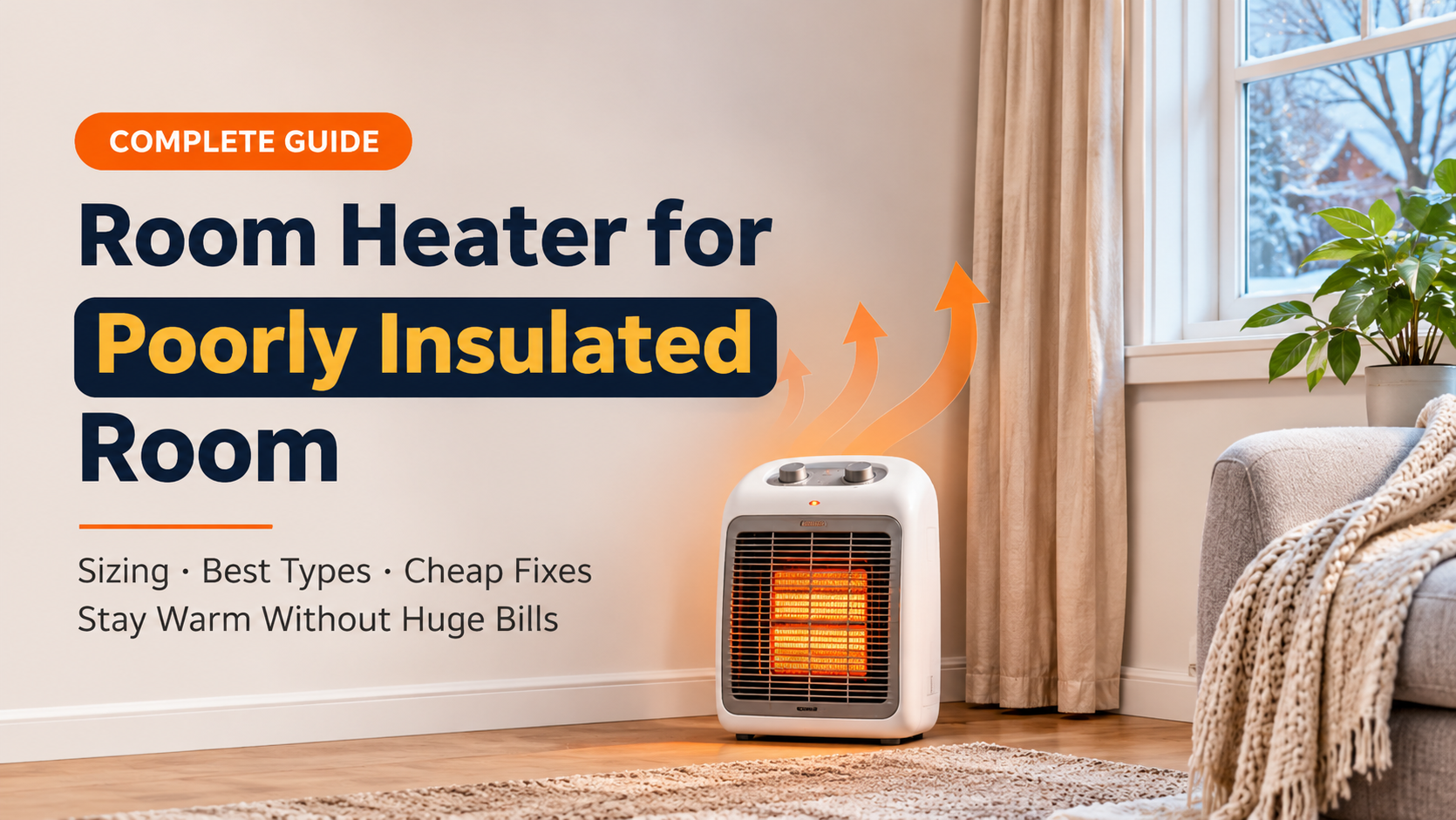
If you have ever switched on a heater and still felt cold ten minutes later, your room is probably leaking heat. Finding the right room heater for a poorly insulated room is different from choosing one for a modern, well-sealed space. Heat escapes through thin walls, single-glazed windows, gaps under doors, and bare floors, so a heater that works perfectly elsewhere can feel weak and expensive here. This guide explains how to size a heater for a leaky room, which types work best, how much it will cost to run, and which cheap fixes make the biggest difference.
Table of Contents
- Why a poorly insulated room feels so cold
- Signs your room is losing heat
- How to size a heater for a poorly insulated room
- Best heater types for a leaky room
- Types to be careful with
- Running cost: poor vs good insulation
- Cheap fixes that make any heater work better
- Smart heating habits
- Safety tips for high-wattage heaters
- Buying guide
- Frequently asked questions
- Conclusion
Why a Poorly Insulated Room Feels So Cold
A heater adds heat to a room, but insulation decides how long that heat stays. In a leaky room, warmth escapes through walls, roof or ceiling, floors, windows, and gaps almost as fast as the heater produces it. The thermostat never reaches its target, the heater runs non-stop, and your electricity bill climbs. The graphic below shows a commonly cited breakdown of where heat goes in an uninsulated building.
The percentages vary between homes, but the pattern holds: walls, roof, and air leaks are the biggest culprits. That is why the best strategy combines a suitable heater with simple insulation fixes.
Signs Your Room Is Losing Heat
- The heater runs constantly but the room never feels comfortable.
- You can feel cold air near windows, doors, sockets, or skirting boards.
- Walls and windows feel cold to the touch.
- Curtains move on a windless day.
- The room cools within minutes after the heater switches off.
- Condensation or damp patches appear on windows or walls.
- The floor feels icy, especially in older houses with bare boards.
How to Size a Heater for a Poorly Insulated Room
For a well-insulated room, a common starting point is about 100 watts per square metre (10 W per sq ft). For a draughty, poorly insulated room, plan for about 150 W per square metre (15 W per sq ft). In very cold climates or with high ceilings, you may need a little more. Use the chart as a guide.
Most single plug-in heaters top out at about 2000W to 2500W. If the number you calculate is higher than that, improve the insulation before adding more heaters. Running two high-wattage heaters on the same circuit can overload it.
Best Heater Types for a Leaky Room
1. Oil Filled Radiator: Best for Steady All-Day Warmth
Oil-filled radiators warm slowly but keep releasing heat after the thermostat cuts power. In a leaky room this helps smooth out temperature swings, though it will still cycle on more often than in a sealed room. Choose a model with 9 to 13 fins or a higher wattage (1500W to 2500W) and a good thermostat. They are silent, which makes them excellent for bedrooms.
- Pros: Silent, steady heat, long lifespan, no dust blowing.
- Cons: Slow warm-up, heavy.
2. Infrared (Radiant) Heater: Best for Direct, Instant Warmth
Infrared heaters warm people and objects directly instead of heating all the air. That is useful when air escapes quickly, such as in a draughty office or workshop, because you feel the warmth immediately even if the room air stays cool. They work best when you sit within a metre or two of the heater.
- Pros: Instant heat, efficient for spot heating, often quiet.
- Cons: Heats only what it faces, not the whole room.
3. Ceramic Fan Heater: Best for Fast Boosts
A ceramic fan heater raises the air temperature quickly, which is handy for a short boost before you get up or before a shower. In a poorly insulated space, however, the warm air disappears fast after switching off, so use it as a boost rather than the main heat source.
- Pros: Fast, compact, affordable.
- Cons: Noisy, heat fades quickly, can dry the air.
4. Convection Panel Heater: Good for Quiet, Moderate Heating
Panel heaters are slim, quiet, and often wall-mountable. They suit rooms that are only slightly leaky. In a very draughty room, the warm air they produce can drift away from where you sit, so pair them with insulation upgrades.
Types to Be Careful With
- Halogen heaters: Instant, but only warm what they face and usually lower power, so they struggle to maintain a leaky room.
- Very low wattage heaters (under 1000W): Unlikely to keep up in a large or very cold, draughty space.
- Fuel-burning heaters (gas, kerosene) in sealed rooms: Need proper ventilation and a carbon monoxide alarm. Do not use them in bedrooms unless specifically designed for it.
Comparison Table
| Heater Type | Best Use in a Leaky Room | Warm-Up | Noise |
|---|---|---|---|
| Oil filled radiator | Main heater for long hours | Slow | Silent |
| Infrared heater | Spot warmth where you sit | Instant | Silent to low |
| Ceramic fan heater | Quick boost | Fast | Audible |
| Convection panel | Mildly leaky rooms | Medium | Silent |
| Halogen heater | Very short, close-up use | Instant | Silent |
Running Cost: Poor vs Good Insulation
Because you need a higher-wattage heater and it runs for longer, a poorly insulated room costs more to heat. Here is a simple illustration using $0.15 per kWh and 6 hours of use at full power.
| Scenario (15 m² room) | Heater | Energy per day | Cost per day | Cost per 30 days |
|---|---|---|---|---|
| Well insulated | 1500W | 9 kWh | $1.35 | about $40 |
| Poorly insulated | 2250W equivalent | 13.5 kWh | $2.03 | about $61 |
That is roughly 50% more, and the real gap may be larger if the heater cannot reach the target temperature. Fixing the biggest leaks often saves more than any change of heater.
Cheap Fixes That Make Any Heater Work Better
You do not need builders to improve a leaky room. These low-cost, renter-friendly steps can noticeably reduce heat loss.
- Draught-proof doors and windows: Self-adhesive foam or rubber strips cost little and are quick to fit. Add a door sweep or draught excluder at floor level.
- Hang thick, lined curtains: Thermal or heavy curtains that reach the floor reduce window heat loss. Close them at dusk.
- Use window insulation film: Clear plastic film creates a thin air gap, a cheap alternative to double glazing for winter.
- Cover bare floors: Rugs and underlay cut heat loss through floorboards and make the room feel warmer underfoot.
- Block unused chimneys and vents: Use a proper chimney balloon or cap, keeping any required ventilation in place.
- Seal small gaps: Use flexible sealant around skirting boards, pipes, and window frames.
- Keep doors closed: Heat one room at a time and stop warm air flowing into cold hallways.
- Add bookshelves or furniture against cold external walls: They add a small buffer, but leave airflow to avoid damp.
If you own the property, loft insulation, cavity wall insulation, and double glazing deliver the largest long-term savings, so they are worth considering.
Smart Heating Habits
- Pre-heat with a timer: Start heating 30 minutes before you use the room, rather than leaving the heater on at full power all day.
- Use a thermostat: Set a target near 20°C (68°F) and let the heater cycle. Do not run it at maximum constantly.
- Combine heaters smartly: An oil radiator for base warmth plus a small infrared or fan heater for boosts often works well.
- Heat the person, not the room: Warm clothes, a blanket, and a hot water bottle reduce how much heat you need.
- Place the heater on an inside wall: Keep it a safe distance from furniture and away from curtains, and not directly under a cold window unless the design allows it.
- Use a room thermometer: It shows when the room is warm enough so you can turn the heater down.
Safety Tips for High-Wattage Heaters
- Plug directly into a wall socket. Avoid extension leads, since 2000W heaters draw a lot of current.
- Do not run two high-wattage heaters on the same circuit or socket strip.
- Choose a model with tip-over protection and overheat cut-off.
- Keep at least one metre clear of curtains, bedding, and furniture, especially because you may be tempted to move the heater near cold windows.
- Never cover the heater or dry clothes on it.
- Check the plug and cable for heat marks. If they feel hot, stop using the heater and have it inspected.
Buying Guide: What to Look For
- Sufficient wattage: Aim for about 150 W per square metre, up to a practical limit of 2000W to 2500W.
- Multiple power settings: Allow you to reduce power when the room warms up.
- Accurate thermostat: Prevents constant full-power running and saves electricity.
- Timer or programmable mode: Useful for pre-heating before you wake or return home.
- Safety features: Tip-over switch, overheat protection, and cool-touch outer where possible.
- Wheels and handle: Helpful for heavier oil-filled radiators.
- Remote control: Convenient for adjusting without leaving your seat or bed.
- Warranty: Choose a model with good support, since the heater will work hard in winter.
Frequently Asked Questions
What is the best heater for a poorly insulated room?
For all-day warmth, an oil-filled radiator is usually the best choice. For direct spot heating, an infrared heater works well. A ceramic fan heater is useful as a quick boost.
How many watts do I need for a poorly insulated room?
Plan on roughly 150 watts per square metre (15 W per sq ft). A 15 m² room would need around 2250W, which in practice means a 2000W to 2500W heater or improved insulation.
Why does my heater never warm my room?
Usually the heater is too small for the room or heat is escaping through gaps, windows, and walls. Check the wattage, seal draughts, and use curtains and rugs.
Is it expensive to heat a poorly insulated room?
Yes, it can cost noticeably more because you need a higher-wattage heater that runs longer. Draught-proofing is often the cheapest way to reduce the cost.
Is an infrared heater good for a draughty room?
It can be, because it warms people directly. It works best at close range and is less effective for heating a whole large room.
Can I use two heaters in one room?
Yes, but use separate wall sockets on a circuit that can handle the load, and never use extension leads for high-wattage heaters. Improving insulation is usually better than adding more heaters.
What is the cheapest way to make a cold room warmer?
Draught strips, thick curtains, window film, and rugs. Together they can make a big difference for very little money.
Conclusion
The best room heater for a poorly insulated room is one that is sized generously (about 150 W per square metre), has a reliable thermostat and timer, and matches the way you use the room. Oil-filled radiators suit steady, long-hours warmth, infrared heaters give direct warmth where you sit, and ceramic fan heaters add quick boosts. Pair your heater with simple fixes such as draught strips, thick curtains, and rugs, and you will feel warmer, spend less, and get far more from every unit of electricity.