
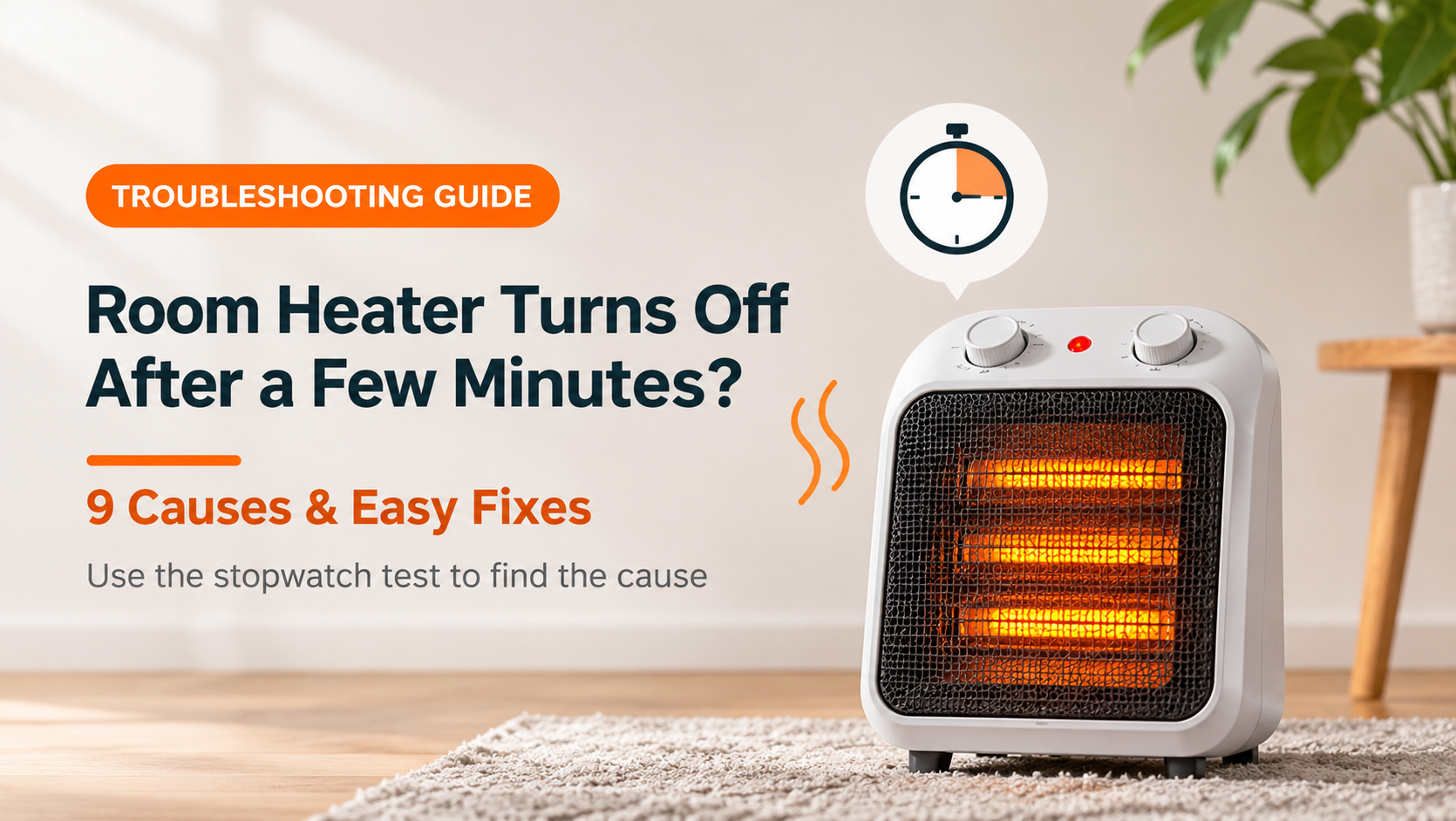
The heater starts, the room barely begins to warm, and then it clicks off. A room heater that turns off after a few minutes is usually protecting itself or reacting to a setting, a plug problem or a circuit limit. The good news is that how long it runs before shutting off is a strong clue to what is wrong.
This guide uses a simple stopwatch test to narrow down the cause, then explains nine common causes with fixes, a flowchart, safety advice and what to look for in a better heater.
The Stopwatch Test: Time It to Find the Cause
Run the heater from cold, time how many minutes pass before it shuts off, and note what else you see: the light, the fan, any smell and whether the plug feels warm. Then compare the result with the timeline below.
9 Reasons Your Room Heater Turns Off After a Few Minutes
Shuts Off Within the First 2 Minutes
1. Tip-over switch triggered by an uneven surface
Why it happens: A heater on carpet, a sloped floor or a wobbly table can trigger its tilt sensor. The heater runs for a moment, then the sensor cuts the power.
What to do: Place the heater on a flat, hard, level surface. Check that nothing presses against the base switch.
2. Loose plug, worn socket or damaged cord
Why it happens: A poor connection can break contact as the plug warms up, so the heater switches off within a minute or two, sometimes with a flickering light.
What to do: Check that the plug fits firmly and does not feel hot. Try another wall socket and replace damaged cords. Never use a multi-plug with a heater.
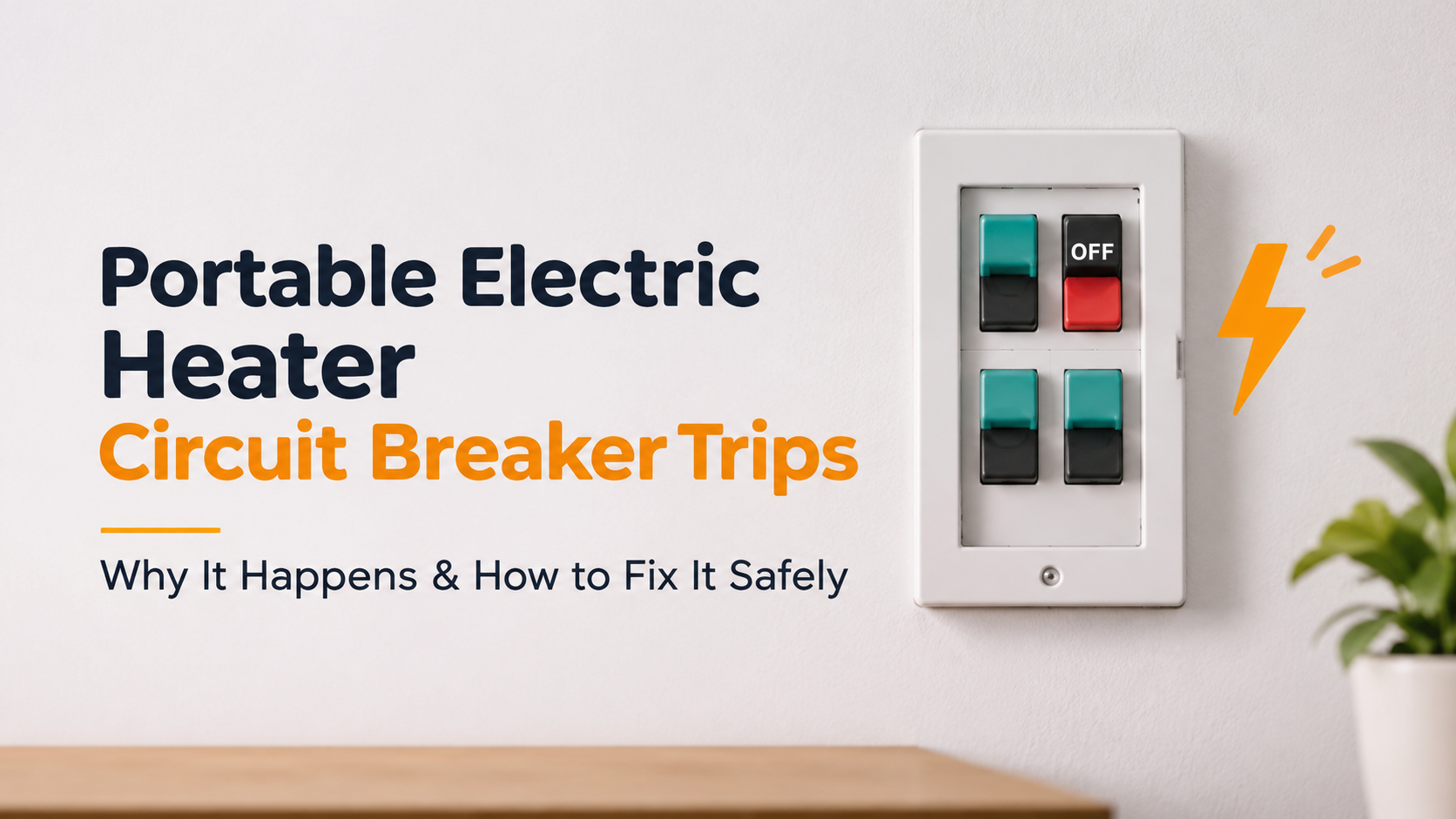
3. Breaker, RCD or short circuit trip
Why it happens: If the whole circuit goes off, the heater is overloading the circuit or has an electrical fault, and the breaker is protecting you.
What to do: Run the heater alone on the circuit and use a lower power setting. If it trips again, stop and call an electrician.
Shuts Off Between 2 and 10 Minutes
4. Overheat cut-off from blocked vents or dust
Why it happens: Dust and blocked grilles trap heat. Inside a few minutes the internal sensor reaches its limit and the heater switches itself off to protect itself.
What to do: Unplug, cool down for 30 minutes and clean the vents and grille. Keep 3 feet of free space and never cover the heater.
5. Dirty filter or failing fan
Why it happens: A clogged filter or a slow, noisy fan reduces airflow, so the element overheats quickly and the cut-off trips.
What to do: Clean or replace the filter, and check that the fan spins freely. A worn fan motor needs professional repair.
6. Heater too close to walls or covered, or in a tiny space
Why it happens: Hot air that cannot escape is drawn back in. A heater pushed against a wall, wrapped in bedding or used in a very small enclosed space overheats and trips.
What to do: Move the heater away from walls, bedding and furniture, and let air circulate in the room.
Shuts Off After 10 Minutes or More
7. Thermostat target reached or a faulty sensor
Why it happens: In a small, well-insulated room the thermostat may reach its target in minutes and switch off, which is normal. A faulty sensor can read too high and cut off too early.
What to do: Turn the thermostat to maximum in a cold room. If it still switches off while the room is cold, the thermostat or sensor needs replacing.
8. Timer, eco mode or automatic power-off
Why it happens: Many heaters have built-in auto power-off, eco, sleep and timer functions. A child or pet can also set a timer by accident.
What to do: Check the display and manual, cancel timers and eco modes, and turn off the child-lock.
9. Aging thermal fuse, switch or control board
Why it happens: Older heaters develop worn safety parts and controls that trigger shut-offs at lower temperatures or at random times.
What to do: If cleaning and settings do not help and the heater is more than 5 to 7 years old, replacement is usually safer than repair.
Harmless or a Problem?
Auto Shut-Off Features by Heater Type
| Heater Type | Common Built-In Shut-Off Features | Often Mistaken For a Fault |
|---|---|---|
| Fan heater | Overheat cut-off, tip-over switch, timer | Thermostat target reached in a small room |
| Ceramic (PTC) heater | Thermostat, tip-over, overheat and auto power-off | Eco or sleep mode, or a remote-set timer |
| Oil-filled radiator | Thermostat and overheat protection | Thermostat cycling once the oil is hot |
| Convector heater | Thermostat, overheat and tip-over protection | Thermostat target reached |
| Halogen or quartz heater | Tip-over switch and overheat cut-off | Tilt switch on an uneven surface |
Quick Symptom Diagnosis Table
| What You Notice | Likely Cause | What to Do |
|---|---|---|
| Shuts off in under a minute | Tip-over switch, loose plug or breaker | Level the heater, check the plug and circuit |
| Light flickers just before it stops | Loose plug or socket | Test another socket, replace worn plugs |
| Restarts only after 15 to 30 minutes | Overheat protection | Clean vents, give space, check the fan |
| Stops when the room feels warm | Thermostat target reached | Normal; adjust the setting if needed |
| Stops at the same time daily | Timer or auto power-off | Cancel the timer and eco modes |
| Stops with a burning smell or hot plug | Internal or electrical fault | Unplug and stop using it |
Step-by-Step Fix
- Run the stopwatch test twice. Note the time before shut-off and any signs.
- Unplug and let the heater cool for 30 minutes. This resets many cut-offs.
- Place it on a flat, hard surface. Keep 3 feet of free space on all sides.
- Clean the vents, grille and filter. Remove dust gently with a vacuum and soft brush.
- Review the settings. Cancel timers, eco, sleep and auto power-off, and raise the thermostat.
- Check the plug, cord and socket. Try another wall socket and avoid extension cords.
- Run the heater alone on the circuit. Unplug other high-power appliances.
- Test again with the stopwatch. See whether the shut-off time has changed.
- Call a technician if it still shuts off early. Do not bypass any safety part.
DIY Fix or Professional Repair?
| You Can Do It Yourself | Leave to a Professional |
|---|---|
| Timing the shut-off and noting signs | Replacing the thermostat or sensor |
| Cleaning vents, grille and filter | Repairing the fan motor or control board |
| Checking settings, timer and eco mode | Replacing the thermal fuse or safety switches |
| Testing another socket and removing extension cords | Any breaker trips, hot plug or burning smell |
Repair or Replace?
Replace the heater if it is more than 5 to 7 years old, shuts off repeatedly within minutes even after cleaning, shows signs of burning, or if repair would cost more than half the price of a new one. Repair is sensible for newer heaters under warranty with a clearly identified fault, such as a failed thermostat.
What to Look for When Buying a Heater That Stays On
- Accurate adjustable thermostat so the heater cycles smoothly and does not shut off early.
- Clear timer, eco and auto power-off controls with a display that shows what is active.
- Error or protection indicators that tell you why the heater stopped.
- Easy-clean vents and filter to prevent overheating trips.
- Tip-over and overheat protection for safety.
- Correct wattage for your room, so the heater is neither overworked nor too powerful.
- Good build quality, thick cord and a solid warranty.
How to Stop It Happening Again
- Clean vents and filters regularly, as dust is the top cause of early shut-offs.
- Keep the heater on a flat, stable surface with free space around it.
- Plug directly into a wall socket and inspect the plug each season.
- Know your heater’s timer and eco settings before the first cold night.
- Replace old heaters before safety parts start to fail.
Frequently Asked Questions
Why does my heater turn off after 5 minutes?
The most common reasons are overheat protection from dust or blocked vents, a failing fan, or heat trapped by poor placement. Clean the heater, give it space and time the shut-off again.
Why does my heater turn off after a minute?
A shut-off within a minute usually points to a tip-over switch on an uneven surface, a loose plug or socket, or a breaker trip.
Is it normal for a heater to turn off by itself?
Yes, when the thermostat reaches its target, or a timer or auto power-off feature ends the session. It is not normal if it shuts off while the room is still cold.
Why does my heater restart after a while?
That is typical of overheat protection. The heater cools, the safety switch resets and it starts again. Frequent repeats mean you should clean it and check airflow.
Can a dirty filter make a heater shut off?
Yes. A clogged filter reduces airflow, the element overheats and the cut-off switches the unit off.
Should I replace a heater that keeps shutting off?
If the heater is old, shuts off early even when clean, or shows burning signs, replacement is the safest option. A newer heater with a simple fault may be worth repairing.
Conclusion
When your room heater turns off after a few minutes, time it. A shut-off within two minutes points to the tip-over switch, plug or breaker. Between two and ten minutes usually means overheating from dust, blocked vents or a weak fan. Ten minutes or more often means thermostat cycling, a timer or an aging part. Clean the heater, give it space, check the settings and the plug, and call a technician if it keeps stopping. A heater with a good thermostat, clear controls and strong safety features will keep you warm without surprise shut-offs.