







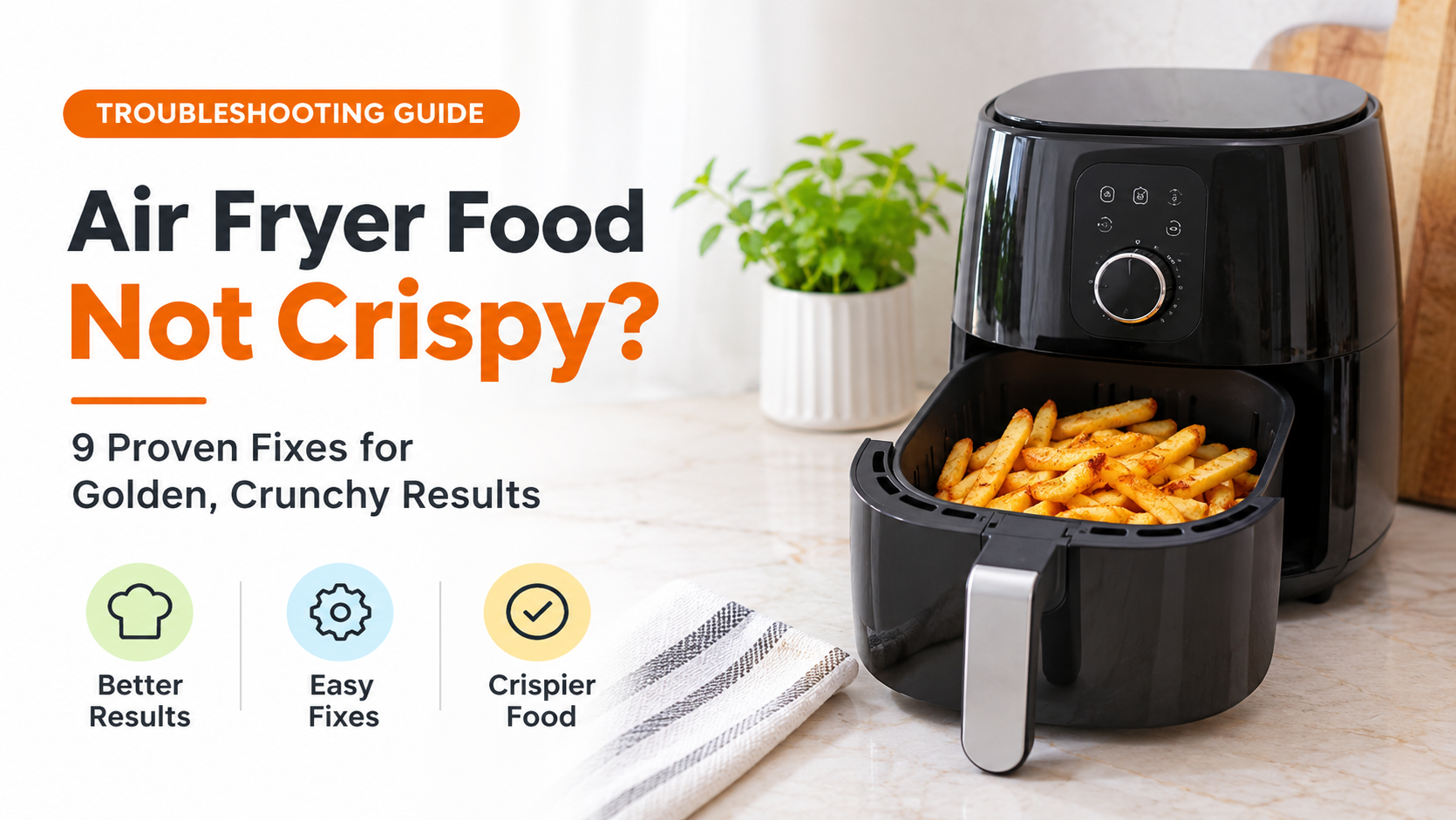
You followed the recipe, set the timer and waited. Then you opened the basket and found pale, limp fries or chicken with soft skin. If your air fryer food is not crispy, you are not alone. It is one of the most common complaints from new and experienced air fryer owners alike.
The good news is that soggy results almost always come from a handful of fixable habits, not from a faulty machine. In this guide you will learn exactly why air fryer food turns out soft, how to fix each cause, which temperatures work best for popular foods, and what to look for if it is time to upgrade.
Quick Answer
Air fryer food is usually not crispy because of overcrowding, excess moisture, too little oil, low temperature, skipped preheating or blocked airflow. Cook in a single layer, pat food dry, add 1-2 teaspoons of oil, preheat for 3-5 minutes, and shake or flip halfway through.
Table of Contents
- How an air fryer creates a crispy texture
- 9 reasons your air fryer food is not crispy (and fixes)
- Recommended temperatures and times
- Food-specific tips for fries, wings, breaded food and veggies
- The 7-step crispy checklist
- Common mistakes to avoid
- Choosing an air fryer that crisps better
- Frequently asked questions
How an Air Fryer Creates a Crispy Texture
An air fryer is a compact convection oven. A heating element warms the air, and a powerful fan pushes that hot air around the food at high speed. This constant movement strips moisture from the surface and encourages browning, which is the Maillard reaction responsible for golden color and a crunchy bite.
That means crispiness depends on three things: dry surfaces, hot air and free-moving airflow. When any of these is missing, steam stays near the food and the surface turns soft instead of crisp.
9 Reasons Your Air Fryer Food Is Not Crispy
Reason 1: The basket is overcrowded
This is the number one cause. When food is piled up, the hot air cannot reach the surfaces underneath. Moisture is trapped between pieces and the food steams in its own vapor.
How to fix it:
- Cook in a single layer with small gaps between pieces.
- Work in two or three batches instead of one big load.
- For fries or nuggets, fill the basket no more than halfway.
- Shake or rearrange the food at least once during cooking.
Reason 2: The food is too wet
Water on the surface has to evaporate before browning can start. Wet food wastes cooking time on drying and often ends up limp.
How to fix it:
- Pat meat, vegetables and tofu completely dry with paper towels.
- Soak cut potatoes in cold water for 30 minutes to remove surface starch, then dry them very well.
- Drain marinades and wipe off excess before cooking.
- Add salt to watery vegetables like zucchini and mushrooms just before or right after cooking, since salt draws out moisture.
Reason 3: Too little (or too much) oil
Air fryers need far less oil than deep fryers, but a very dry surface will brown poorly. On the other hand, a heavy pour makes food greasy and can cause smoke.
How to fix it:
- Use 1-2 teaspoons of oil for a normal batch and toss the food in a bowl so it coats evenly.
- Choose oils with a high smoke point such as avocado, canola, peanut or refined olive oil.
- Use a refillable oil mister if you like spraying. Many manufacturers warn that aerosol cooking sprays can damage nonstick coatings over time.
Reason 4: The temperature is too low
Cooking below about 180°C (350°F) tends to dry food out slowly instead of crisping the exterior. Many recipes that call for oven temperatures need a small adjustment for the air fryer.
How to fix it:
- Aim for 190-200°C (375-400°F) for most crispy foods.
- Reduce an oven recipe temperature by about 10-20°C and shorten the cooking time.
- Finish with a 2-3 minute blast at the highest setting if the surface needs extra color.
Reason 5: You skipped preheating
Dropping food into a cold basket means the first minutes are spent warming up the machine. The food heats gradually and releases steam before the surface can sear.
How to fix it:
- Preheat for 3-5 minutes at your target temperature, even if your model does not have a preheat button.
- Add the food quickly so the heat does not escape.
Reason 6: You never shake or flip the food
The side facing the airflow browns faster, while the bottom sits in a pocket of steam. Skipping the mid-cook shake leaves uneven, partly soft results.
How to fix it:
- Shake the basket or flip pieces halfway through the cooking time.
- For wings, chicken and fish, turn each piece with tongs.
- On oven-style models, rotate trays between racks if your unit has more than one.
Reason 7: Liners, foil or the wrong basket are blocking airflow
Solid foil, oversized parchment or a basket with clogged holes stops hot air from moving underneath the food. The bottom stays pale and wet.
How to fix it:
- Use perforated parchment liners made for air fryers and make sure food weighs them down.
- Never preheat with loose parchment, since it can lift into the heating element.
- Keep foil limited to small portions and leave the edges clear.
- Wash the basket regularly so grease does not seal the holes.
Reason 8: Frozen food was handled the wrong way
Ice crystals melt as frozen food heats up, adding water to the surface. Thawing breaded items first can make this even worse.
How to fix it:
- Cook frozen fries, nuggets and fish sticks directly from the freezer.
- Shake off loose ice before cooking.
- Do not stack frozen pieces. Spread them out in one layer.
- Add 1-2 minutes for the last stage if the pack instructions are for a conventional oven.
Reason 9: The coating is wrong or too wet
Wet batter drips through the basket and never sets. Breadcrumbs that are not pressed on firmly fall off and leave bare, soft patches.
How to fix it:
- Use a dry coating method: flour, then egg, then panko breadcrumbs.
- Press the crumbs on firmly and rest the food for 10 minutes before cooking.
- Lightly oil any dry-looking spots halfway through.
- Avoid wet batters like tempura unless the recipe is designed for air fryers.
Recommended Temperatures and Cooking Times
Use the table and chart below as a starting point. Every air fryer heats a little differently, so check food a minute or two early the first time.
| Food | Temperature | Time | Key tip |
|---|---|---|---|
| Fresh cut fries | 200°C / 400°F | 15-20 min | Soak 30 min, dry well, shake twice |
| Frozen fries | 200°C / 400°F | 12-18 min | Cook from frozen, shake halfway |
| Chicken wings | 200°C / 400°F | 22-25 min | Dry well, flip halfway |
| Breaded chicken | 190°C / 375°F | 12-15 min | Spray dry spots, flip once |
| Frozen nuggets | 200°C / 400°F | 8-10 min | Single layer, flip at 5 min |
| Roasted vegetables | 195°C / 380°F | 10-15 min | Salt just before or after |
| Bacon | 185°C / 365°F | 8-10 min | Drain grease midway |
| Tofu cubes | 200°C / 400°F | 12-15 min | Press 20 min, coat in cornstarch |
Note
These times are general guides. Always follow safe internal cooking temperatures for meat, poultry and fish, and use a food thermometer when in doubt.
Food-Specific Tips for Extra Crunch
Crispy French fries
Cut potatoes evenly, soak them in cold water for 30 minutes, then dry them thoroughly. Toss with a teaspoon or two of oil, cook at 200°C, and shake twice during cooking. Salt immediately after they come out for the best crunch.
Crispy chicken wings
Dry the wings with paper towels, then toss them with a little baking powder (not baking soda) and salt. The baking powder helps the skin dry out and blister. Cook at 200°C, flipping halfway, until the skin is deep golden and the meat is fully cooked.
Breaded chicken and fish
Use the flour, egg and panko sequence and press the crumbs on firmly. Spray or brush any floury spots lightly with oil. Flip once and avoid overcrowding so the coating stays dry and crunchy.
Vegetables
Cut vegetables into even pieces, dry them well and coat lightly in oil. Broccoli, Brussels sprouts, cauliflower and potatoes crisp particularly well. Leave extra space around watery vegetables so steam can escape.
Leftovers and reheating
The air fryer is excellent for reviving pizza, fries and fried chicken that went soft in the fridge. Reheat at 175-180°C for 3-5 minutes in a single layer, without covering the food.
The 7-Step Crispy Checklist
Save this simple routine and run through it every time you cook something that should be crunchy.
Common Mistakes to Avoid
- Treating it like a deep fryer. Soaking food in oil does not make it crispier and often makes it greasy.
- Adding sugary sauces too early. Glazes and barbecue sauce can burn and make the surface sticky. Brush them on during the last 2 minutes.
- Ignoring grease build-up. Old residue in the basket and around the element causes smoke and uneven heating.
- Using the same time for every food. Thickness, starch and water content change the cooking time.
- Opening the lid constantly. A quick check is fine, but repeated interruptions let heat escape.
- Leaving food in the basket after cooking. Trapped steam softens crispy food within minutes. Serve it right away or move it to a wire rack.
Is Your Air Fryer the Problem?
If you have corrected every habit above and your food is still pale or soft, the appliance itself may be limiting your results. Here is what separates a strong crisper from a weak one.
- Power: Look for roughly 1,400 to 1,800 watts for fast preheating and strong browning. Underpowered models struggle to crisp larger batches.
- Capacity versus household size: A basket that is too small forces overcrowding. A 4-6 quart model suits most 2-4 person households, while larger families may prefer an oven-style or dual-zone unit.
- Shape of the cooking area: Wide, shallow baskets and oven-style trays give more surface area for a true single layer.
- Airflow design: A perforated basket or crisper tray allows air to reach the underside of the food.
- Temperature range and accuracy: A maximum of 200-230°C and a precise thermostat help with browning.
- Easy cleaning: Dishwasher-safe, nonstick parts encourage regular cleaning, which protects performance over time.
- Useful controls: A clear preheat function, a shake reminder and an accurate digital timer remove guesswork.
Pro Tip
Before buying a new machine, run a test with fresh, dry potato wedges, 1 teaspoon of oil, a 5-minute preheat and a single layer at 200°C. If they still come out soft, the appliance may be underpowered or have a heating issue.
Frequently Asked Questions
Why is my air fryer food not crispy even at 200°C?
Temperature alone does not fix moisture or airflow problems. Overcrowding, wet food, too little oil and trapped steam are the usual causes. Fix those first, then check that the unit is preheated and clean.
Do I really need to preheat an air fryer?
Yes, for crispy results. Three to five minutes of preheating means the food hits hot air immediately, so the surface sears and dries instead of slowly steaming.
Should I use more oil to get a crispier finish?
Not much more. One to two teaspoons for a standard batch is usually enough. Too much oil makes food greasy and can cause smoke, while too little leaves it dry and pale.
Why are my frozen foods soggy?
Ice crystals melt into water as the food heats up. Cook from frozen in a single layer, shake the basket, and for homemade frozen items, flash freeze them on a tray first so they do not clump.
Can parchment paper or foil make food less crispy?
Yes, if it covers the basket holes or blocks airflow. Use perforated air fryer liners, keep them weighed down by food, and leave the edges clear.
How do I make breaded food crispy without it falling off?
Dry the food, coat it in flour, then egg, then breadcrumbs, and press the crumbs on firmly. Rest it for 10 minutes before cooking, and lightly oil any dry spots.
Is an oven-style or basket air fryer crispier?
Both can work well. Basket models are compact and fast. Oven-style units have a bigger cooking area, which helps with single-layer cooking for larger batches.
How often should I clean my air fryer?
Wash the basket and tray after every use, and wipe the heating element area when it is cool, about once a month. Grease build-up causes smoke and uneven cooking.
Final Thoughts
When air fryer food is not crispy, the cause is almost always something simple: too much food, too much moisture, not enough heat or blocked airflow. Preheat the machine, dry your ingredients, add a small amount of oil, cook in a single layer and shake halfway through. Those five habits solve the vast majority of soggy-food problems.
Start with the temperature table above, adjust for your own model, and keep notes on what works. In a few batches you will know exactly how your air fryer behaves, and golden, crunchy results will become the normal outcome rather than the exception.