


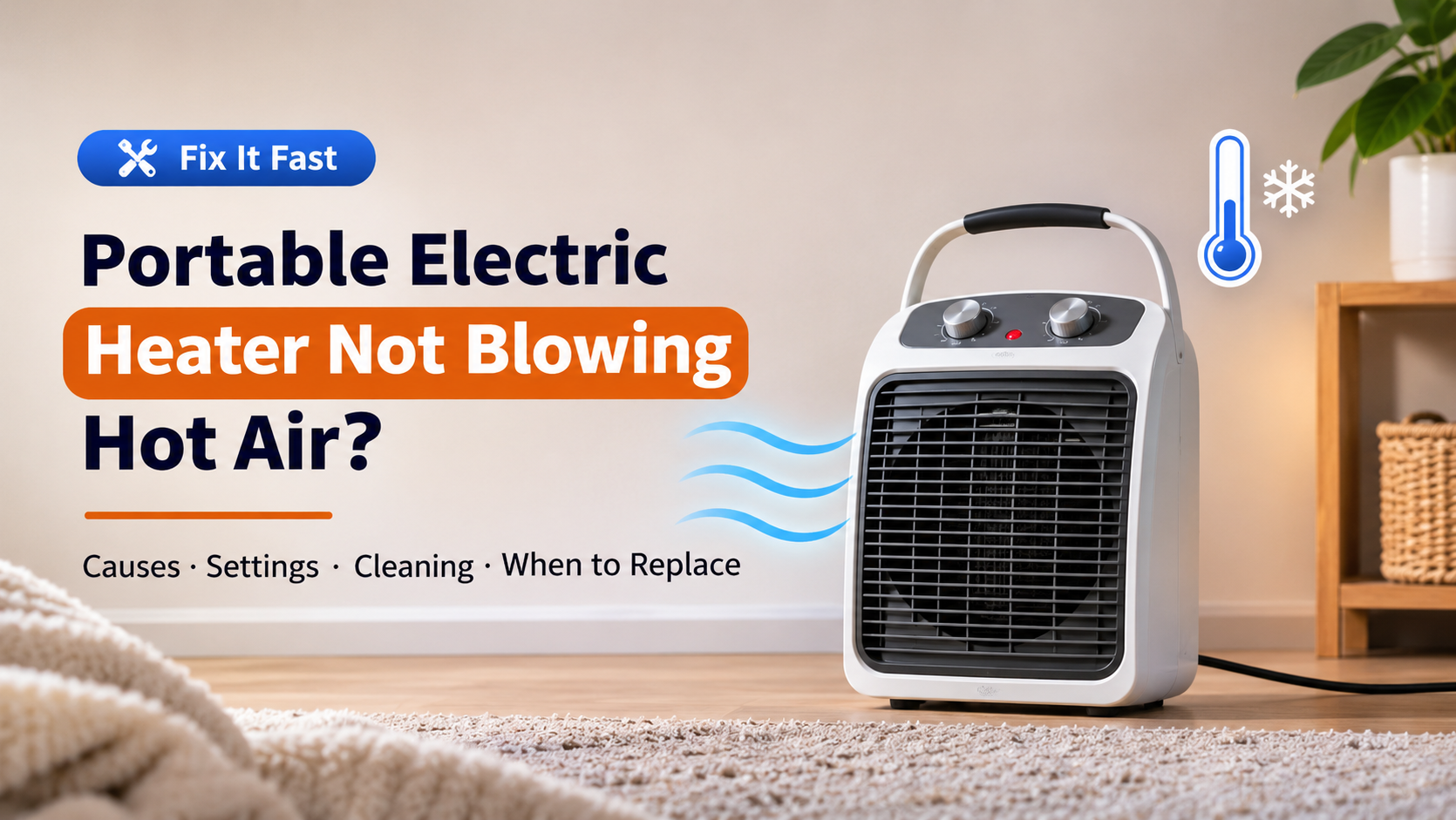
You switch on your heater, hear the fan spinning, and hold out your hand, but the air feels cool or barely warm. A portable electric heater that is not blowing hot air is frustrating, especially in cold weather. The cause is often simple: a wrong mode, a dusty grille, a thermostat setting, or a safety cut-out that has tripped. Less often, the heating element has failed. This guide helps you work out which problem you have, fix it safely, and decide when it is time to replace the heater.
Table of Contents
- How a portable electric heater makes hot air
- Which problem do you have?
- Settings to check first
- Weak or no airflow
- Airflow but cold air
- Warm but not hot
- Clean to restore airflow
- When the heating element has failed
- Repair or replace?
- Prevention tips
- Choosing a heater that stays hot
- Frequently asked questions
- Conclusion
How a Portable Electric Heater Makes Hot Air
Understanding the basics makes troubleshooting easier. A fan or ceramic heater has three main parts working together:
- Heating element: A metal coil or a PTC ceramic plate that heats up when electricity passes through it.
- Fan: Pulls room air across the hot element and pushes it out as warm air.
- Controls and safety devices: A thermostat, selector switch, thermal fuse or cut-out, and a tip-over switch that decide when the element can run.
If any of these fails or is switched off, the heater can still run the fan while producing little or no heat. That is why a heater can look as if it works but blow cold air.
Also note that portable heaters usually produce warm air, not scalding air. Air leaving the grille is noticeably warmer than the room, but it spreads out and cools quickly. A properly working heater will still feel clearly warm when you hold your hand close to the outlet.
Which Problem Do You Have?
Set the heater to the highest heat setting, run it for about five minutes, and see which column best matches what you notice.
Settings to Check First
Before you assume the heater is broken, check these six settings. They solve a large share of cold-air complaints.
- Mode: Many heaters have Fan, Low, High, and Eco positions. Make sure you are not on Fan-only or Cool.
- Thermostat: If the dial is set below the current room temperature, the element stays off and only the fan runs. Turn it to maximum.
- Power level: Choose the highest wattage step, such as 1500W or 2000W, to test.
- Eco or auto mode: These modes hold a lower temperature and may switch the element off often. Disable them to test.
- Timer: A timer may be limiting heating cycles. Cancel it.
- Tip-over and lock: Place the heater on a flat, hard surface and make sure any child lock is off.
Weak or No Airflow
If very little air comes out, the heater may also overheat and cut its heat to protect itself.
- Blocked grille or intake: Dust, pet hair, or fabric covering the back or front reduces airflow.
- Clogged filter: Some models have a removable dust filter. A dirty one restricts air and triggers overheat protection.
- Dusty fan blades: A coating of dust slows the fan and reduces output.
- Poor placement: A heater pushed against a wall, sofa, or curtains cannot draw in enough air.
- Failing fan motor: Grinding, rattling, or a fan that spins slowly or stops suggests the motor is wearing out. This is usually not worth repairing.
Airflow but Cold Air
When the fan runs normally but the air stays cold, heat generation is the issue.
- Fan-only or cool setting: Re-check the mode switch.
- Thermostat satisfied: The heater may think the room is already warm, especially if the sensor sits near a warm spot or the room temperature is higher than you think.
- Thermal cut-out or thermal fuse tripped: After overheating, the heater may disable the element while keeping the fan on. Unplug for 30 minutes after cleaning. Some units have a one-time thermal fuse that cannot be reset, meaning the heater needs replacing.
- Failed heating element or ceramic plate: After years of use, elements can burn out. The fan works, but no heat is produced.
- Faulty control board or relay: Digital heaters may have a failed circuit that stops power reaching the element.
- Low voltage supply: A long extension lead or a shared circuit can reduce power. Plug directly into a wall socket.
Warm but Not Hot
Sometimes the heater is working, but the result does not feel hot enough. This usually comes from the room or setup, not a fault.
- Room too large: A 1500W heater suits rooms of roughly 15 m² (160 sq ft) in good conditions. In larger or poorly insulated rooms, it will feel weak.
- Low power setting: Check you are not using a 750W or 800W step.
- Cold draughts: Gaps around windows and doors remove warm air quickly. Draught strips and thick curtains help.
- Distance: Warm air from fan heaters cools as it travels. Place the heater closer to where you sit, at least a safe distance away.
- Cold start: A very cold room needs time. Allow 10 to 20 minutes before judging.
- Expectations: Some ceramic heaters deliver gentle warmth rather than hot blasts. That is normal.
Clean to Restore Airflow
Cleaning is safe, free, and often effective. Here is the process.
- Unplug the heater and let it cool completely (30 minutes).
- Use a soft brush or vacuum with a brush attachment to clear the front and back grilles.
- Remove and wash the dust filter if your model has one, and let it dry fully before refitting.
- Wipe visible fan blades with a soft, slightly damp cloth, or use compressed air. Do not push anything into the heater.
- Place it on a flat surface, plug directly into a wall socket, set to High heat, and test for 10 minutes.
When the Heating Element Has Failed
If all settings are correct, the heater is clean, and the cut-out has had time to reset, but the air is still cold, the element or a safety part has probably failed. Typical signs include:
- The fan runs normally, but the air never warms up, even after 10 minutes on High.
- The heater worked fine last season and gradually blew cooler and cooler.
- You hear no clicking from the thermostat when you turn the dial.
- The heater is several years old or has been used heavily.
Internal parts are not user-serviceable. Check the warranty, and if it has expired, replacement is the safest and often cheapest option for a budget heater.
Comparison Table: Symptom, Cause, and Fix
| Symptom | Likely Cause | What to Do |
|---|---|---|
| Fan only, no heat | Mode or thermostat setting | Select Heat, raise thermostat |
| Cold air after a few minutes | Overheat cut-out | Clean, unplug 30 minutes, retest |
| Weak airflow | Dust, filter, fan | Clean grille, filter, and blades |
| Warm but not hot | Room size or low setting | Use High, seal draughts, move closer |
| Cold even on High | Failed element or thermal fuse | Check warranty, replace |
| Cold with extension lead | Voltage drop | Plug into wall socket |
Repair or Replace?
- Fix it yourself: Settings, cleaning, placement, and a plug fuse (where fitted) are safe for anyone.
- Use the warranty: If the heater is under warranty, contact the seller or manufacturer instead of opening it.
- Replace: A failed element, thermal fuse, fan motor, or control board on an inexpensive heater is rarely worth repairing.
- Stop using immediately: If you notice burning smells, melted plastic, sparks, or a hot cable.
Prevention Tips
- Vacuum the grilles and wash the filter every few weeks during use.
- Store the heater covered in a dry place in summer.
- Keep at least one metre of clear space on all sides.
- Avoid extension leads and multi-plugs.
- Do not block the intake with curtains, blankets, or furniture.
- Use the heater on a flat, hard surface.
- Avoid running the heater non-stop at maximum in a room it cannot warm. Improve insulation instead.
Choosing a Heater That Stays Hot
- Correct wattage: About 100 W per m² for normal rooms, and up to 150 W per m² for poorly insulated rooms.
- Digital thermostat with real temperature display: Easier to set than a dial.
- Multiple heat settings: For example 800W, 1200W, and 2000W.
- Removable, washable filter: Stops dust from causing overheating.
- PTC ceramic element: Self-regulating and tends to be safer and more consistent.
- Tip-over and overheat protection: A must-have.
- Warranty: A clear warranty of one year or more.
- Alternative type: If you want steadier warmth, consider an oil-filled radiator, which does not rely on a fan.
Frequently Asked Questions
Why is my electric heater blowing cold air?
The most common reasons are fan-only mode, a thermostat set too low, eco mode, a tripped overheat cut-out from dust, or a failed heating element.
Why does my heater blow warm but not hot?
Portable heaters deliver warm air by design. If it feels weak, the room may be too large or draughty, the power setting may be low, or the heater may be too far from you.
How do I know if the heating element is broken?
If the fan runs normally but the air never warms on the highest setting, even after cleaning and waiting for the cut-out to reset, the element or a safety part has probably failed.
Can a dirty filter make a heater blow cold air?
Yes. A dirty filter or grille reduces airflow, which makes the heater overheat and trip its protection, switching off the element while the fan keeps running.
How long should a heater take to blow hot air?
Fan and ceramic heaters usually produce warm air within seconds to a minute. If there is no warmth after a few minutes on High, something is wrong.
Can I fix a broken heater element myself?
It is not recommended. The parts are not designed for home repair and mains electricity is dangerous. Use the warranty or replace the heater.
Does an extension cord affect heater performance?
It can. Thin or long extension leads cause voltage drop and may overheat. Always plug a high-wattage heater directly into a wall socket.
Conclusion
When a portable electric heater is not blowing hot air, start with the simple fixes: select Heat mode, raise the thermostat, choose the highest power level, and plug directly into a wall socket. Next, clean the grille, filter, and fan, then give the overheat protection 30 minutes to reset. If the fan still runs but the air stays cold, the element or thermal fuse has likely failed, and it is safest to use your warranty or replace the unit with a model that has a digital thermostat, washable filter, and good safety features. With regular cleaning and sensible placement, your heater will keep delivering warm air all winter.