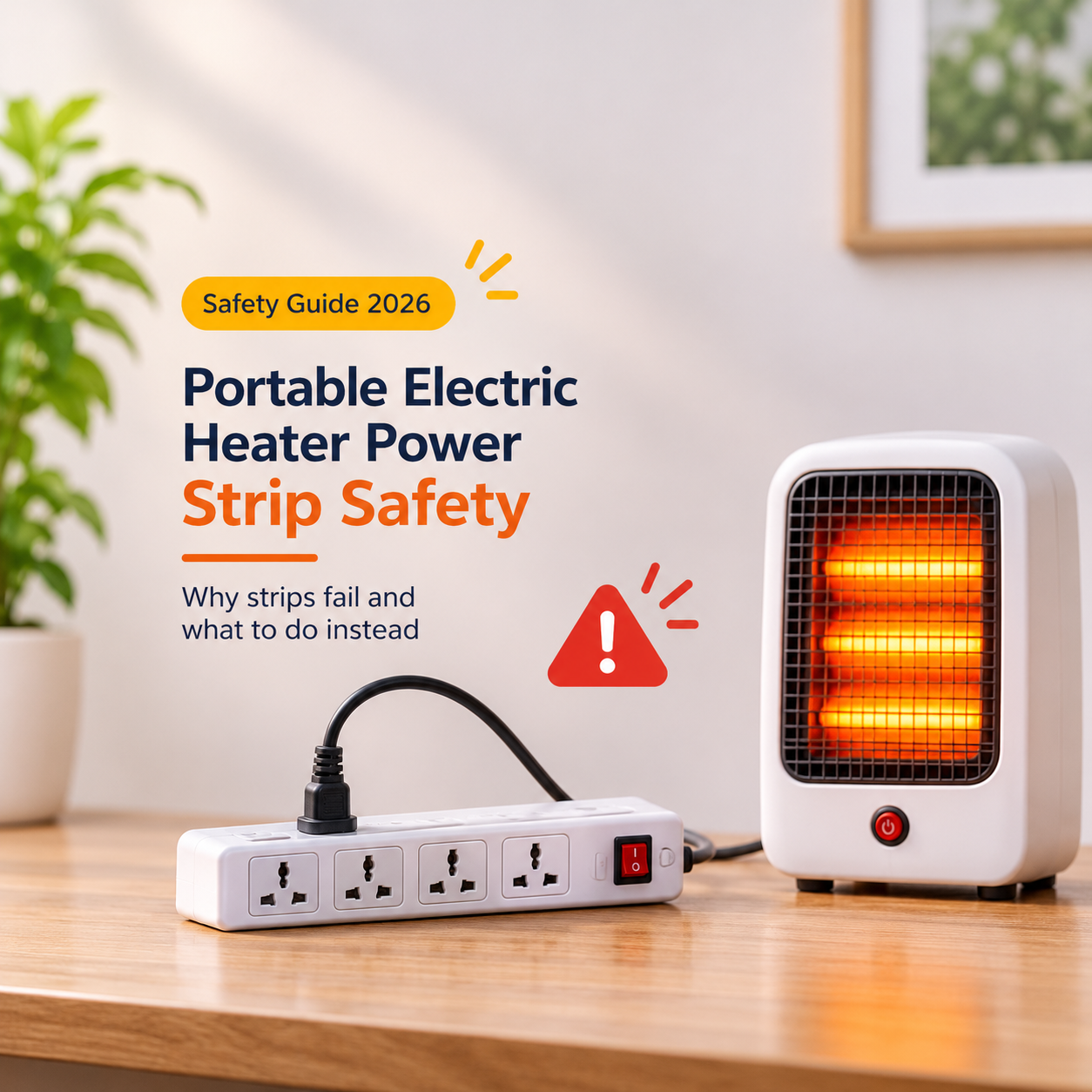
Homes never seem to have enough outlets, and a power strip feels like the obvious fix. It works for phones, lamps and computers, so why not for a heater? The answer is that heaters are very different from most household devices. Following good portable electric heater power strip safety habits can prevent overheated plugs, melted sockets and house fires.
This guide explains why power strips and heaters do not mix, what the ratings really mean, how daisy-chaining raises the danger, and safer ways to power your heater.
Why Power Strips and Heaters Are a Bad Match
- Heavy, continuous load: A 1500W heater draws about 12.5 amps at 120V for hours, which strains parts designed for light, intermittent use.
- Thin internal wiring: Strips often use light conductors, so heat builds up inside the housing where you cannot see it.
- Extra contact points: The strip’s switch, plug and sockets each add resistance, which turns into heat under high current.
- Shared outlets: Other devices plugged into the strip add to the total load.
- Hidden wear: Loose sockets and worn contacts make the problem worse over time.
What Do the Ratings on a Power Strip Mean?
Most power strips are labeled with a maximum such as 15 amps at 125 volts, which equals about 1875 watts. Safety guidelines generally advise keeping continuous loads to about 80 percent of the rating, which is roughly 1500 watts. A 1500W heater therefore uses the entire safe allowance by itself, leaving no room for anything else.
Power Strip vs Extension Cord vs Wall Outlet
| Connection method | Why | Verdict |
|---|---|---|
| Wall outlet (direct) | Fewest connections, designed for the load | Best choice |
| Heavy-duty extension cord | Thick wire, but adds a connection | Acceptable only if the manual allows it |
| Standard power strip | Thin internal wiring, switch and sockets add heat points | Not recommended |
| Surge protector | Protection parts wear out and are not made for heating loads | Not recommended |
| Daisy-chained strips or cords | Multiple weak links in series | Never |
Power strips usually fare worse than heavy-duty extension cords because of their thinner internals and extra switching parts. A direct wall outlet has the fewest weak links.
Surge Protectors and Heaters
Surge protectors look sturdier, but they are made to guard electronics from voltage spikes, not to carry heating loads. Their protection components wear down over time, and the unit can keep working while offering less protection. Using one with a heater adds risk without any benefit.
The Danger of Daisy-Chaining
Plugging a power strip into an extension cord, or one strip into another, forces the whole load through the weakest link. It also makes problems harder to spot, since heat may build where you cannot easily see or feel it.
Warning Signs of Trouble
Unplug the heater once it is safe to do so, and do not reuse the strip or outlet until it has been replaced or checked by a qualified electrician.
Safer Ways to Power Your Heater
1. Use a wall outlet directly
This is the best and simplest option. Place the heater close enough to reach the outlet with its own cord.
2. Give it its own circuit capacity
Avoid plugging other high-draw devices such as hair dryers, microwaves or air fryers into the same circuit. If the breaker keeps tripping, move the heater to a different circuit.
3. Add a properly installed outlet
If you often need power where there is none, an electrician can install a new outlet in a safer spot.
4. Choose a lower-wattage heater
A smaller heater, such as a 750W or 1000W model, draws less current and is easier on your wiring, which suits small rooms and personal heating.
5. Check the outlet itself
Old, loose or discolored outlets can overheat even without a strip. If the plug feels loose or the outlet is warm, have it inspected.
Everyday Safety Habits
Common Mistakes to Avoid
- Using a power strip because the heater cord is too short.
- Thinking a switch or reset button on the strip makes it safe for heaters.
- Plugging a heater into a strip that also powers a computer, TV or aquarium.
- Leaving a heater and strip running unattended.
- Ignoring a plug that feels warm.
Features to Look For in a Heater
- A power cord long enough for your room layout.
- Overheat protection and tip-over shut-off.
- Adjustable thermostat and timer to limit runtime.
- ETL or UL safety listing.
- Lower wattage settings for small spaces.
Frequently Asked Questions
Can I plug a space heater into a power strip?
Most heater manufacturers and fire safety groups say no. Plug the heater directly into a wall outlet. Power strips are built for small devices, not for the steady high draw of a heater.
What if the power strip has a 15-amp breaker?
A breaker adds some protection, but it does not fix the underlying problem. Strips can overheat at the plug, switch or sockets before the breaker trips, and a heater sits right at a 15A strip’s practical limit.
Is a surge protector safer than a power strip for a heater?
No. Surge protectors guard against voltage spikes, not sustained heavy loads, and their protection components can degrade over time. Do not use one with a heater.
Are heavy-duty or industrial power strips okay?
Some are built more robustly, but a heater manual that forbids strips still applies. A direct wall outlet remains the safest option.
What should I do if my power strip feels warm?
Switch the heater off, unplug it carefully, and stop using that strip. Have the outlet and wiring inspected if the plug or socket looks discolored or smells burnt.
Final Thoughts
The rule for portable electric heater power strip safety is simple: do not use a power strip. Plug the heater straight into a wall outlet, keep the circuit free of other heavy loads, and watch for heat, smells or tripped breakers. If outlets are the problem, solve that with better placement or a new outlet rather than with a strip.
Disclosure: Some affiliate sites earn a commission from qualifying purchases at no extra cost to readers. Add your own disclosure text here as required. Electrical safety advice is general; consult a qualified electrician for your home’s wiring.