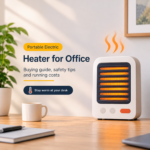


A cold office kills focus. Stiff fingers, a chilly back and a thermostat you do not control make long workdays harder than they need to be. A portable electric heater for office use is one of the simplest fixes: plug it in, set the temperature and warm the space around you without waiting for the building’s heating to change.
But not every heater suits a workplace. Some are too loud for a quiet room, some are too powerful for a shared circuit, and some are simply unsafe under a desk. This guide explains how office heaters work, which type fits your space, how much power you need, what they cost to run and which safety features matter most, so you can choose with confidence.
Why Use a Portable Electric Heater in Your Office?
- Personal comfort: Offices rarely suit everyone. A personal heater lets you set your own comfort level.
- Lower energy waste: Warming one person is far cheaper than raising the temperature of an entire floor.
- Better productivity: Studies on workplace temperature consistently link comfortable conditions with better concentration and fewer errors.
- Flexible and easy: No installation. Move it between your desk, meeting room or home office.
- Quick relief: Many models deliver warmth within a minute or two.
Types of Portable Electric Heaters for Office

1. Ceramic Fan Heaters
Ceramic heaters pass air over a heated ceramic element and blow it out with a fan. They warm up very quickly and are compact, which makes them a favorite for small offices and cubicles. The downside is fan noise, which can be noticeable in a silent room. Choose a model with a low-noise or quiet mode if you take calls.
2. Oil-Filled Radiator Heaters
These heat sealed oil, which then radiates warmth steadily. They are completely silent and the heat lasts even after the thermostat cycles off. They take longer to warm up and are heavier, but they are excellent for private offices where the heater runs for hours.
3. Infrared (Radiant) Heaters
Infrared models heat objects and people directly instead of heating the air. That makes them effective in drafty rooms and ideal for a person sitting at a desk. They are silent, but they only warm what is in front of them, so they are not designed for whole-room heating.
4. Panel and Micro-Thermic Heaters
Slim panel heaters work well when floor space is tight. Many are designed to sit under a desk or mount on a wall. They run quietly and use moderate power, which suits shared offices.
How to Choose the Right Wattage
Wattage is the main factor that decides how much heat you get. A simple rule is about 10 watts per square foot of floor space in a room with a standard ceiling height. Poor insulation, large windows or high ceilings mean you may need more.

Most portable heaters top out at 1500 watts because that is about the safe limit for a standard household-style outlet circuit. If a heater offers multiple heat settings, you can use the low setting to maintain temperature and save energy.
What Does It Cost to Run an Office Heater?
You can estimate the cost with a simple formula: kilowatts × hours used × your price per kWh. A 1500 W heater uses 1.5 kWh for each hour at full power. At an example rate of $0.17 per kWh, that is roughly $0.26 per hour.

In practice, a heater with a thermostat cycles on and off, so the real cost is usually lower than running at full power continuously. Your local electricity rate will change these numbers, so check your bill to get an accurate figure.
Key Features to Look For
| Feature | Why It Matters |
|---|---|
| Adjustable thermostat | Keeps the temperature steady and prevents wasted energy. |
| Tip-over switch | Cuts power automatically if the unit is knocked over. |
| Overheat protection | Shuts the heater off if internal temperature gets too high. |
| Low noise level | Important for calls, meetings and shared workspaces. |
| Timer or auto-off | Stops the heater if you forget to switch it off at the end of the day. |
| Cool-touch housing | Reduces burn risk near legs, papers and cables. |
| Compact, light design | Easy to carry and fits under most desks. |
| Safety certification | A recognized listing such as UL or ETL shows the product passed safety testing. |
Office Heater Safety Tips

Space heaters are a leading cause of home and workplace heating fires, so safe use matters as much as the model you buy. Follow these rules every time:
- Keep at least three feet of clear space around the heater. Papers, curtains, boxes and clothing must stay away.
- Plug directly into a wall outlet. Avoid extension cords and power strips, which can overheat under heavy load.
- Place it on a flat, hard surface, never on a chair, shelf or carpet pile that can tip.
- Switch it off and unplug it when you leave your desk or finish for the day.
- Inspect the cord and plug regularly. Stop using the heater if you notice damage, a burning smell or unusual noise.
- Check your workplace rules. Some offices restrict personal heaters, so ask your facilities or HR team before bringing one in.
Pros and Cons of Portable Office Heaters
Pros
- Fast, targeted warmth at your own desk
- Affordable to buy and to run when used with a thermostat
- No installation and easy to move
- Many quiet and compact options
Cons
- Can only heat a limited area
- Needs a free outlet and constant safety attention
- Fan models can be noisy
- May be restricted by building or company policy
Which Heater Is Best for Your Situation?
- Cubicle or shared desk: A small ceramic or infrared heater for quick, personal warmth.
- Cold feet under the desk: An under-desk panel or infrared heater that warms your legs directly.
- Private office used all day: An oil-filled radiator for silent, steady heat.
- Home office: A thermostat-controlled ceramic heater with a timer for flexible use.
- Noise-sensitive workplace: Oil-filled, infrared or panel models, which run without a loud fan.
Tips to Stay Warm and Save Energy
- Seal drafts near your desk, windows and doors.
- Use the thermostat setting instead of leaving the heater on high all day.
- Wear layers and keep a blanket or heated cushion nearby for extra comfort.
- Close doors and keep the heated area small so heat is not wasted.
- Turn the heater off 10 to 15 minutes before you leave, since the warm room holds heat for a while.
Frequently Asked Questions
Is a portable electric heater safe to use in an office?
Yes, when you choose a certified model with tip-over and overheat protection and follow safe placement rules. Never leave it running unattended.
What size heater do I need for a small office?
A 750 to 1000 watt heater is usually enough for a cubicle or small private office. A 1500 watt model suits rooms of around 150 square feet.
Which type is quietest?
Oil-filled radiators and infrared heaters are the quietest because they have no fan.
Can I use an extension cord with my heater?
It is best to avoid it. Heaters draw a lot of current, so plug directly into a wall outlet whenever possible.
Do electric heaters use a lot of electricity?
They use more power than most office devices, but a thermostat-controlled heater that cycles on and off keeps costs reasonable, especially when it only warms your own space.
How long can I leave a heater on?
Run it only while you are at your desk. Use a timer or auto-off feature, and always unplug it at the end of the day.
Final Thoughts
The best portable electric heater for office use matches your space, your noise tolerance and your safety needs. Pick ceramic for speed, oil-filled for silent all-day warmth, infrared for direct comfort at your desk or a slim panel when space is tight. Match the wattage to your room size, choose a model with a thermostat and proper safety protection, and follow sensible placement habits. Do that, and you will enjoy a warm, focused workday all winter.
Disclosure: This article may contain affiliate recommendations. We may earn a small commission at no extra cost to you if you buy through our recommendations.