Disclosure: This article may contain affiliate links in the product sections you add. If you buy through them, we may earn a small commission at no extra cost to you.
Stepping out of a hot shower into a cold bathroom is nobody’s idea of comfort. A portable electric heater for the bathroom can fix that quickly, but the bathroom is also the most hazardous place in the home to use an electric appliance. Water, steam and electricity are a risky combination, so choosing the right heater matters far more here than in a bedroom or living room.
This guide explains which kinds of heaters are suitable for bathrooms, what the water-protection (IP) ratings mean, how to place and use a heater safely, how much it costs to run, and what to check before you buy.
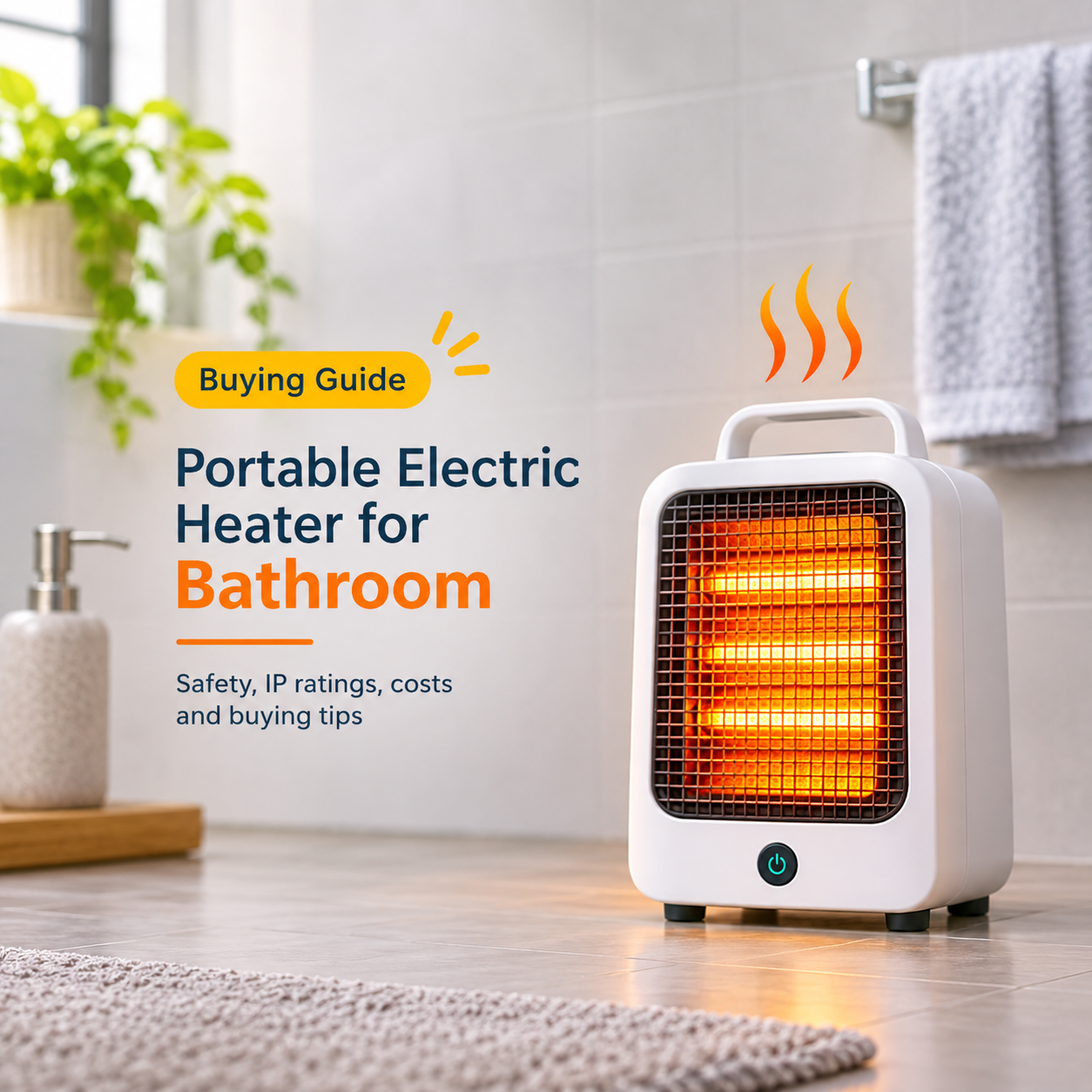
Only use a heater that the manufacturer explicitly states is designed for bathroom use, look for at least an IPX4 splash-protection rating, keep it as far from water as possible (at least 1 m or 3 ft), and plug it directly into a protected outlet such as a GFCI. A 1,000 W to 1,500 W model suits most bathrooms. If you use the heater daily, a fixed wall-mounted bathroom heater is usually the safer long-term choice.
Table of Contents
- Can You Use a Portable Heater in a Bathroom?
- Understanding IP Ratings
- Types of Bathroom Heaters
- How to Choose the Right Wattage
- Must-Have Safety Features
- Where and How to Place the Heater
- Running Costs
- Bathroom Heater Safety Rules
- Tips to Keep a Bathroom Warm and Dry
- Buying Checklist
- Frequently Asked Questions
- Final Verdict
Can You Use a Portable Heater in a Bathroom?
It depends on the heater and on local rules. A standard household portable heater, such as a typical oil-filled radiator or basic fan heater, is not designed for damp rooms. Most manufacturers warn against using them near water, and in some countries wiring regulations discourage or restrict plug-in heaters in bathrooms altogether.
Some heaters are specifically built for bathrooms, with splash-resistant housings and a water-protection rating. These are the only portable heaters you should consider for this room. Always read the product manual, follow local electrical regulations, and when in doubt, choose a fixed wall-mounted bathroom heater installed by a qualified electrician.
Never use a standard portable heater within reach of a bath, shower or sink, and never use one with wet hands. If the manual does not say the heater is suitable for bathrooms, do not use it there.
Understanding IP Ratings
An IP (Ingress Protection) rating shows how well a product resists dust and water. For bathroom heaters, the second digit, often shown as an X in front (for example IPX4), tells you the level of water protection.
| Rating | Meaning | Bathroom Use |
|---|---|---|
| IPX0 | No water protection | Do not use |
| IPX1 to IPX2 | Dripping water only | Do not use |
| IPX3 | Light spray | Limited, check the manual |
| IPX4 | Splashes from any direction | Common minimum for bathroom-rated heaters |
| IPX5 or higher | Water jets | Good for wet areas |
A high rating does not make a heater safe to place in a shower or to splash with water. It only means the housing has been tested against certain types of water exposure. Placement still matters.
Types of Bathroom Heaters
Bathroom-Rated Ceramic Fan Heaters
These are compact and fast. A ceramic element heats air that a small fan pushes into the room, so a cold bathroom warms up in minutes. Choose a model with a splash rating and a thermostat, and expect some fan noise.
Wall-Mounted Bathroom Heaters
These mount at a safe height and distance from water and often include timers and splash-proof housings. They keep the floor clear and reduce the chance of being knocked over or touched with wet hands. If you heat your bathroom every day, they are often the best long-term choice.
Infrared and Quartz Heaters
Infrared heaters warm people and objects directly rather than the air. That is handy for a short burst of warmth right after a shower, though they do little to warm the whole room.
Heated Towel Rails
Electric towel rails provide gentle warmth and warm, dry towels. They help control dampness but heat the room slowly, so they work best as a supplement.
| Type | Pros | Cons | Best For |
|---|---|---|---|
| Ceramic fan (bathroom-rated) | Fast warm-up, compact, affordable | Fan noise, needs a safe spot and outlet | Small to medium bathrooms, quick warm-ups |
| Wall-mounted heater | Out of the way, often splash-rated, can have a timer | Needs installation, not portable | Frequent daily use, shared bathrooms |
| Infrared / quartz | Warms you directly, instant feel of heat | Warms objects and people, not the whole room | Short use after a shower |
| Heated towel rail | Warms towels, gentle background heat | Slow room heating, low output | Towel warmth and damp control |
How to Choose the Right Wattage
Bathrooms are usually small, but they lose heat quickly because of tiled walls, hard floors, and extractor fans. A heater that is too weak will struggle to make a difference, while an oversized one wastes energy. As a rough rule, aim for about 10 watts per square foot, and go toward the higher end if the room is cold or poorly insulated.
| Bathroom Size | Typical Floor Area | Suggested Output |
|---|---|---|
| Small (powder room) | Under 35 sq ft (3 m2) | 750 W to 1,000 W |
| Standard | 35 to 60 sq ft (3 to 5.5 m2) | 1,000 W to 1,500 W |
| Large / en-suite | 60 sq ft (5.5 m2) and above | 1,500 W or a fixed heater |
Most portable heaters top out at around 1,500 W, which is the usual limit for a standard household outlet.
Must-Have Safety Features
- Water-protection rating: at least IPX4 and stated for bathroom use.
- Tip-over switch: shuts the heater off automatically if it falls.
- Overheat protection: cuts power if internal temperature gets too high.
- Cool-touch housing: lowers burn risk.
- Thermostat: keeps the temperature steady and avoids constant full-power running.
- Timer: prevents the heater from running longer than needed.
- Recognized safety certification: look for a respected safety mark on the product.
- Stable base or mounting: prevents accidental knocks.
Where and How to Place the Heater
Placement is as important as the heater itself. Keep it as far from the bath, shower and sink as the room allows, and never where it could fall into water. If the manual specifies a minimum distance, follow it. As a general guide, keep at least 1 meter (3 feet) from water sources.
- Plug the heater directly into a wall outlet. Do not use extension cords or power strips.
- Use an outlet protected by a GFCI or RCD, which cuts power if a fault is detected.
- Keep towels, bathrobes, curtains and toiletries well clear of the heater.
- Place it on a flat, stable surface or mount it securely on the wall.
- Do not use it to dry towels or clothes by covering or draping them over it.
Running Costs
Bathroom heaters are typically used for short periods, so costs are modest. The formula is simple:
Running cost = kilowatts x hours of use x electricity rate per kWh
A 1.5 kW heater running for 30 minutes uses 0.75 kWh. At $0.15 per kWh, that is about $0.11. Using it twice a day for a month would cost around $6 to $7.
To save more, turn the heater on 10 minutes before you shower, switch it off when you leave, and use the timer instead of leaving it running.
Bathroom Heater Safety Rules
- Use only heaters that are stated as suitable for bathrooms.
- Never touch the heater, the plug or the switch with wet hands.
- Never place the heater on the edge of a bath, sink or toilet tank.
- Do not leave the heater running when nobody is in the room.
- Do not use it while taking a bath or shower.
- Do not cover the heater or block its air vents.
- Inspect the cord and plug regularly. Stop using it if you see damage or heat marks.
- Keep children and pets away from the heater.
- Test the GFCI or RCD outlet regularly to make sure it works.
- Have a qualified electrician install a fixed heater if you use it every day.
Tips to Keep a Bathroom Warm and Dry
- Use the extractor fan: it removes steam and prevents mold, but avoid leaving it on after the room is warm.
- Add a bath mat: warm feet make the room feel warmer.
- Close doors and windows: keep heat from escaping.
- Seal drafts: around windows and under doors.
- Warm towels in advance: an electric towel rail or radiator adds comfort.
- Wipe wet surfaces: less moisture means less heat wasted on evaporation.
Buying Checklist
- Bathroom use stated: the product description and manual say so clearly.
- IP rating: IPX4 or higher.
- Wattage: matched to your bathroom size.
- Safety features: tip-over, overheat protection and thermostat.
- Mounting style: wall-mounted for daily use, portable for occasional use.
- Cord length and plug: long enough to reach a safe outlet without extension cords.
- Noise level: check reviews if you are sensitive to fan noise.
- Warranty and certification: choose reputable brands with recognized safety marks.
Frequently Asked Questions
Is it safe to use a portable heater in the bathroom?
Only if it is designed and rated for bathroom use, placed away from water, and plugged into a protected outlet. Standard portable heaters are not suitable for damp rooms.
What IP rating do I need for a bathroom heater?
IPX4 is commonly considered the minimum for splash protection. Check the manual and local regulations, as requirements vary by region and by where in the bathroom the heater is installed.
Can I use an oil-filled radiator in the bathroom?
Most oil-filled radiators are not designed for bathrooms and are usually not rated for wet environments. Use one only if the manufacturer clearly states it is suitable.
Can I use an extension cord with a bathroom heater?
No. Plug the heater directly into a wall outlet. Extension cords add risk in damp rooms.
How big a heater do I need?
Most bathrooms are well served by 1,000 W to 1,500 W. Small powder rooms may need only around 750 W.
Is a wall-mounted heater better than a portable one?
For daily use, usually yes. A wall-mounted heater stays in a fixed, safe position, reduces tripping and tip-over risks, and often has better splash protection.
How much does it cost to run a bathroom heater?
Costs are low for short use. A 1.5 kW heater used for 30 minutes costs roughly $0.11 at $0.15 per kWh.
Can I leave the heater on while I shower?
Do not leave a portable heater running during a shower or bath unless it is specifically designed and installed for that purpose. It is safer to warm the room beforehand and turn it off before you get in.
Final Verdict
A portable electric heater can make your bathroom far more comfortable, but safety must come first. Choose a heater that is clearly rated for bathroom use with at least an IPX4 rating, size it to the room, keep it away from water, and plug it into a protected outlet. For daily use, a wall-mounted bathroom heater is generally the better and safer investment.
Use the checklist above to compare models, and add your preferred products to the sections of this article to help readers pick the right one.