





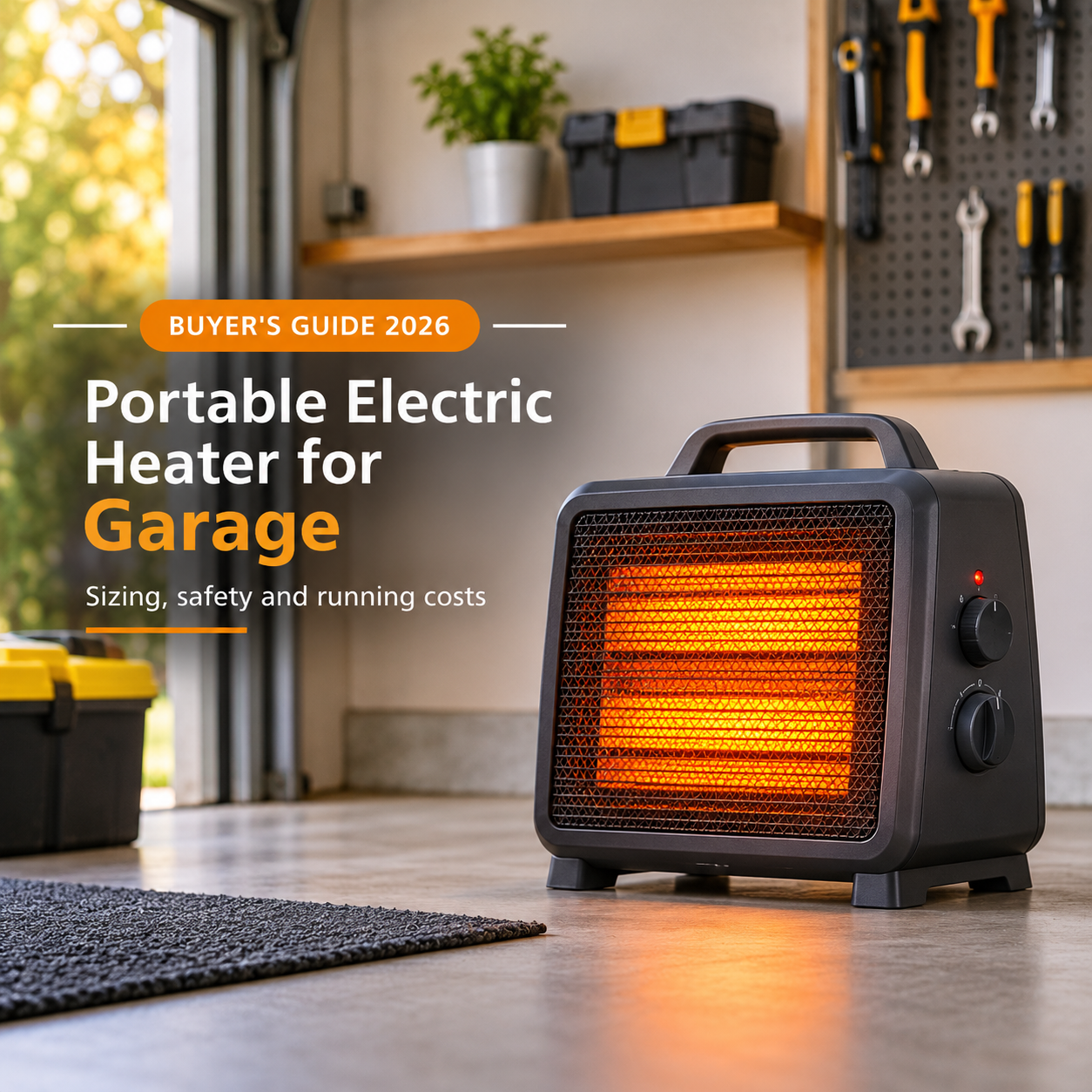
A garage is one of the hardest spaces in a home to heat. It has thin walls, a big door that leaks air, and often a bare concrete floor that stays cold all winter. Whether you use it as a workshop, a home gym, a place to tinker with cars, or just a spot to park comfortably, a portable electric heater for a garage can turn it into a usable space within minutes.
This guide covers the main heater types, how to size one correctly, what safety features matter in a space with fuel and chemicals, how much it costs to run, and how to get the most warmth from every watt.
Why Use an Electric Heater in a Garage?
- No fumes or carbon monoxide: Electric heaters burn no fuel, so they are safer for enclosed spaces than propane or kerosene models.
- Easy setup: Many models simply plug in. Larger ones need a 240V outlet but no gas line or venting.
- Clean and quiet: No fuel storage, soot or odor.
- Thermostat control: Maintain a steady temperature automatically.
- Portable: Move it to your workbench, car or gym corner as needed.
Types of Electric Garage Heaters Compared
| Type | Pros | Cons | Best for |
|---|---|---|---|
| Ceramic fan heater (120V) | Cheap, portable, plug-in | Limited to about 1500W; best for small spaces | Spot heat in a 1-car garage |
| 240V forced-air shop heater | Powerful, heats quickly, 4000-7500W | Needs a dedicated 240V circuit | 2-3 car garages, workshops |
| Infrared / quartz | Warms you instantly, ignores cold air | Heats only what it faces | Workbench or project zones |
| Oil-filled radiator | Silent, steady heat | Slow, weak for large cold spaces | Insulated, small garage gyms |
| Hardwired wall/ceiling unit | Frees floor space, no tripping | Needs installation by an electrician | Permanent workshop setups |
Ceramic Fan Heaters
These are compact and affordable. They suit small or well-insulated garages and personal spaces, but a single 1500W unit struggles in a large, cold garage.
240V Forced-Air Heaters
These are the workhorses. With 4000-7500W of power and a strong fan, they can warm a 2-car garage far faster than a 120V heater. They need a dedicated circuit, so factor in electrician costs if you do not already have a 240V outlet.
Infrared Heaters
Infrared heaters warm objects and people directly, which makes them a great choice for a workbench or a spot where you stand or work. They are effective even in drafty spaces because they do not rely on heating the air.
How to Size a Garage Heater
A common guideline is about 10 watts per square foot for an insulated garage with an 8-foot ceiling. Multiply your garage length by width, then adjust for conditions. Poor insulation, a leaky door, very cold climates or high ceilings can push the requirement up by 25-50 percent.
To convert watts to BTU, multiply by 3.41. For example, a 5000W heater delivers roughly 17,000 BTU per hour.
Key Features to Look For
- Adjustable thermostat: Prevents overheating and saves electricity.
- Voltage and circuit compatibility: Confirm whether the heater is 120V or 240V and match it to your outlet.
- Rugged construction: Garages are dusty. Choose durable housings and easy-to-clean filters or grills.
- Mounting options: Wall or ceiling brackets keep it off the floor and away from spills.
- Multiple heat settings: Start at high, then drop to low to maintain temperature.
- Cord length and wheels: Useful for moving a heavier heater around.
Garage Safety: What Makes It Different
Garages often store gasoline, paint thinner, aerosols and other flammable products. Because of that, heater safety needs extra attention.
Safe Placement and Use Tips
- Keep the heater at least 3 feet from flammable items, vehicles, boxes and fuel containers.
- Never use a heater while spraying paint, solvents or any flammable aerosol.
- Store gasoline cans and chemicals in a separate area, away from the heater.
- Place the heater on a stable, level, non-combustible surface, or mount it securely.
- Plug 1500W heaters directly into a wall outlet that is not shared with other high-draw tools.
- Avoid extension cords. If unavoidable, use a heavy-gauge cord rated for the load.
- Never leave the heater running unattended for long periods.
- Keep a fire extinguisher and a working smoke alarm in the garage.
How Much Does It Cost to Run?
Running cost equals kilowatts multiplied by hours multiplied by your electricity rate. At an example rate of $0.16 per kWh:
| Heater power | Energy per hour | Approx. cost per hour (full power) |
|---|---|---|
| 1500W | 1.5 kWh | $0.24 |
| 3000W | 3 kWh | $0.48 |
| 5000W | 5 kWh | $0.80 |
| 7500W | 7.5 kWh | $1.20 |
Real costs are lower because the thermostat cycles the heater on and off once the room is warm.
Tips to Heat a Garage Efficiently
- Insulate the garage door: A reflective or foam insulation kit cuts heat loss significantly.
- Seal gaps: Add weatherstripping at the bottom and sides of the door.
- Insulate walls and ceiling: Even basic insulation makes a big difference.
- Use rubber floor mats: They reduce the cold felt from concrete.
- Pre-heat before working: Turn on the heater 20-30 minutes ahead of time.
- Heat only the work zone: Use infrared at a bench instead of heating the whole garage.
Which Heater for Which Garage Use?
| Use | Recommended heater | Why |
|---|---|---|
| Small 1-car garage | 1500W ceramic or infrared | Cheap and plug-in, enough for light use |
| Woodworking or car workshop | 240V forced-air, 4000-5000W | Fast, powerful heating |
| Home gym | Oil-filled or ceramic with thermostat | Steady, quiet warmth |
| Occasional weekend use | Portable infrared | Instant warmth where you stand |
| Permanent workshop | Hardwired wall or ceiling heater | Clear floor, always ready |
Common Mistakes to Avoid
- Buying an undersized heater and running it nonstop.
- Ignoring insulation and wasting energy.
- Plugging a heavy heater into a shared or overloaded circuit.
- Placing the heater near fuel, paint or sawdust.
- Skipping certification marks like ETL or UL.
Frequently Asked Questions
Is an electric heater safe to use in a garage?
Generally yes, if it is rated for the use, has tip-over and overheat protection, and is kept well away from gasoline, solvents, paint and other flammables. Because vapors can collect near the floor, choose a heater with an enclosed element and place it on a stable surface.
Do electric garage heaters produce carbon monoxide?
No. Electric heaters burn no fuel, so they do not produce carbon monoxide. This is a big advantage over propane, kerosene and gas heaters, though you should still keep the space reasonably ventilated when working with chemicals.
What size heater do I need for a 2-car garage?
An insulated 2-car garage typically needs about 4000-5000W, usually a 240V unit. An uninsulated garage may need considerably more, so insulation is often the cheapest way to improve results.
Can I plug a garage heater into a regular outlet?
Small 1500W models work on a standard 120V, 15A circuit, ideally one with nothing else running. Larger heaters need a dedicated 240V circuit installed by a licensed electrician.
Is it expensive to heat a garage with electricity?
A 5000W heater uses 5 kWh per hour, about $0.80 per hour at $0.16 per kWh. A thermostat and good insulation reduce actual runtime significantly.
Final Thoughts
The best portable electric heater for a garage depends on size, insulation, voltage and how you use the space. Small garages do well with a 1500W ceramic or infrared unit, while larger garages and workshops benefit from a 240V forced-air heater. Whatever you choose, prioritize safety certification, keep flammables far away, and improve insulation to get the most warmth for your money.
Disclosure: Some affiliate sites earn a commission from qualifying purchases at no extra cost to readers. Add your own disclosure text here as required.